
Research library
Published literature and compound references
Summaries of published laboratory and preclinical literature, compound reference sheets, and analytical methods — updated regularly. Provided for scientific reference only.
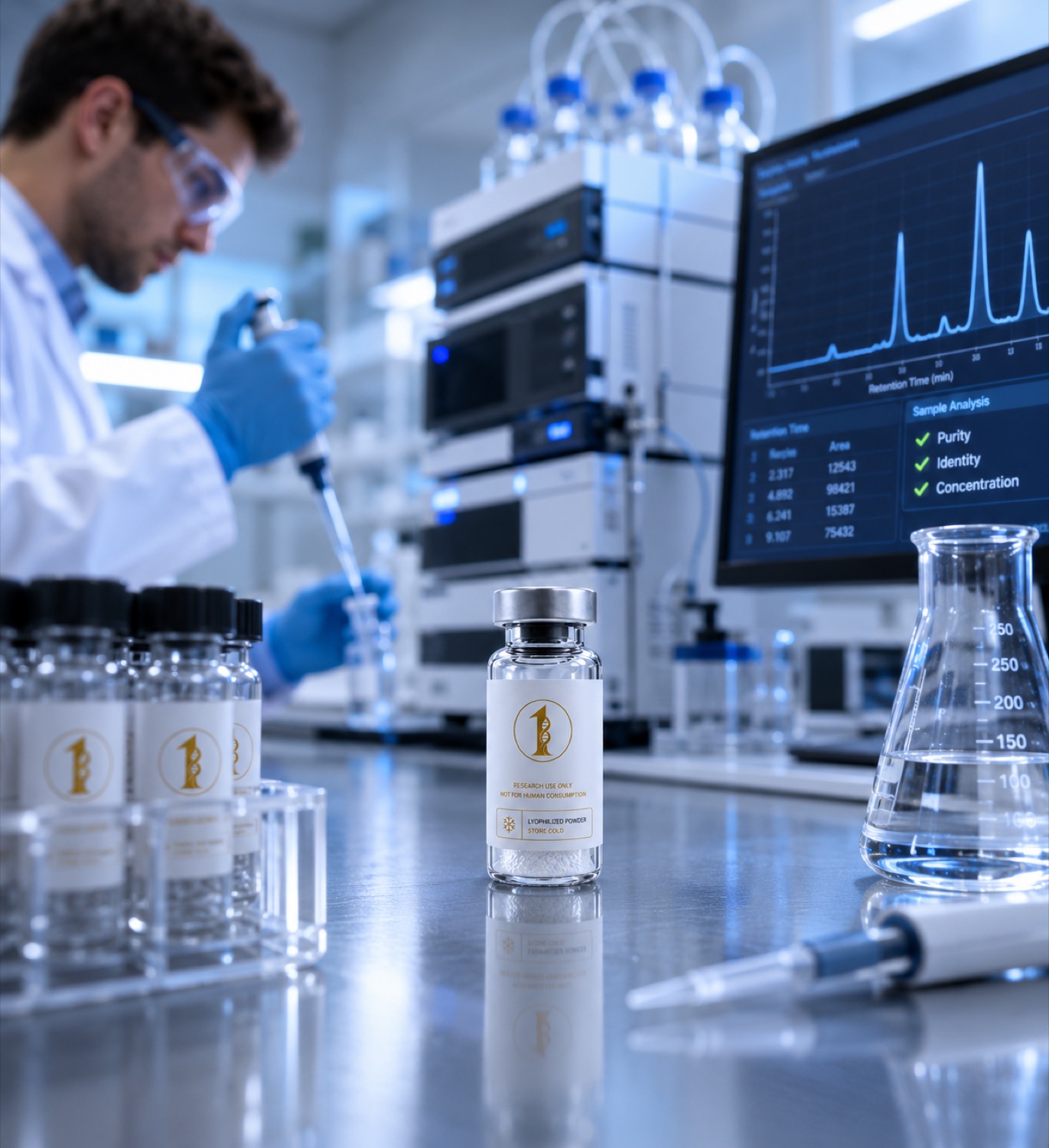
Why a peptide solution turns cloudy: aggregation, pH and preservative effects
Cloudiness is light scattering from aggregates or undissolved solid. What drives it: pH, temperature, agitation, freeze-thaw and benzyl alcohol. Research use only.
What does research use only mean? RUO labelling for peptides explained
RUO labelling explained: what the designation covers, why peptide suppliers require it, and what it means for laboratory records. Research use only.
Read moreWhat are lyophilized peptides? Freeze-drying, excipients and why vials arrive as powder
Freeze-drying explained: sublimation, the amorphous cake, bulking agents and cryoprotectants, and why research peptides ship dry. Research use only.
Read more
TB-500 and thymosin beta-4 in wound-model research: actin, migration and the published studies
What actin-binding assays, corneal alkali-injury models and full-thickness rodent wound models measured for thymosin beta-4 and TB-500. Research use only.
Read moreTB-500 and hair-follicle research: what thymosin beta-4 studies in mice examined
A model-by-model reading of the mouse and rat hair-follicle studies on thymosin beta-4, with no human data discussed anywhere. Research use only.
Read morePeptides studied in injury and recovery research models: BPC-157, TB-500 and KPV
Rat tendon, rodent muscle, mouse cardiac and keratinocyte culture models, read strictly as models. No human data is discussed. Research use only.
Read morePeptide storage and stability: lyophilized, reconstituted and freeze-thaw
Temperature, moisture, light and freeze-thaw cycling decide how long a peptide stays what the label says it is. A laboratory storage reference. Research use only.
Read more
MOTS-c in mitochondrial and metabolic research: AMPK, skeletal muscle and the published studies
Cell assays, mouse skeletal-muscle models and respirometry experiments behind the MOTS-c literature, described by model and measured variable. Research use only.
Read moreKLOW vs GLOW peptide blends: the KPV difference
KLOW is the GLOW combination plus one tripeptide. What KPV adds chemically and which model literature covers it. Research use only.
Read moreIpamorelin vs tesamorelin: two routes into growth-hormone-axis research
A five-residue secretagogue and a 44-residue releasing-factor analogue sit in the same catalogue aisle but different literatures. Research use only.
Read moreIpamorelin and tesamorelin in growth-hormone-axis research: receptors, models and the published studies
Two different entry points to the same axis: receptor assays and rat models for ipamorelin, GHRH analogue chemistry for tesamorelin. Research use only.
Read moreHow long do lyophilized peptides last? Stability, storage and what shortens shelf life
What sets the shelf life of a freeze-dried peptide: moisture, temperature, light, sequence chemistry and handling in the laboratory. Research use only.
Read more
GHK-Cu alone vs the GLOW blend: one tripeptide or three peptides
A single copper tripeptide against a three-component blend built around it. What each format lets a protocol isolate. Research use only.
Read moreGHK-Cu in dermatology and gene-expression research: skin models and the published studies
Cultured dermal fibroblast assays, rat wound and irradiated-skin models, and the gene-expression datasets behind the GHK-Cu literature. Research use only.
Read moreCJC-1295 with DAC vs without DAC: what the drug affinity complex changes
The DAC linker is the whole difference between the two CJC-1295 forms. What it adds chemically and what the rat data measured. Research use only.
Read moreBPC-157 vs TB-500: sequence, origin and what the research models differ on
BPC-157 and TB-500 differ in origin, sequence and the preclinical models each was characterised in. A laboratory-side comparison. Research use only.
Read moreBPC-157 in tissue-repair research: what the preclinical studies examined
How preclinical studies examined BPC-157 in rat tendon, muscle, alkali-burn and gastric models, and what each experiment actually measured. Research use only.
Read moreBacteriostatic water vs sterile water for peptide reconstitution
One diluent carries a benzyl alcohol preservative and one does not. What that changes for multi-draw vials and compatibility. Research use only.
Read moreVilon research peptide: sequence and published literature
Vilon is a synthetic 2-residue peptide (Lys-Glu), also called the KE peptide. Sequence, laboratory storage and the published literature. Research use only.
Read moreTesamorelin (TESA) research peptide: CAS and published literature
Tesamorelin is a synthetic 44-residue GHRH analogue (CAS 218949-48-5, C221H366N72O67S, 5136.00 g/mol). Identity and storage. Research use only.
Read moreTB-500 research peptide: sequence and published literature
TB-500 is a synthetic N-acetylated 7-residue peptide (Ac-LKKTETQ, C38H68N10O14). Sequence, identity, storage and literature. Research use only.
Read more
Pinealon research peptide: sequence and published literature
Pinealon is a synthetic 3-residue peptide (Glu-Asp-Arg), also called the EDR peptide. Sequence, laboratory storage and the published literature. Research use only.
Read moreMOTS-c research peptide: sequence, CAS and published literature
MOTS-c is a 16-residue mitochondrial-derived peptide (CAS 1627580-64-6, C101H152N28O22S2). Sequence, identity and storage. Research use only.
Read moreMelanotan-2 research peptide: CAS and published literature
Melanotan-2 is a synthetic cyclic heptapeptide analogue of alpha-MSH (CAS 121062-08-6, C50H69N15O9, 1024.20 g/mol). Identity and handling. Research use only.
Read moreKLOW BLEND (GHK-Cu, BPC-157, TB-500, KPV): constituents, identity and published literature
KLOW BLEND is a four-component research blend of GHK-Cu, BPC-157, TB-500 and KPV. Constituent identities, storage and literature. Research use only.
Read moreIpamorelin research peptide: sequence, CAS and published literature
Ipamorelin is a synthetic pentapeptide (CAS 170851-70-4, C38H49N9O5, 711.90 g/mol). Sequence, identifiers, storage and literature. Research use only.
Read moreIGF-1 LR3 research peptide: identity and published literature
IGF-1 LR3 is an 83-residue synthetic analogue of human IGF-1 (C400H625N111O115S9) with an N-terminal extension and an arginine at position three. Research use only.
Read moreL-Glutathione research peptide: sequence, CAS and published literature
L-Glutathione (GSH) is a reduced gamma-glutamyl tripeptide, gamma-Glu-Cys-Gly, CAS 70-18-8, C10H17N3O6S. Identity, storage and literature. Research use only.
Read moreGLP-3 RT research peptide: identity and published literature
GLP-3 RT is a synthetic 39-residue GIP, GLP-1 and glucagon receptor agonist peptide analogue (C221H342N46O68). Identity and storage. Research use only.
Read moreGLP-2 TZ research peptide: identity and published literature
GLP-2 TZ is a synthetic 39-residue dual GIP and GLP-1 receptor agonist peptide analogue (C225H348N48O68). Identity, storage and literature. Research use only.
Read moreGLP-1 SM research peptide: identity and published literature
GLP-1 SM is a synthetic 31-residue GLP-1 receptor agonist peptide analogue (C187H291N45O59). Identity, laboratory storage and literature. Research use only.
Read moreGLOW MIX blend (GHK-Cu, BPC-157, TB-500): constituents, identity and published literature
GLOW MIX is a three-component research blend of GHK-Cu, BPC-157 and TB-500. Constituent identities, laboratory storage and literature. Research use only.
Read moreGHK-Cu research peptide: sequence and published literature
GHK-Cu is a copper(II) complex of the tripeptide Gly-His-Lys (C14H21CuN6O4, 400.90 g/mol). Identity, storage and literature. Research use only.
Read more
DSIP research peptide: sequence, CAS and published literature
DSIP, delta sleep-inducing peptide, is a synthetic nine-residue peptide (CAS 62568-57-4, C35H48N10O15). Sequence, identifiers and literature. Research use only.
Read moreCJC-1295 (ND) + Ipamorelin blend (CJC-1295, ipamorelin): constituents and identity
CJC-1295 (ND) + Ipamorelin is a two-peptide research blend: a tetrasubstituted GHRH(1-29) analogue and a synthetic pentapeptide ghrelin mimetic. Research use only.
Read moreBPC-157 research peptide: sequence, CAS and published literature
BPC-157 is a synthetic 15-residue peptide (CAS 137525-51-0, C62H98N16O22). Sequence, identifiers, storage and literature. Research use only.
Read moreBacteriostatic water for laboratory reconstitution: composition and handling
Bacteriostatic water is sterile water containing 0.9% benzyl alcohol as a bacteriostatic preservative, supplied as a laboratory diluent. Research use only.
Read more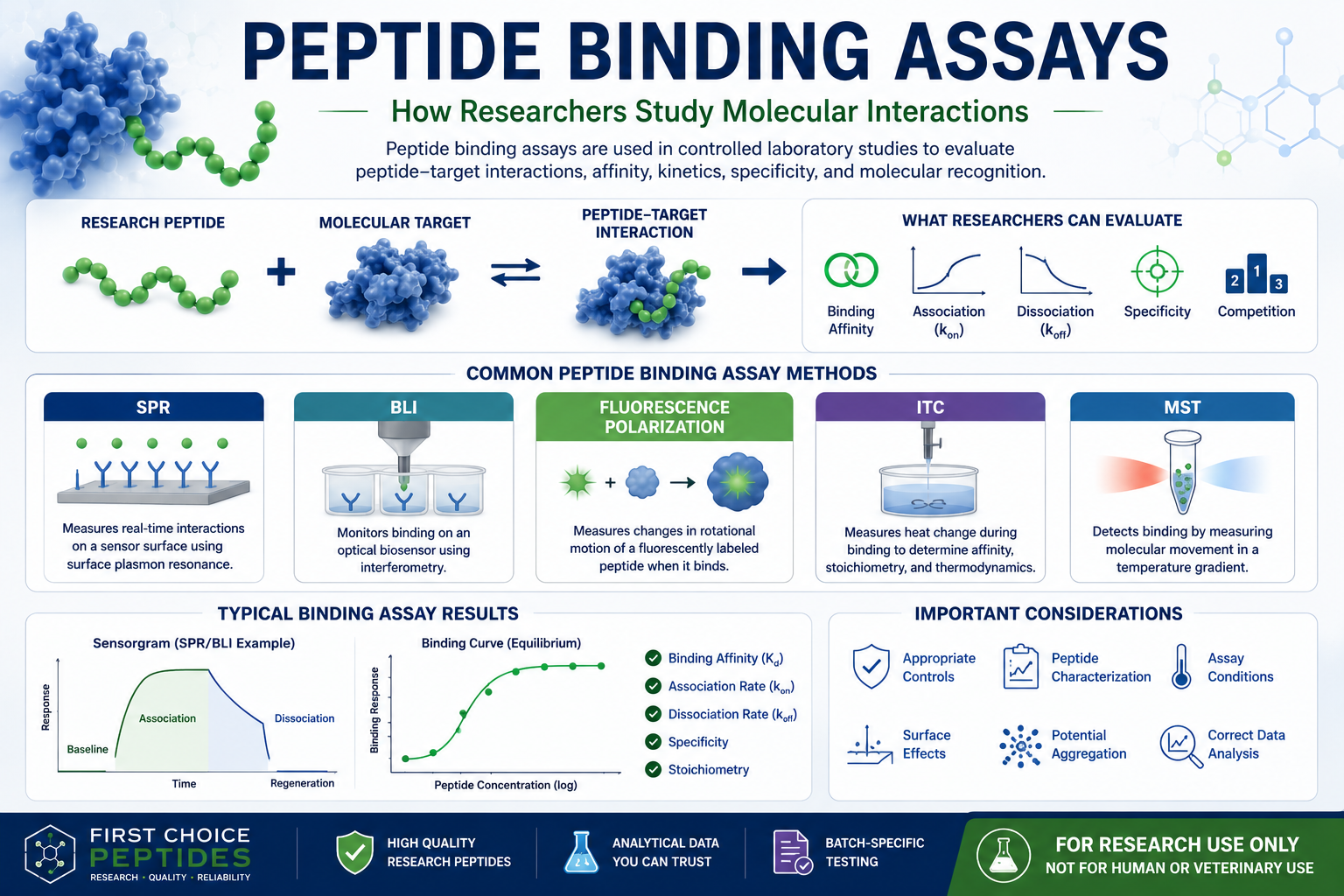
Peptide Binding Assays: How Researchers Study Molecular Interactions
Learn how peptide binding assays are used in controlled laboratory research to evaluate peptide-protein interactions, binding affinity, specificity, association and dissociation kinetics, and molecular recognition.
Read moreWhat Are Research Peptides Used For in Laboratory Studies?
Learn how research peptides are used in controlled laboratory studies, including molecular interaction research, binding assays, analytical characterization, assay development, stability studies, and structure-function investigations.
Read more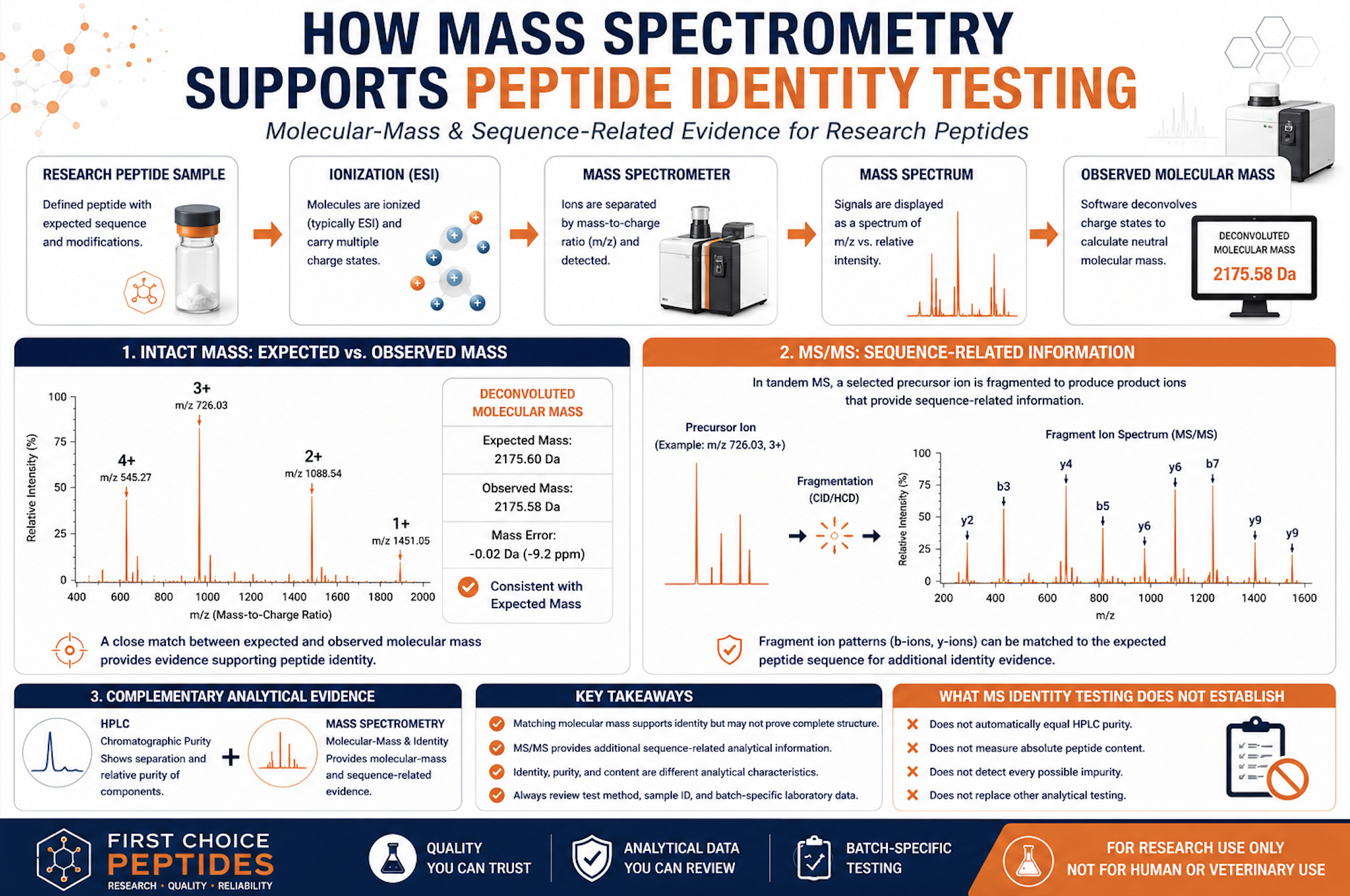
How Mass Spectrometry Supports Peptide Identity Testing
Learn how mass spectrometry supports peptide identity testing by comparing expected and observed molecular mass, evaluating charge states, and using MS/MS fragment data for additional sequence-related analytical information.
Read more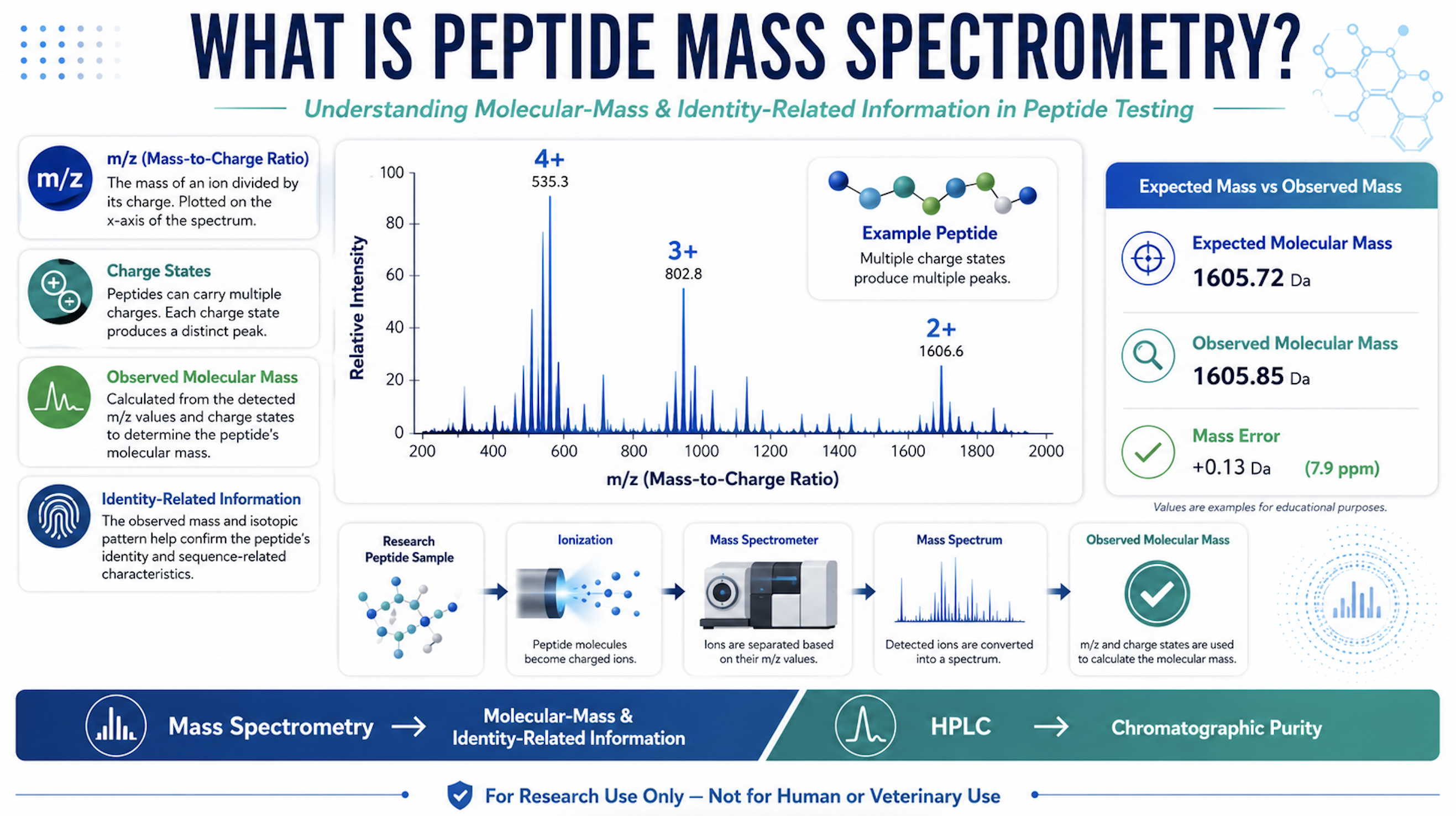
What Is Mass Spectrometry in Peptide Testing? A Researcher’s Guide
Learn how mass spectrometry is used in peptide testing, including mass-to-charge ratio, molecular mass, charge states, deconvolution, LC-MS, and how researchers interpret mass-spectrometric data on peptide COAs.
Read more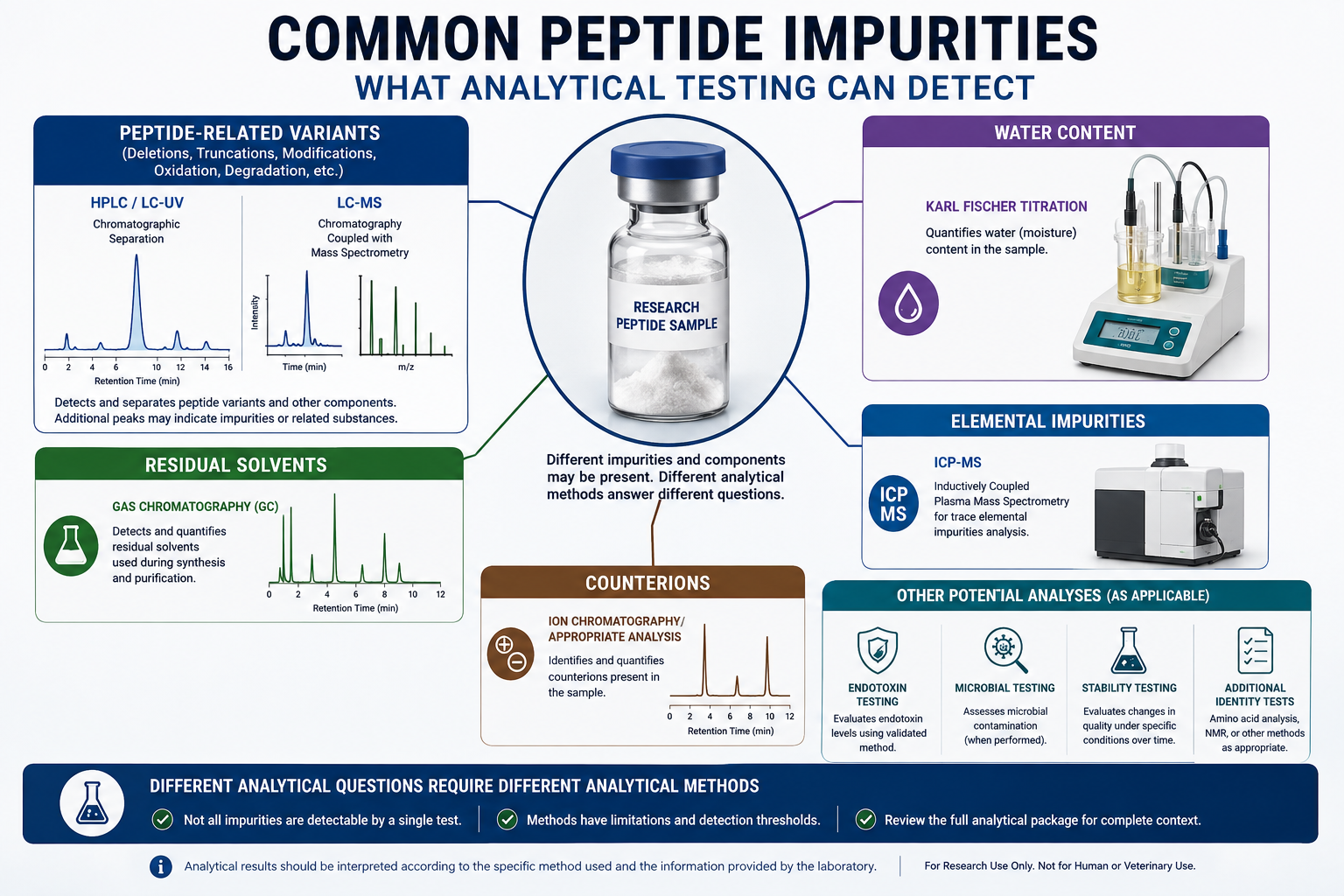
Common Peptide Impurities: What Analytical Testing Can Detect
Learn about common peptide-related impurities and how analytical methods such as HPLC and mass spectrometry can help researchers evaluate research materials, including the important limitations of each testing method.
Read more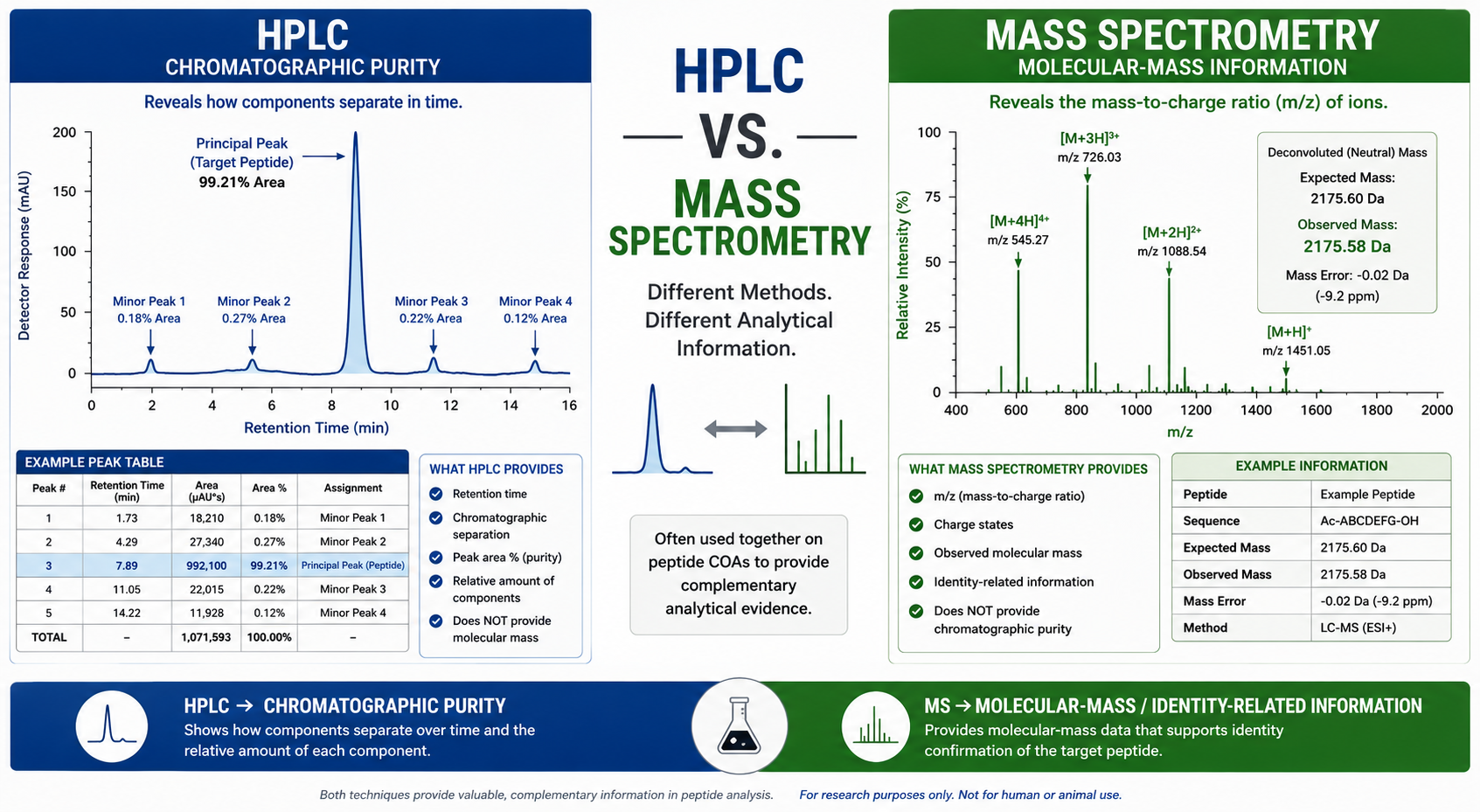
HPLC vs. Mass Spectrometry for Peptide Analysis: What’s the Difference?
HPLC and mass spectrometry provide different analytical information in peptide research. Learn how HPLC evaluates chromatographic purity, how mass spectrometry provides molecular-mass information, and why both may appear on a peptide Certificate of Analysis.
Read more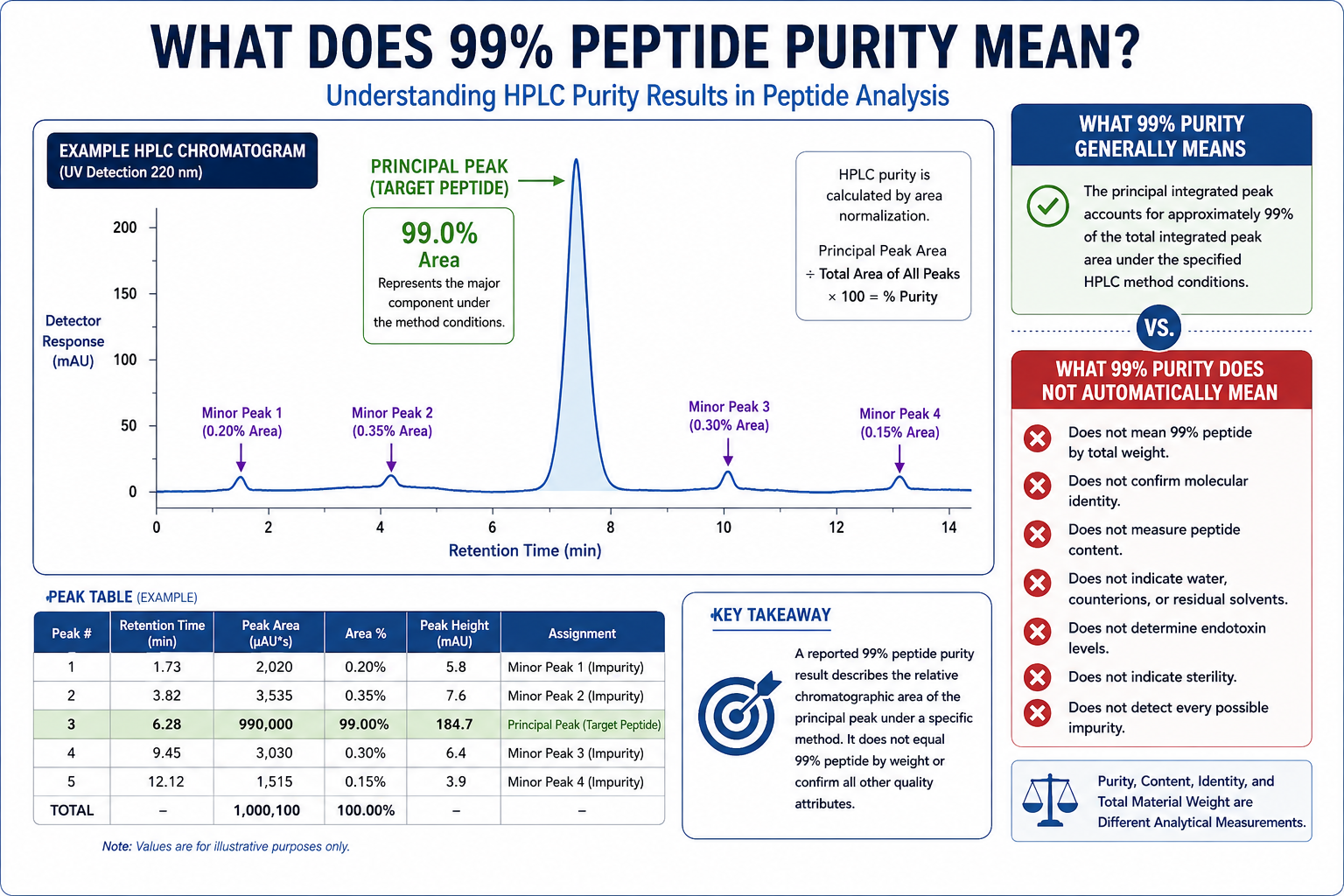
What Does 99% Peptide Purity Actually Mean?
What does 99% peptide purity actually mean? Learn how HPLC purity percentages are calculated, what a 99% result can indicate, and why purity, peptide content, molecular identity, and total material weight are different analytical measurements.
Read more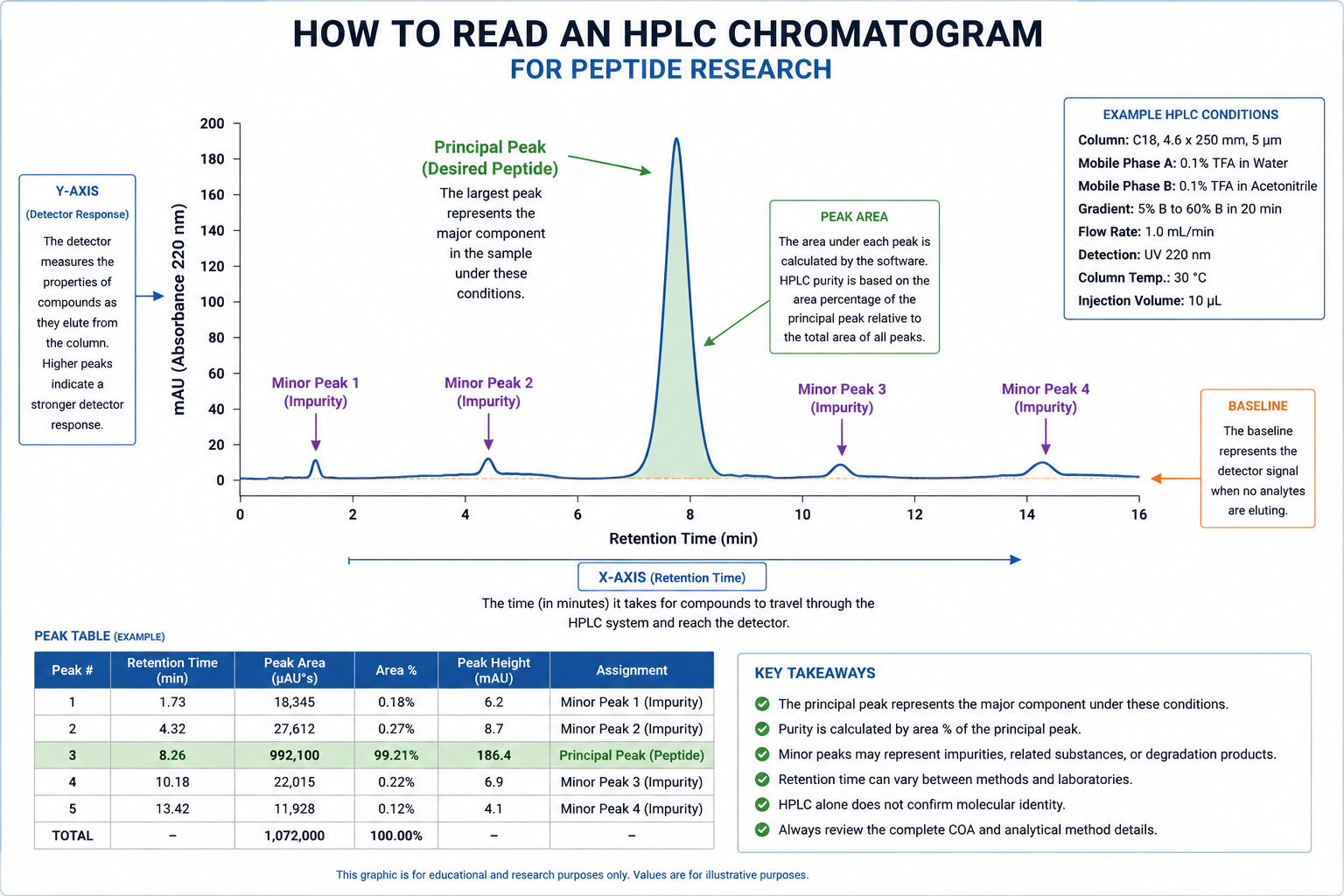
How to Read an HPLC Chromatogram for Peptide Research
Learn how to read an HPLC chromatogram for peptide research, including retention time, principal and minor peaks, peak area, area percentage, baseline, and how chromatographic purity is interpreted in laboratory testing.
Read more
What Is HPLC Peptide Purity? A Researcher’s Guide
Learn what HPLC peptide purity means, how high-performance liquid chromatography separates sample components, how chromatograms and purity percentages are interpreted, and what an HPLC result does—and does not—tell researchers.
Read more
Third-Party Peptide Testing: What Researchers Should Look For
What does third-party peptide testing actually mean? Learn how researchers can evaluate independent laboratory testing, HPLC purity, mass spectrometry, batch-specific COAs, laboratory accreditation, and analytical documentation.
Read more
Peptide Purity vs. Peptide Content: What’s the Difference?
Peptide purity and peptide content are not the same measurement. Learn what HPLC purity percentages represent, how peptide content is measured, and why researchers should distinguish purity, identity, and quantity when reviewing a Certificate of Analysis.
Read more
How to Verify a Peptide COA and Laboratory Test Report
Learn how to verify a peptide Certificate of Analysis (COA) by checking lot numbers, laboratory information, report identifiers, HPLC and mass spectrometry data, testing dates, analytical methods, and laboratory accreditation.
Read moreWhat Is a Certificate of Analysis (COA) for Research Peptides?
What is a peptide Certificate of Analysis (COA)? Learn how COAs document batch-specific laboratory testing, including peptide identity, HPLC purity, mass spectrometry results, lot numbers, and other analytical data used in research.
Read moreHow to Read a Peptide Certificate of Analysis (COA)
Learn how to read a peptide Certificate of Analysis (COA), including HPLC purity, mass spectrometry, endotoxin testing, batch numbers, and laboratory verification. This research-focused guide explains each section of a COA and how to interpret analytical testing results.
Read moreGet new research in your inbox
Monthly summaries of the latest peptide literature. No spam, unsubscribe anytime.