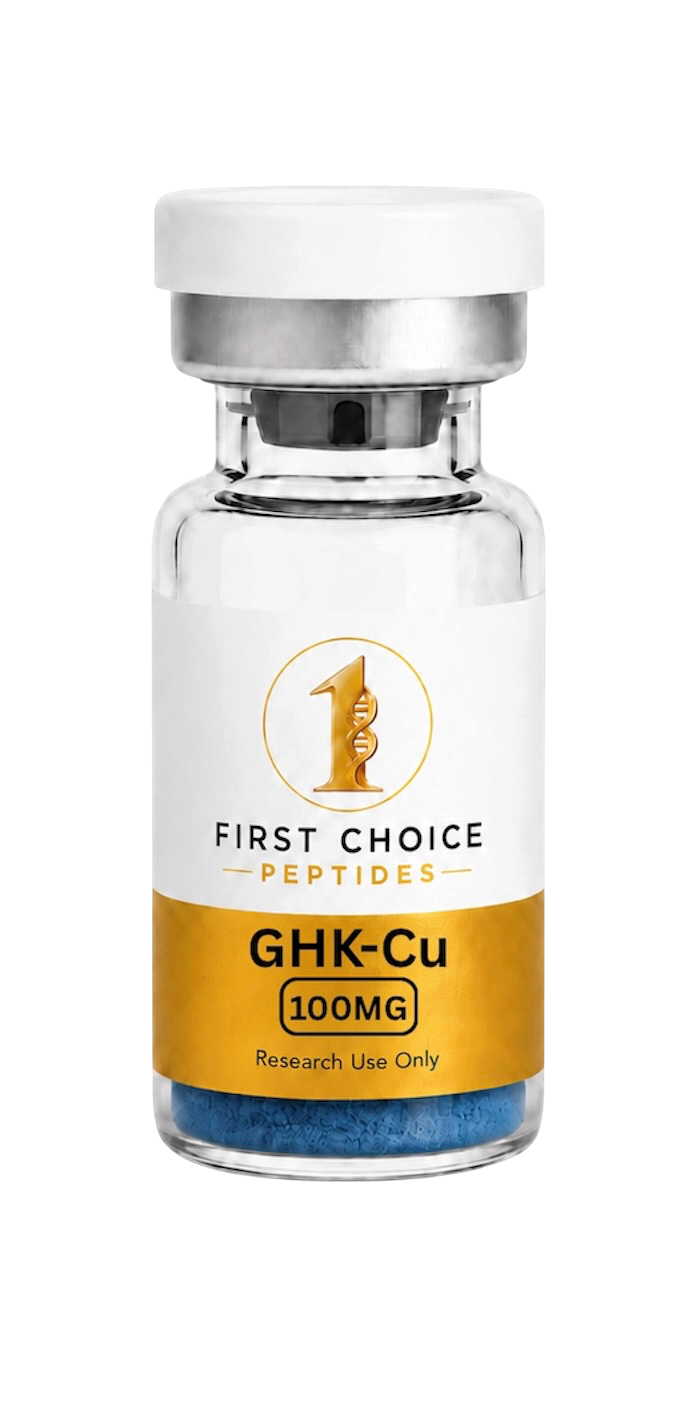

GHK-Cu is a copper(II) complex of the tripeptide Gly-His-Lys (C14H21CuN6O4, 400.90 g/mol). Identity, storage and literature. Research use only.
GHK-Cu at a glance
- Molecular formula
- C14H21CuN6O4
- Molecular weight
- 400.90 g/mol
What GHK-Cu is
GHK-Cu is a synthetic 3-residue peptide complex whose sequence corresponds to glycyl-L-histidyl-L-lysine, a human tripeptide sequence, supplied as its copper(II) coordination complex. The material is therefore two things at once: a very short peptide, and a metal complex in which the copper ion is held by the peptide rather than sitting alongside it as a simple mixed salt. The catalogue files the entry under dermatology research and lists Copper tripeptide-1 as a synonym, which is the name most often used in ingredient and formulation literature for the same complex.
The peptide portion is a naturally occurring human sequence, and the copper complex has been the subject of published laboratory and preclinical research across cell-culture and gene-expression work. The catalogue presentation is a 100 mg vial of lyophilized material, a larger unit than most peptide entries, which reflects the low molecular weight of the complex. First Choice Peptides supplies GHK-Cu strictly for laboratory research. It is not a drug, not a cosmetic ingredient supplied for formulation, and it is not for human or veterinary use.
Structure and identifiers
The peptide sequence is Gly-His-Lys, written GHK in single-letter notation: glycine at the N terminus, histidine in the centre and lysine at the C terminus. The histidine imidazole side chain and the peptide backbone nitrogens give the tripeptide the donor atoms that let it bind a divalent copper ion, which is the structural basis of the complex and the reason the material is described as copper-coordinated rather than as a copper salt of the peptide. In practical terms the complex is coloured, and its ultraviolet and visible absorbance differs from that of the free tripeptide.
The catalogue entry lists the molecular formula C14H21CuN6O4 and a molecular weight of 400.90 g/mol. Copper appears in that formula, so the mass figure is the mass of the complex and not of the free tripeptide. A CAS registry number is not recorded in this entry, so none is stated here. Because copper has two abundant natural isotopes, the isotope pattern of the complex is a distinctive feature in a mass spectrum, and that pattern is part of what an identity check for this material looks at.
What the published literature has examined
Published work has examined GHK and GHK-Cu in in-vitro fibroblast and keratinocyte culture systems, in gene-expression datasets and in topical-formulation studies, within dermatology research, extracellular-matrix biology and bioinorganic chemistry. The papers listed on this page are bibliographic references only; they are not evidence of safety or efficacy and describe laboratory findings, not any use in people or animals.
A large part of the record is review literature that surveys the sequence across many cellular pathways. A 2015 review in BioMed Research International and a 2018 review in the International Journal of Molecular Sciences both work from gene-expression data, which is to say from transcriptome-scale datasets in cultured cells rather than from single-endpoint experiments. Reviews of this shape are best read as maps of which pathways and which model systems have been looked at.
A second strand is materials and tissue oriented. A 2008 paper in the Journal of Biomaterials Science, Polymer Edition places the tripeptide in the context of tissue-remodelling and biomaterials research, where the questions are about extracellular-matrix components, collagen-associated markers and scaffold behaviour in culture. A 2025 paper in BioImpacts examines the peptide as a topically applied agent, and that literature is mainly concerned with formulation problems: skin-model permeability, vehicle selection and the stability of a metal complex in a finished preparation.
A third strand is chemical rather than biological. Because the complex carries a redox-active metal, it appears in the oxidative-stress and metal-binding literature, including a 2012 paper in Oxidative Medicine and Cellular Longevity. The analytical methods that recur across these papers are cell culture with gene and protein expression profiling, spectroscopic characterisation of the metal complex and chromatographic separation of the peptide from its free and complexed forms. None of these findings is described here as an outcome in a person or an animal.
Storage and handling as a laboratory reagent
The catalogue storage table lists two states for this entry. Lyophilized material is held at -20 C and protected from light, which matters more than usual for a coloured metal complex. Reconstituted solution is held at 2 to 8 C and treated as a short-term laboratory reagent. A sealed vial is best equilibrated to room temperature before opening, and a brief spin down collects powder that has moved to the stopper in transit.
After reconstitution, single-use aliquots are preferable to repeated withdrawals, and repeated freeze-thaw cycling is avoided. A copper complex also warrants attention to the diluent and to the labware: chelating buffers and metal-binding additives are not neutral in the presence of a coordinated metal ion, and a colour change in solution is a signal worth investigating rather than ignoring. Aliquots labelled with lot number and date keep results traceable to a single certificate of analysis. Concentration arithmetic can be worked through with the reconstitution calculator, and the usual laboratory diluent for a lyophilized preparation of this kind is bacteriostatic water.
Analytical verification
Purity and identity are verified by third-party HPLC and mass spectrometry, with one certificate of analysis issued per lot. Reversed-phase HPLC reports purity as a percentage of integrated peak area, and mass spectrometry confirms identity by matching the measured mass against the expected molecular weight of 400.90 g/mol for the copper complex. The documents for a given lot are filed in the certificate library.
Identity testing is the more informative of the two reports for a metal complex, because the mass and isotope pattern distinguish the coordinated form from free tripeptide that would chromatograph as its own peak. How that measurement is performed and interpreted is set out in peptide identity testing by mass spectrometry, and the structure of the accompanying document is covered in how to verify a peptide certificate of analysis. Nothing beyond the HPLC purity result, the mass spectrometry identity result and the per-lot certificate is claimed for this material.
Published literature
Papers in which GHK-Cu has been the subject of laboratory or preclinical study. Listed for bibliographic reference only.
Research and educational purposes only. These references are provided for bibliographic context. They are not evidence of safety or efficacy, and nothing here is medical advice or a claim about any use in humans or animals.
BioImpacts : BI
Topically applied GHK as an anti-wrinkle peptide: Advantages, problems and prospective
International journal of molecular sciences
Regenerative and Protective Actions of the GHK-Cu Peptide in the Light of the New Gene Data
BioMed Research International
GHK peptide as a natural modulator of multiple cellular pathways
Oxidative medicine and cellular longevity
The human tripeptide GHK-Cu in prevention of oxidative stress and degenerative conditions of aging: implications for cognitive health
Journal of biomaterials science. Polymer edition
The human tri-peptide GHK and tissue remodeling
Research use only