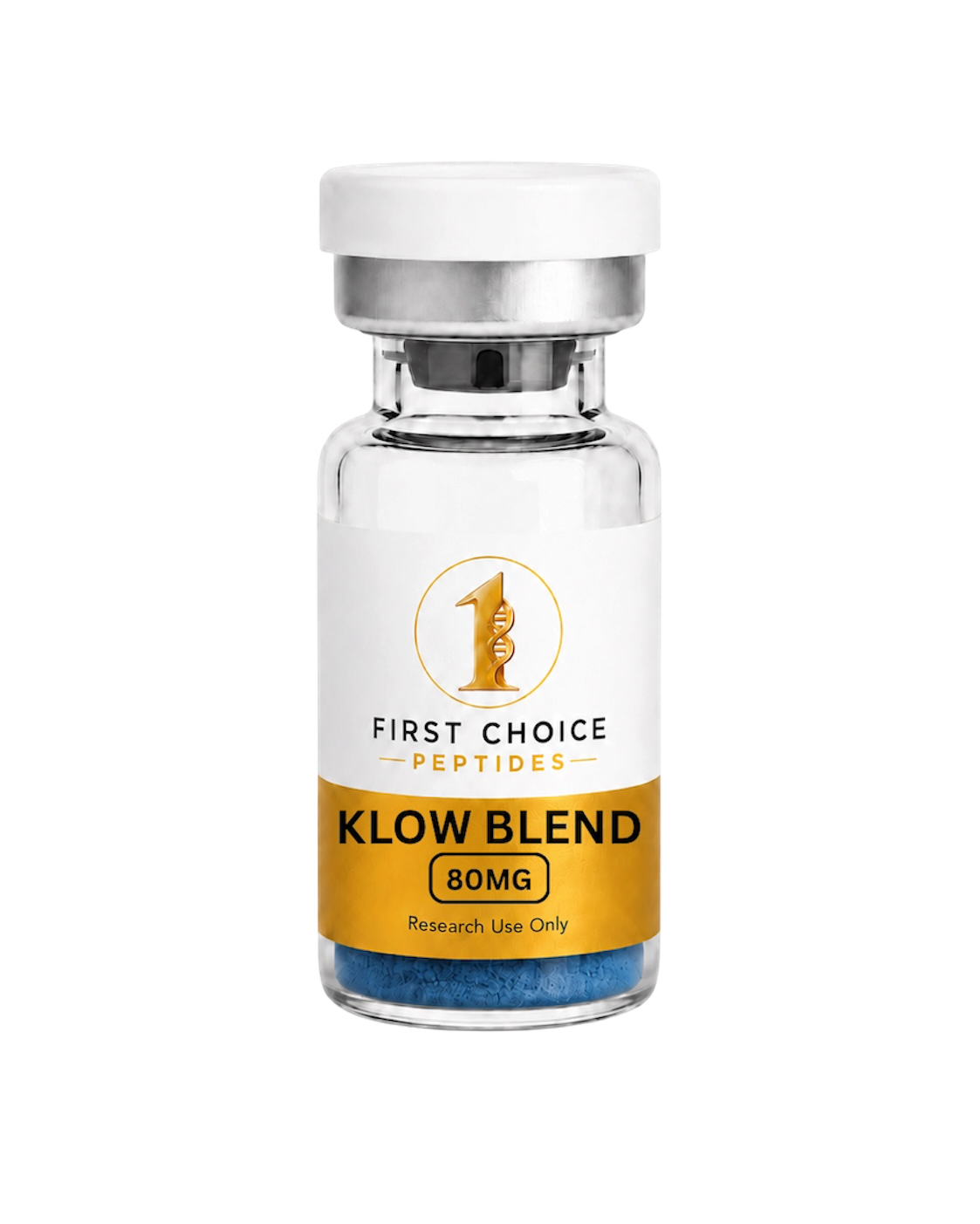
KLOW BLEND is a four-component research blend of GHK-Cu, BPC-157, TB-500 and KPV. Constituent identities, storage and literature. Research use only.
What KLOW BLEND is
KLOW BLEND is not a single molecule. It is a four-component peptide blend supplied in one vial, and KLOW is a nonstandard commercial blend name used for the combination of GHK-Cu, BPC-157, TB-500 and KPV. The name carries no chemical meaning: it identifies a packaging format rather than a compound, and no registry or nomenclature body recognises it. The material is intended only for controlled laboratory research involving multiple peptide analytes, and it is listed in the regenerative-biology section of the catalogue.
The blend is the four-component counterpart to the three-component GLOW format, the added constituent being KPV. Because a blend has no structure of its own, its identity is the identity of its four constituents: a copper-complexed tripeptide, a synthetic 15-residue peptide, a synthetic acetylated 7-residue peptide and a tripeptide fragment of a melanocortin hormone. Each is described separately below. A blended vial also means the four peptides share one lyophilisate, one reconstitution and one set of handling conditions, which is the practical difference between a blend and four separate vials.
The catalogue records no synonyms for the blend beyond the KLOW name itself. KLOW BLEND is supplied strictly as a laboratory research material and is not for human or veterinary use, nor for consumption, administration, diagnostic use or therapeutic use.
Structure and identifiers
The catalogue entry records no CAS registry number, no molecular formula and no molecular weight for the blend, and none is stated here. That absence is expected rather than an omission: a mixture of four peptides has no single formula and no single mass, so the identifiers that matter belong to the constituents individually and are listed on their own pages where those pages exist. The blend is offered in one 80 mg vial format, which is the total peptide mass across the four components.
GHK-Cu is the copper(II) complex of the tripeptide glycyl-L-histidyl-L-lysine, sequence Gly-His-Lys. The copper ion is coordinated by the peptide rather than bonded covalently to it, which makes the material a metal complex and gives it its characteristic blue colouration in solution. Its constituent guide is at GHK-Cu.
BPC-157 is a synthetic 15-residue peptide, sequence GEPPPGKPADDAGLV, corresponding to a partial sequence of a protein found in human gastric juice, from which the name body protection compound is taken. The chain is proline-rich in its central region and carries no metal and no recorded terminal modification. Its constituent guide is at BPC-157.
TB-500 is a synthetic 7-residue peptide, sequence Ac-LKKTETQ, an N-terminally acetylated fragment corresponding to the actin-binding region of the protein thymosin beta-4. It is a fragment rather than the full 43-residue protein, and the two are distinct materials. Its constituent guide is at TB-500.
KPV is the tripeptide L-lysyl-L-prolyl-L-valine, sequence Lys-Pro-Val, which corresponds to the C-terminal three residues of alpha-melanocyte-stimulating hormone, usually abbreviated alpha-MSH. It is therefore a fragment of a larger endogenous peptide hormone rather than an analogue of one. KPV is not a separate catalogue product, so it has no guide page of its own and is described here only as a constituent.
What the published literature has examined
Published work has examined the constituents of this blend in cell-culture, tissue and rodent models within regenerative biology, dermatology and inflammation research. The papers listed on this page are bibliographic references only; they are not evidence of safety or efficacy and describe laboratory findings, not any use in people or animals. There is no literature on KLOW BLEND as a combination: the blend is a commercial format, and the reference below concerns a single constituent studied on its own.
One reference is attached to this catalogue entry, a 2025 article in a pharmacology journal that reviews the published literature and the patent filings relating to BPC 157. A review of that shape is a secondary source: it does not report new laboratory work but surveys what has already been published, so its methodology consists of literature-database searching, screening against inclusion criteria and examination of patent families rather than of any assay. Its value on a page like this one is bibliographic, as a route into a scattered primary literature, and nothing in it is summarised here.
The other three constituents carry their own reference sets. Those for GHK-Cu and TB-500 are listed on their constituent pages rather than duplicated here. KPV has no references attached to this catalogue entry, and none is invented for it; the published work on melanocortin fragments generally sits in inflammation and epithelial cell biology and uses cultured cell models, but no specific study is cited or described on this page.
Model systems and methods that recur in the constituent literature include cultured dermal fibroblasts, keratinocytes and epithelial cell lines, three-dimensional tissue constructs, cell-free matrix and actin-binding assays, and rodent models used in regenerative-biology research. Analytical methods include reverse-phase HPLC, mass spectrometry, immunoassay and immunohistochemistry, transcript-expression measurement, and spectroscopic methods suited to copper coordination. This section describes fields, models and methods only. No result or endpoint from any cited study is stated on this page, and none of them establishes safety or efficacy for any use.
Storage and handling as a laboratory reagent
No compound-specific storage rows are recorded in the catalogue entry, so the general handling profile for lyophilized research peptides applies, with one blend-specific point. In lyophilized form the vial is held at -20 C, protected from light, and kept sealed until it is opened. Protection from light matters more than usual here because one constituent is a copper complex, and metal-peptide complexes are the most light-sensitive and oxidation-sensitive materials in this catalogue. Allowing a cold vial to reach room temperature before opening keeps condensation from forming on the dry solid.
Once reconstituted, the solution is a short-lived laboratory reagent rather than a stock. Reconstituted solutions are held refrigerated at 2 to 8 C for short-term laboratory use, kept out of direct light, and protected from repeated freeze-thaw cycling. Freeze-thaw damage is compounded in a four-component vial, since peptides with different aggregation and solubility behaviour are cycled together and the composition of the solution can drift away from the nominal ratio without any visible change.
Concentrations are worked out before diluent goes into the vial, and for a blend the vial mass is the combined mass rather than the mass of any one component. The reconstitution calculator converts a vial mass and a target concentration into a diluent volume, and bacteriostatic water is the diluent most commonly catalogued for laboratory vials that will be entered more than once.
Analytical verification
Identity and purity for a blend are established per constituent. Purity is assessed by third-party reverse-phase HPLC, where the chromatogram resolves the four peptides from one another and from synthesis-related species such as deletion sequences and oxidation products, so that each component is integrated as its own peak rather than counted into a single total. That separation is harder in a four-component vial than in a two-component one, since two short polar tripeptides can elute close together near the start of the gradient. Identity is assessed by mass spectrometry against the expected molecular weight of each constituent, which is the only way to confirm that all four named peptides are present rather than three of the four. A certificate of analysis is issued for each lot, and the certificates are held in the certificate library.
Two related articles cover how those documents are read. Peptide identity testing by mass spectrometry explains what an identity result establishes and what it leaves open. How to verify a peptide certificate of analysis sets out which fields on a certificate carry weight, including lot identity, test dates and the identity of the testing laboratory. Purity and identity information on this page is limited to exactly that: third-party HPLC and mass spectrometry, with one certificate per lot. No purity figure, component ratio, lot number or testing-laboratory name is stated here, because those values belong to individual lots and are reported on the certificate for the lot supplied.
Published literature
Papers in which KLOW BLEND has been the subject of laboratory or preclinical study. Listed for bibliographic reference only.
Research and educational purposes only. These references are provided for bibliographic context. They are not evidence of safety or efficacy, and nothing here is medical advice or a claim about any use in humans or animals.
Pharmaceuticals (Basel, Switzerland)
Multifunctionality and Possible Medical Application of the BPC 157 Peptide-Literature and Patent Review
The Journal of investigative dermatology
alpha-Melanocyte-stimulating hormone, MSH 11-13 KPV and adrenocorticotropic hormone signalling in human keratinocyte cells
Annals of the New York Academy of Sciences
New insights into the functions of alpha-MSH and related peptides in the immune system
Journal of leukocyte biology
Antimicrobial effects of alpha-MSH peptides
Research use only