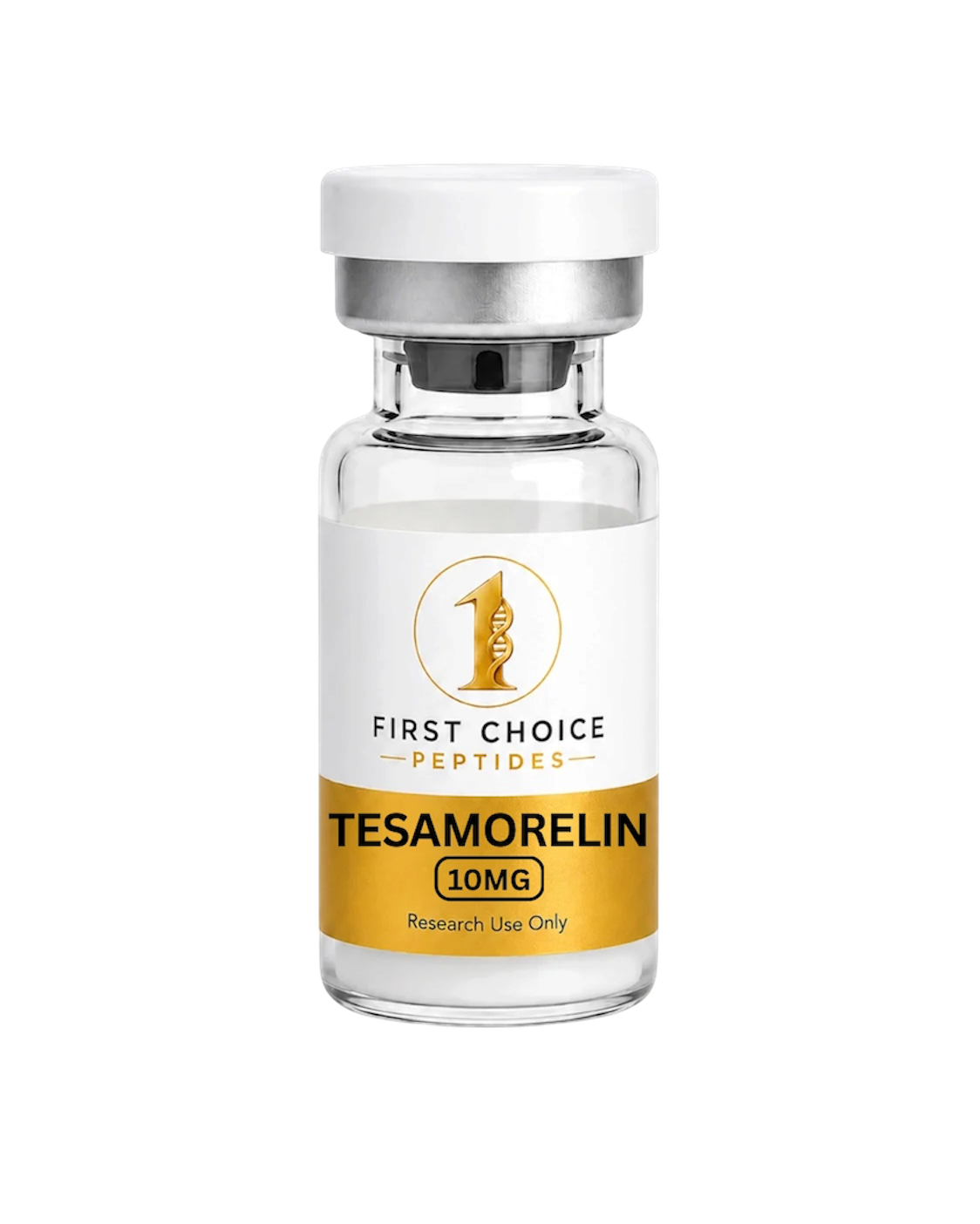

Tesamorelin is a synthetic 44-residue GHRH analogue (CAS 218949-48-5, C221H366N72O67S, 5136.00 g/mol). Identity and storage. Research use only.
Tesamorelin(TESA) at a glance
- CAS number
- 218949-48-5
- Molecular formula
- C221H366N72O67S
- Molecular weight
- 5136.00 g/mol
What Tesamorelin is
Tesamorelin is a synthetic 44-residue peptide whose sequence corresponds to human growth-hormone-releasing hormone, the hypothalamic releasing factor that acts at the GHRH receptor. It is an analogue rather than a copy of the native hormone, and it is prepared synthetically rather than isolated from tissue. The catalogue lists the entry as Tesamorelin, abbreviated TESA on the product label, files it under cell biology, and records no additional synonyms.
As a releasing-factor analogue, the compound belongs to a peptide family studied in endocrine research: sequences that are examined at their receptor, in receptor-expressing cell lines and in structure-activity work comparing analogues against the parent hormone. At 44 residues it is a long peptide by catalogue standards, closer in size to a small protein than to the short signalling fragments listed elsewhere in the range, and that length shapes both how it is handled and how it is analysed.
The catalogue presentation is a 10 mg vial of lyophilized material. First Choice Peptides supplies Tesamorelin strictly as a laboratory research reagent. It is not supplied as a drug or for any clinical purpose, and it is not for human or veterinary use.
Structure and identifiers
No sequence is stated on this page. The full 44-residue sequence and any terminal modification are not recorded in the catalogue entry, and a long sequence of this kind is not something to reconstruct from memory on a specification page, so the identity description here rests on the catalogued identifiers instead.
It is catalogued under CAS 218949-48-5 with the molecular formula C221H366N72O67S and a molecular weight of 5136.00 g/mol. Three things follow from those values for practical laboratory work. The registry number ties the entry to one chemical identity, which is the value to quote when cross-checking a supplier document. The formula contains a single sulfur atom, so the sequence carries one sulfur-bearing residue and no disulfide bridge is possible within a single chain. The molecular weight of 5136.00 g/mol is the expected mass used in identity testing, and at that size electrospray mass spectrometry produces a series of multiply charged ions rather than a single dominant peak, so the measured value is arrived at by deconvoluting that charge envelope.
Size also matters for chromatography. A 44-residue peptide is more prone than a short fragment to conformational effects on a reversed-phase column, and purity methods for material of this length usually run at elevated column temperature with a shallow gradient. Any value the catalogue does not record, including salt form and counter-ion content, is left unstated here rather than estimated.
What the published literature has examined
Published work has examined Tesamorelin within endocrine and receptor-pharmacology research, in the context of growth-hormone-releasing hormone analogues and their receptors. The papers listed on this page are bibliographic references only; they are not evidence of safety or efficacy and describe laboratory findings, not any use in people or animals.
The reference listed for this entry is a single bibliographic monograph record rather than a primary laboratory report. That is representative of the wider record for this compound: the literature associated with Tesamorelin is limited on the laboratory side and largely clinical and regulatory in nature, which is a different body of work from the in-vitro and preclinical papers that accompany most entries in this catalogue. No summary of that clinical or regulatory material is offered here, and no additional references are invented to fill the gap.
What remains relevant to a laboratory buyer is narrower and purely chemical: the compound is catalogued as a research material, and the useful published context is the analytical and structural literature on releasing-factor analogues, which concerns synthesis of long peptide chains, purification of full-length product away from deletion sequences, and mass-spectrometric confirmation of chain integrity. Those are the questions a laboratory can actually put to this material.
Storage and handling as a laboratory reagent
The catalogue entry carries no storage table of its own, so the standard handling for a lyophilized research peptide applies. Lyophilized material is held at -20 C and protected from light. Reconstituted solution is held at 2 to 8 C and treated as a short-term laboratory reagent rather than a long-term stock.
A sealed vial is best equilibrated to room temperature before it is opened, so that condensation does not settle on the powder, and a brief spin down collects material that has moved onto the stopper during transit. Diluent is added slowly down the vial wall rather than directly onto the cake, since a long peptide is more sensitive to shear and foaming than a short one, and the vial is swirled rather than shaken. After reconstitution, single-use aliquots are preferable to repeated withdrawals from one vial, and repeated freeze-thaw cycling is avoided, because each cycle is an opportunity for aggregation and for loss of intact chain. Aliquots labelled with lot number and date keep analytical results traceable to a single certificate of analysis. Concentration arithmetic for a given vial mass and diluent volume can be worked through with the reconstitution calculator, and the usual laboratory diluent for a lyophilized peptide of this type is bacteriostatic water.
Analytical verification
Purity and identity are verified by third-party HPLC and mass spectrometry, with one certificate of analysis issued per lot. Reversed-phase HPLC reports purity as a percentage of integrated peak area, and mass spectrometry confirms identity by matching the measured mass against the expected molecular weight of 5136.00 g/mol. Documents for a given lot are filed in the certificate library.
For a chain this long the two reports answer different questions, and both are needed. A deletion sequence missing one residue differs from full-length material by a small fraction of the total mass and may co-elute closely, so the purity chromatogram and the deconvoluted mass are read together rather than in isolation. How purity percentages are generated and what they cover is set out in HPLC peptide purity, and the identity side is covered in mass spectrometry peptide testing. Nothing beyond the HPLC purity result, the mass spectrometry identity result and the per-lot certificate is claimed for this material.
Published literature
Papers in which Tesamorelin(TESA) has been the subject of laboratory or preclinical study. Listed for bibliographic reference only.
Research and educational purposes only. These references are provided for bibliographic context. They are not evidence of safety or efficacy, and nothing here is medical advice or a claim about any use in humans or animals.
Expert opinion on investigational drugs
Tesamorelin, a human growth hormone releasing factor analogue
Basic & clinical pharmacology & toxicology
Non-clinical pharmacology and safety evaluation of TH9507, a human growth hormone-releasing factor analogue
Research use only