
What does 99% peptide purity actually mean? Learn how HPLC purity percentages are calculated, what a 99% result can indicate, and why purity, peptide content, molecular identity, and total material weight are different analytical measurements.
What Does 99% Peptide Purity Actually Mean?
A laboratory report or peptide Certificate of Analysis (COA) may contain a result such as:
HPLC Purity: 99.0%
But what does 99% peptide purity actually mean?
The answer depends on the analytical method used to generate the number.
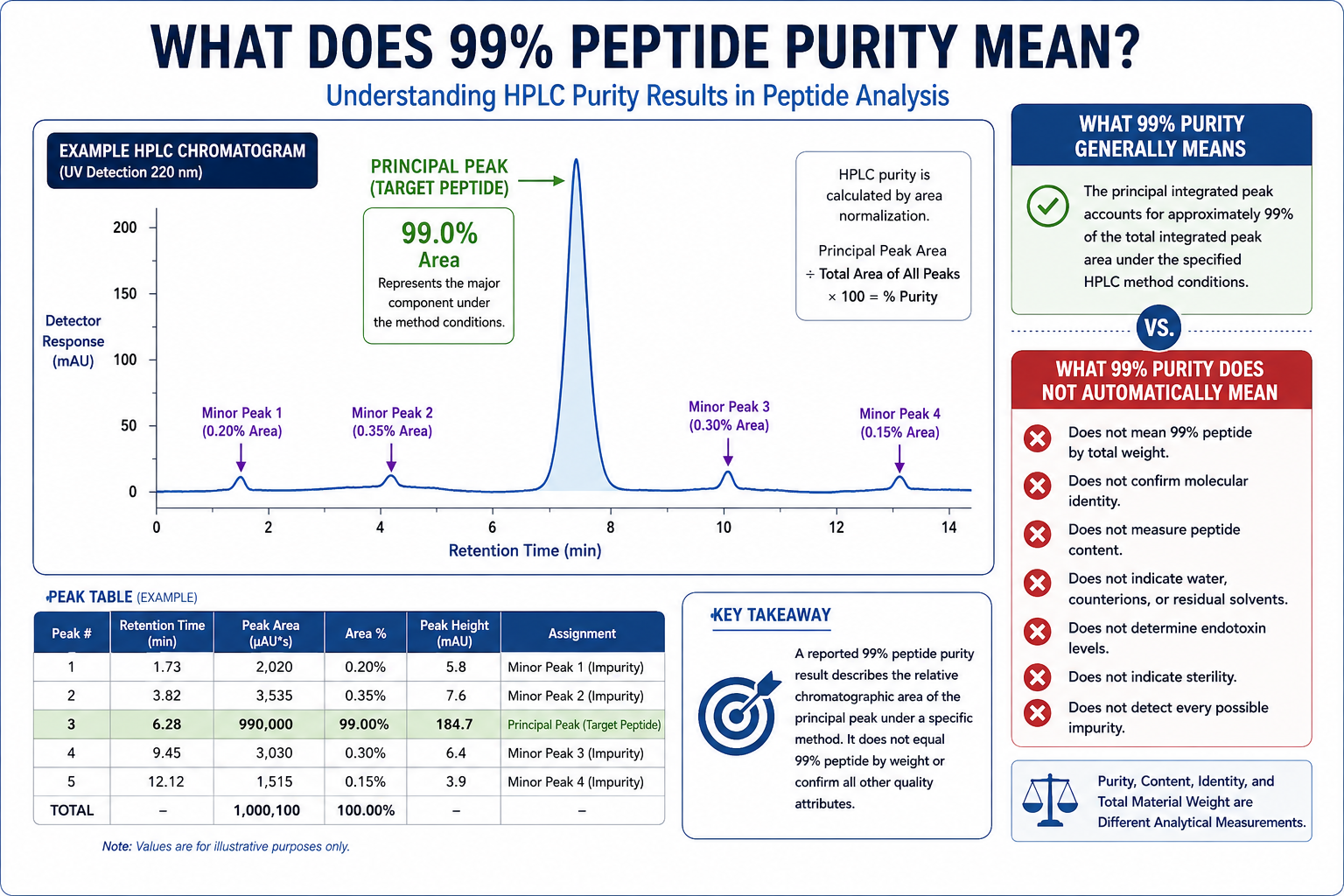
When purity is reported using high-performance liquid chromatography (HPLC) and calculated using relative peak areas, a 99% result generally means that the principal integrated chromatographic peak accounts for approximately 99% of the relevant total integrated peak area under the specified analytical conditions.
That is useful analytical information—but it does not automatically mean that 99% of the total physical material by weight is the target peptide.
Understanding this distinction is essential when interpreting peptide COAs and laboratory reports.
Research-use notice: This article discusses analytical chemistry, laboratory testing, and characterization of research materials only. It does not provide information or instructions concerning administration, dosing, reconstitution for administration, clinical use, diagnosis, prevention, treatment, or human or animal use.
What Does “Peptide Purity” Mean?
The term peptide purity can have different meanings depending on the analytical context.
On many peptide laboratory reports, purity refers specifically to:
Chromatographic purity measured by HPLC.
HPLC separates detectable components within a sample.
As those components pass through the chromatographic system, a detector records signals that appear as peaks on an HPLC chromatogram.
The laboratory can integrate the area associated with each detected peak.
The relative area associated with the principal peak may then be reported as the chromatographic purity percentage.
What Does a 99% HPLC Purity Result Mean?
Consider a simplified example.
An HPLC analysis produces the following results:
Peak
Area %
Minor Peak 1
0.20%
Minor Peak 2
0.35%
Principal Peak
99.00%
Minor Peak 3
0.30%
Minor Peak 4
0.15%
Total
100.00%
Under this simplified area-normalization example, the principal peak accounts for:
99.00% of the integrated chromatographic peak area.
That is the basis for the reported 99% HPLC purity result.
It describes the relative detector response represented by the principal chromatographic peak under the method used.
How Is HPLC Peptide Purity Calculated?
A simplified area-normalization calculation can be written as:
Principal Peak Area ÷ Total Relevant Integrated Peak Area × 100
For example:
Principal peak area:
990,000
Total relevant integrated peak area:
1,000,000
Calculation:
990,000 ÷ 1,000,000 × 100 = 99.0%
The reported chromatographic purity would therefore be:
99.0%
Actual laboratory methods, integration rules, exclusions, corrections, and calculations can be more detailed, so the laboratory’s stated method should always control interpretation.
Does 99% Purity Mean 99% of the Material Is Peptide?
Not necessarily.
This is one of the most important concepts in peptide analytical testing.
A relative HPLC area-purity result should not automatically be treated as an absolute measurement of the physical composition of the entire sample.
The sample may contain components such as:
Water
Counterions
Residual solvents
Inorganic material
Other substances that may not be represented proportionally by the HPLC detector
Therefore:
99% HPLC area purity does not automatically equal 99% peptide by total material mass.
These are different measurements.
Peptide Purity vs. Peptide Content
Peptide purity and peptide content should not be used interchangeably.
Peptide Purity
When measured using HPLC area normalization, purity describes the relative chromatographic area associated with the principal peak compared with other relevant integrated peaks.
Peptide Content
Peptide content addresses how much target peptide is present according to an appropriate quantitative analytical method.
The two measurements answer different questions.
For a complete explanation, read:
[Peptide Purity vs. Peptide Content: What’s the Difference?]
Does 99% Purity Mean the Remaining 1% Is Impurities?
Not necessarily in the sense of the complete physical composition of the material.
If an HPLC result reports a principal peak area of 99%, the remaining approximately 1% of the relevant integrated chromatographic area may consist of other detected peaks under that method.
That does not automatically mean the complete physical sample consists of exactly:
99% peptide + 1% impurities by weight.
Some components may respond differently to the detector, may not be detected by that method, or may require separate analytical techniques.
What Could Minor HPLC Peaks Represent?
Minor peaks are additional chromatographic detector signals.
Depending on the sample and analytical method, these may potentially represent:
Synthesis-related components
Truncated peptide sequences
Deletion sequences
Modified species
Oxidation-related products
Degradation-related components
Other detectable substances
However, a chromatogram alone does not necessarily establish the chemical identity of a minor peak.
Additional analytical characterization may be required.
Does 99% HPLC Purity Confirm Peptide Identity?
No—not by itself.
Purity and identity are different analytical characteristics.
A chromatogram may show one dominant peak, but the fact that a peak is large does not independently establish that the detected component has the expected molecular identity.
Additional analytical methods may be used to provide identity-related information.
One commonly used technique is:
Mass spectrometry (MS)
Mass spectrometry measures ions according to their mass-to-charge ratio (m/z).
Observed molecular information can then be compared with the expected molecular characteristics of the material.
In simplified terms:
HPLC → chromatographic separation and relative purity
Mass spectrometry → molecular-mass and identity-related information
These methods provide complementary rather than interchangeable information.
What Does 99% Purity Not Tell You?
A reported 99% HPLC purity result should not automatically be interpreted as evidence of:
Absolute peptide content
Total material quantity
Complete molecular identity
Water content
Counterion content
Residual-solvent levels
Elemental impurity levels
Endotoxin status
Sterility
Every possible impurity
Each of these represents a separate analytical question.
If a characteristic is important to a research protocol, researchers should determine whether an appropriate test for that characteristic was actually performed and reported.
Why Water Content Matters
Water provides a straightforward example of why chromatographic purity and total material composition are different.
Water may contribute to the physical mass of a material.
However, a standard peptide HPLC area-purity result does not necessarily quantify that water as part of the chromatographic purity calculation.
Water can instead be evaluated using a dedicated analytical method, such as Karl Fischer titration, when appropriate.
Therefore, a high HPLC purity percentage should not be interpreted as evidence that a material contains no water.
Why Counterions Matter
Peptides may exist in association with counterions depending on synthesis and purification conditions.
Counterions can contribute to the total physical composition of a material.
They are not necessarily represented proportionally in an HPLC area-purity percentage.
If counterion content is relevant to an analytical objective, a separate appropriate measurement may be required.
Again:
Chromatographic purity and total material composition are different analytical concepts.
Why Residual Solvents Are Separate
Solvents may be used during synthesis, purification, and processing.
Testing for residual solvents requires an analytical method suitable for those compounds.
A 99% HPLC peptide-purity result should not be interpreted as proof that residual solvents are absent.
If residual-solvent analysis was performed, researchers should look for a separate result on the laboratory documentation.
Does 99% Purity Mean No Endotoxin?
No.
HPLC purity does not determine endotoxin status.
Endotoxin analysis is a separate laboratory test.
A material could have a high chromatographic purity result without that HPLC analysis providing any information about endotoxin.
Researchers should look for an actual endotoxin result when endotoxin testing is part of the analytical scope.
Does 99% Purity Mean Sterile?
No.
Sterility and chromatographic purity are completely different analytical characteristics.
An HPLC chromatogram does not establish sterility.
Sterility cannot be inferred from:
HPLC purity
Mass spectrometry
Appearance
Packaging
Endotoxin results
If sterility was evaluated, that requires appropriate separate testing and documentation.
Why the HPLC Detection Method Matters
A chromatographic purity percentage is based on detector response.
Different components may produce different detector responses.
For example, in UV-based HPLC analysis, the selected detection wavelength can influence how strongly various components are detected.
Therefore, chromatographic peak-area percentages do not necessarily correspond directly to physical mass percentages.
This is another reason researchers should avoid interpreting:
99% area purity
as automatically meaning:
99% by weight.
Why HPLC Method Conditions Matter
HPLC results depend on the analytical method.
Important variables can include:
Column chemistry
Column dimensions
Mobile phase
Gradient
Flow rate
Temperature
Detection wavelength
Sample preparation
Injection conditions
Integration parameters
Changing these conditions can change chromatographic separation and detector response.
Researchers should therefore interpret purity results in the context of the method used.
Is 99% Purity Always Better Than 98%?
A larger numerical purity result indicates a larger relative principal-peak area under the respective analytical conditions, but comparing two numbers without examining the methods can be misleading.
For example:
Laboratory A: 99.2%
Laboratory B: 98.9%
It may be tempting to conclude immediately that the first material is analytically “better.”
But a meaningful comparison requires considering:
Were the same methods used?
Were the same detection conditions used?
Were the integration procedures comparable?
Were the samples prepared similarly?
Were the same types of components detectable?
Were the laboratories using comparable specifications?
A difference of a few tenths of a percentage point should not automatically be treated as a complete quality comparison between independently generated reports.
What About “Greater Than 99% Purity”?
A laboratory or supplier may report:
>99% purity
Researchers should determine what measurement supports that statement.
Questions include:
Was purity measured by HPLC?
What was the actual reported numerical result?
Is the chromatogram available?
Is the peak table available?
Which sample was tested?
Which lot was tested?
Which laboratory performed the analysis?
When was the analysis performed?
The analytical documentation provides more useful information than the marketing shorthand alone.
Why Batch-Specific Testing Matters
A 99% result is meaningful only in relation to the sample that was actually analyzed.
Researchers should therefore look for a clear chain of traceability:
Research material → Lot number → Laboratory sample → Report number → HPLC analysis → Purity result
A purity result from one batch should not automatically be assumed to represent another batch.
For more information, see:
[How to Verify a Peptide COA and Laboratory Test Report]
How to Evaluate a 99% Peptide Purity Claim
When encountering a reported 99% purity result, researchers can ask:
What method generated the 99% result?
Was it HPLC area purity?
Which laboratory performed the analysis?
Which batch was tested?
Is there a unique report number?
Is the chromatogram available?
Is a peak table provided?
Are the analytical conditions identified?
Was molecular identity evaluated separately?
Are additional analytical claims supported by separate tests?
These questions provide substantially more context than the percentage alone.
How to Read the HPLC Chromatogram Behind the 99% Result
If a laboratory provides the chromatogram, researchers can examine:
Retention time
Where peaks appear along the chromatographic run.
Principal peak
The dominant integrated detector response.
Minor peaks
Additional detected chromatographic signals.
Peak area
The integrated detector response associated with each peak.
Area percentage
The relative contribution of each integrated peak.
Baseline
The background detector signal between peaks.
Peak table
The numerical data associated with the chromatogram.
For a detailed walkthrough, read:
[How to Read an HPLC Chromatogram for Peptide Research]
99% Peptide Purity vs. Other Analytical Results
Result
What It Generally Addresses
99% HPLC Purity
Relative chromatographic peak area
Mass Spectrometry
Molecular-mass / identity-related information
Peptide Content Assay
Quantitative target peptide amount
Water Analysis
Measured water or moisture
Counterion Analysis
Measured counterion
Residual Solvent Test
Selected residual solvents
Endotoxin Test
Endotoxin result under the specified method
The presence of one result should not be interpreted as though all of the others were also measured.
Common Misunderstandings About 99% Peptide Purity
“99% purity means the material is exactly 99% peptide by weight.”
Not necessarily.
“The remaining 1% tells me everything else in the material.”
No. It generally represents other relevant integrated chromatographic peak area under the HPLC method, not necessarily the complete physical composition.
“99% HPLC purity proves molecular identity.”
No. Identity requires appropriate analytical evidence.
“99% purity means endotoxin was tested.”
No. Endotoxin analysis is separate.
“99% purity means the material is sterile.”
No. HPLC does not establish sterility.
“99.5% is always better than 99.0%.”
Not necessarily as an overall analytical comparison, especially when methods, laboratories, or samples differ.
Frequently Asked Questions About 99% Peptide Purity
What does 99% peptide purity mean?
When reported using HPLC area normalization, it generally means the principal integrated chromatographic peak represents approximately 99% of the relevant total integrated peak area under the specified method.
Does 99% purity mean 99% peptide by weight?
Not necessarily. Chromatographic area purity and absolute peptide content are different measurements.
What is the other 1%?
In an HPLC area-normalization result, approximately 1% may represent other relevant integrated chromatographic peak area. It should not automatically be interpreted as the complete remaining physical composition of the sample.
Is 99% HPLC purity the same as peptide content?
No. Peptide content requires an appropriate quantitative measurement.
Does 99% purity confirm peptide identity?
Not by itself. Molecular identity requires appropriate analytical evidence.
Can HPLC detect every impurity?
No analytical method should automatically be assumed to detect every possible impurity. Detection depends on the method, separation, detector response, concentration, and other analytical factors.
Should researchers look at the chromatogram?
Yes. When available, the chromatogram and peak table provide useful context behind the reported purity percentage.
Understanding Purity Results at First Choice Peptides
At First Choice Peptides, we believe researchers should be able to examine available analytical documentation beyond a headline purity percentage.
A reported HPLC purity value becomes more meaningful when evaluated together with:
Batch identification
Laboratory information
HPLC chromatogram
Peak table
Analytical method
Molecular identity data
Additional testing actually performed
Continue learning:
[What Is HPLC Peptide Purity? A Researcher’s Guide]
[How to Read an HPLC Chromatogram for Peptide Research]
[Peptide Purity vs. Peptide Content: What’s the Difference?]
[How to Read a Peptide Certificate of Analysis (COA)]
[How to Verify a Peptide COA and Laboratory Test Report]
[Third-Party Peptide Testing: What Researchers Should Look For]
[Certificate of Analysis Library]
Final Takeaway
So, what does 99% peptide purity actually mean?
When the number comes from an HPLC relative area calculation, it generally indicates that the principal integrated chromatographic peak accounts for approximately 99% of the relevant integrated detector response under the specified analytical conditions.
It does not automatically establish:
99% peptide by total mass
Molecular identity
Absolute peptide content
or the results of tests that were never performed.
The most useful way to evaluate a 99% purity result is therefore not to look at the percentage in isolation.
Researchers should examine the method, chromatogram, batch, laboratory report, identity data, and other analytical testing associated with the result.
Research use only