
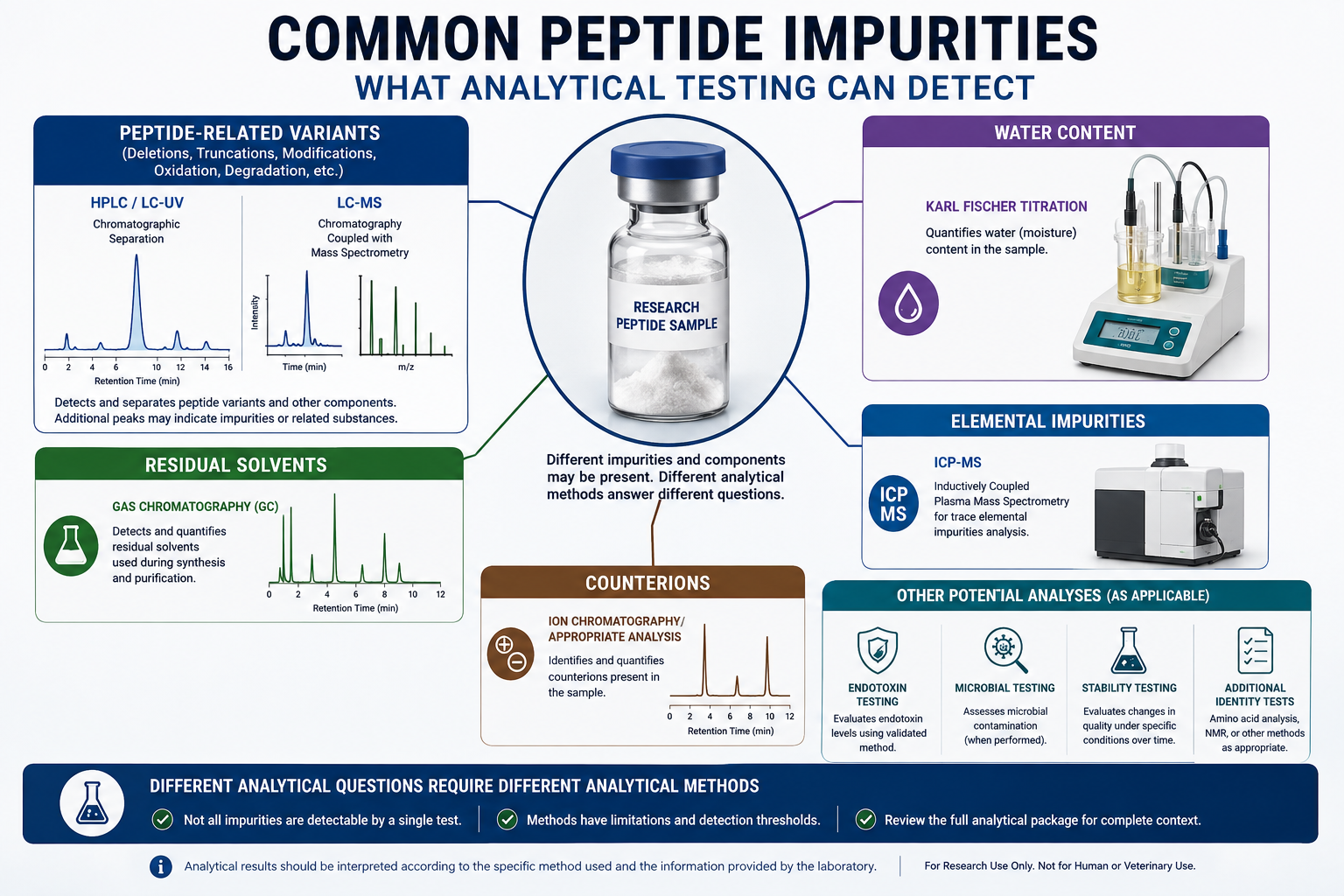
Learn about common peptide-related impurities and how analytical methods such as HPLC and mass spectrometry can help researchers evaluate research materials, including the important limitations of each testing method.
Common Peptide Impurities: What Analytical Testing Can Detect
Peptide analytical testing involves more than looking for a single purity percentage on a Certificate of Analysis (COA).
Researchers evaluating analytical documentation may encounter HPLC chromatograms, mass spectra, water analysis, residual-solvent testing, counterion analysis, and other laboratory results.
Each method answers a different analytical question.
Understanding common peptide impurities and the capabilities and limitations of different analytical methods can help researchers interpret laboratory reports more accurately.
One principle is particularly important:
No single analytical test should automatically be assumed to detect every possible impurity or component in a peptide research material.
This guide explains several categories of peptide-related impurities and other measurable components, how laboratories may evaluate them, and what researchers should look for when reviewing analytical documentation.
Research-use notice: This article discusses analytical chemistry, laboratory testing, and characterization of research materials only. It does not provide information or instructions concerning administration, dosing, reconstitution for administration, clinical use, diagnosis, prevention, treatment, or human or animal use.
What Is a Peptide Impurity?
In analytical chemistry, an impurity is generally a component of a material other than the intended target substance or a component that falls outside the defined composition or specification being evaluated.
For synthetic peptides, additional components may arise during:
Synthesis
Cleavage
Purification
Isolation
Processing
Storage
Different components have different chemical properties.
As a result, laboratories may need multiple analytical methods to evaluate different characteristics of a research material.
Where Can Peptide-Related Impurities Come From?
Synthetic peptides are commonly produced through a sequence of chemical reactions in which amino acids are assembled into a defined sequence.
Because peptide synthesis involves many individual chemical steps, additional molecular species can potentially form.
Depending on the peptide and process, these can include:
Deletion sequences
Truncated sequences
Incomplete reaction products
Modified peptide species
Oxidation-related products
Degradation-related products
Other synthesis-related components
Other non-peptide components may also be present and require separate analytical evaluation.
These may include:
Water
Counterions
Residual solvents
Inorganic material
Selected elemental impurities
The analytical method determines which of these characteristics can actually be evaluated.
What Are Deletion Sequences?
A deletion sequence is a peptide-related species in which one or more expected amino-acid residues are absent from the intended sequence.
For example, consider a simplified intended sequence:
A-B-C-D-E-F
A deletion-related species could conceptually be:
A-B-C-D-F
where one expected residue is missing.
Because deletion sequences differ chemically from the intended peptide, an appropriate chromatographic method may separate some of these species from the principal component.
Mass spectrometry may also provide molecular-mass information useful for further characterization when the species is detected.
What Are Truncated Peptides?
A truncated peptide is shorter than the intended full-length sequence.
Using the same simplified example:
Expected:
A-B-C-D-E-F
Truncated species:
A-B-C-D
The truncated species has a different molecular composition and molecular mass from the intended full-length peptide.
Depending on the analytical conditions, chromatographic and mass-spectrometric methods may provide information useful for detecting or characterizing such species.
What Are Incomplete Reaction Products?
Peptide synthesis involves repeated chemical reactions.
When a reaction does not proceed completely, intermediate or related products can potentially remain.
Purification processes are designed to separate the target peptide from unwanted components, but analytical testing is used to evaluate the resulting material.
An HPLC chromatogram may reveal additional peaks when these components are sufficiently separated and detectable under the method.
However, the presence of a minor HPLC peak does not by itself establish its chemical identity.
What Are Oxidation-Related Peptide Impurities?
Certain amino-acid residues can undergo oxidation under particular chemical or environmental conditions.
Oxidation changes the chemical composition of the affected species and may alter:
Molecular mass
Chromatographic behavior
Detector response
Depending on the material and analytical method, oxidation-related species may therefore produce different chromatographic or mass-spectrometric signals.
The identity of an observed signal should be established using appropriate analytical evidence rather than inferred solely from its position on a chromatogram.
What Are Degradation-Related Products?
Peptides can undergo chemical changes over time depending on their structure and environmental conditions.
Potential degradation pathways vary by peptide and may include chemical transformations such as:
Oxidation
Hydrolysis
Deamidation
Other sequence- or condition-dependent changes
Analytical methods may detect changes in chromatographic profiles or molecular information associated with some degradation-related species.
However, the analytical method must be capable of detecting and distinguishing the relevant component.
What Can HPLC Detect?
High-performance liquid chromatography (HPLC) separates components according to their interactions with a chromatographic system.
A peptide HPLC chromatogram may contain:
A principal peak
Minor peaks
Retention times
Integrated peak areas
Relative area percentages
When additional components are sufficiently separated and detectable under the method, they may appear as additional chromatographic peaks.
This makes HPLC useful for evaluating the relative chromatographic profile of a sample.
Can HPLC Identify Every Impurity?
No.
An HPLC chromatogram can indicate that additional detector signals are present, but it does not necessarily establish what every peak represents.
There are several reasons.
Co-Elution
Two or more components may elute at similar times and appear within the same chromatographic region.
Detector Response
Some components may produce weak or different detector responses.
Detection Wavelength
A compound may not respond strongly at the wavelength being monitored.
Concentration
A component present below the method’s detection or reporting capability may not appear as a reportable peak.
Method Selectivity
A chromatographic method may not adequately separate every possible component.
Therefore:
A high HPLC purity percentage does not establish that every possible impurity has been excluded.
What Can Mass Spectrometry Detect?
Mass spectrometry (MS) provides molecular information based on the mass-to-charge ratio (m/z) of detected ions.
Mass spectrometry may help researchers evaluate:
Expected molecular mass
Observed molecular mass
Charge states
Additional detected molecular species
Molecular-mass differences associated with certain variants
When an additional species produces detectable ions, its mass information may help characterize it.
However, mass spectrometry also has analytical limitations.
Can Mass Spectrometry Detect Every Impurity?
No.
Whether a component is detected depends on factors such as:
Ionization behavior
Concentration
Instrument sensitivity
Mass range
Resolution
Sample preparation
Analytical method
Signal suppression
Data-processing parameters
The absence of a reported MS signal should not automatically be interpreted as proof that every possible impurity is absent.
Why HPLC and Mass Spectrometry Can Be Complementary
HPLC and mass spectrometry answer different analytical questions.
HPLC can help answer:
How does the sample separate chromatographically?
Mass spectrometry can help answer:
What molecular-mass information is associated with detected ions?
When combined as LC-MS, chromatographic separation can be connected with mass-spectrometric information.
This can provide additional information about components detected during an analysis.
For more detail, see:
[HPLC vs. Mass Spectrometry for Peptide Analysis: What’s the Difference?]
What Is LC-MS?
LC-MS combines liquid chromatography with mass spectrometry.
The liquid-chromatography portion separates components.
The mass spectrometer then provides m/z information for ions detected from those chromatographic components.
Conceptually:
Sample → Chromatographic Separation → Detected Peak → Mass Information
This can help laboratories investigate whether additional chromatographic components have molecular masses consistent with particular peptide-related species.
Interpretation still depends on the method and available analytical evidence.
What About Water?
Water is an excellent example of why a high HPLC purity percentage should not be interpreted as the complete physical composition of a material.
Water can contribute to the physical mass of a research material but is not necessarily represented proportionally in a standard peptide HPLC area-purity result.
Water therefore requires a dedicated analytical measurement when it is part of the testing scope.
One commonly used technique is:
Karl Fischer titration
What Is Karl Fischer Testing?
Karl Fischer titration is an analytical technique specifically used for determining water content.
A laboratory may report water as:
Percentage
Mass fraction
Another appropriate quantitative unit
The important distinction is:
HPLC purity does not substitute for water analysis.
If water content is relevant to a research protocol, researchers should look for an actual water-analysis result.
What Are Peptide Counterions?
Peptides may exist in association with counterions resulting from synthesis, purification, or isolation conditions.
Counterions are chemically distinct from the peptide itself and can contribute to total material composition.
Depending on the material, counterion analysis may be performed separately.
Researchers should not infer counterion content from an HPLC purity percentage.
Can HPLC Purity Determine Counterion Content?
Not automatically.
A standard peptide HPLC area-purity result is not necessarily a quantitative measurement of counterion content.
If counterion content is being reported, researchers should determine:
Which counterion was measured
Which analytical method was used
What units were reported
Whether the result corresponds to the relevant batch
What Are Residual Solvents?
Solvents may be used during chemical synthesis, purification, processing, or isolation.
Small quantities can potentially remain in a material after processing.
These are known as:
Residual solvents
Residual-solvent testing requires an analytical method appropriate for volatile or semi-volatile compounds being evaluated.
One commonly used analytical technique is:
Gas chromatography (GC)
depending on the analytical objective.
Can HPLC Purity Tell You About Residual Solvents?
Not automatically.
A reported:
99% HPLC purity
does not establish that residual solvents are absent.
Residual-solvent analysis represents a separate analytical measurement.
Researchers should look for an actual residual-solvent result if that characteristic is part of the testing scope.
What Are Elemental Impurities?
Materials can potentially contain trace amounts of elemental substances introduced from:
Raw materials
Processing equipment
Reagents
Manufacturing processes
Environmental sources
When elemental impurity analysis is required, laboratories may use specialized techniques such as:
ICP-MS — inductively coupled plasma mass spectrometry
This is distinct from the mass-spectrometric techniques commonly used to evaluate peptide molecular mass.
Is ICP-MS the Same as Peptide Mass Spectrometry?
No.
Although both techniques contain the words mass spectrometry, they serve very different analytical purposes.
Peptide MS may be used to obtain molecular-mass information about peptide-related ions.
ICP-MS is commonly used for highly sensitive elemental analysis.
The exact analytical method should always be identified rather than relying only on the phrase “mass spectrometry.”
What About Endotoxin?
Endotoxin testing is separate from peptide purity testing.
Neither a high HPLC purity percentage nor a matching peptide molecular mass automatically establishes endotoxin status.
If endotoxin testing was performed, researchers should look for:
Test method
Sample identification
Result
Units
Reporting or specification information when applicable
Do not infer endotoxin results from unrelated analytical methods.
Purity Testing vs. Impurity Testing
These terms can overlap but should not automatically be treated as identical.
A chromatographic purity test may show the relative proportion of a principal peak compared with other detected peaks.
A targeted impurity test may specifically evaluate a defined substance or class of substances.
For example:
HPLC chromatographic purity → evaluates chromatographic profile
Water analysis → specifically measures water
Residual-solvent analysis → evaluates selected solvents
Elemental analysis → evaluates selected elements
Endotoxin analysis → evaluates endotoxin under the specified method
The analytical question determines the appropriate method.
What Does a Minor HPLC Peak Mean?
A minor peak tells researchers that an additional chromatographic detector signal was integrated under the method.
It does not necessarily tell researchers:
Exact chemical identity
Exact physical mass
Toxicological significance
Source of the component
Additional analytical characterization may be needed.
This is why a COA should be interpreted as analytical documentation rather than a collection of isolated percentages.
What Does “Below Detection Limit” Mean?
Laboratory reports may sometimes use terminology such as:
ND — Not Detected
or
Below Detection Limit
These statements should be interpreted according to the analytical method.
“Not detected” generally should not be interpreted as:
Absolute proof that zero molecules of the substance exist.
Instead, it indicates that the analyte was not detected according to the method and its applicable detection capability.
Detection Limit vs. Quantitation Limit
Researchers may encounter:
LOD — Limit of Detection
and
LOQ — Limit of Quantitation
These concepts are related but different.
Limit of Detection
The approximate lowest level at which an analyte can be reliably distinguished from background under the method.
Limit of Quantitation
The approximate lowest level at which an analyte can be quantitatively measured with defined analytical performance under the method.
The exact definitions and calculations depend on the analytical procedure.
These limits provide important context when interpreting very low-level analytical results.
Why “Not Detected” Does Not Mean “Does Not Exist”
Every analytical method has limitations.
If a laboratory reports:
Not Detected
the scientifically useful interpretation is that the analyte was not detected under the conditions and capabilities of the method used.
The result should not automatically be expanded into a universal claim that the substance is completely absent.
This distinction is especially important when evaluating trace-level analytical measurements.
Peptide-Related Components and Possible Analytical Methods
A simplified comparison:
Analytical Characteristic
Possible Analytical Approach
Chromatographic purity
HPLC
Molecular-mass information
Mass spectrometry
Peptide-related variants
HPLC / LC-MS depending on method
Water content
Karl Fischer or another appropriate method
Residual solvents
Gas chromatography or another suitable method
Counterion content
Appropriate ion/counterion analysis
Elemental impurities
ICP-MS or other elemental analysis
Endotoxin
Specific endotoxin assay
This table is illustrative.
The appropriate analytical method depends on the material, laboratory procedure, analytical objective, and method validation or qualification.
Does 99% Peptide Purity Mean Only 1% Impurities?
Not necessarily.
If a laboratory reports:
99% HPLC area purity
the remaining approximately 1% generally represents other relevant integrated chromatographic area under that method.
It should not automatically be interpreted as:
99% target peptide by physical mass + exactly 1% of every other component combined.
Water, counterions, solvents, and other substances may require separate analytical measurements.
For more information:
[What Does 99% Peptide Purity Actually Mean?]
Why Multiple Analytical Methods Matter
Consider a hypothetical analytical package containing:
HPLC
Provides chromatographic purity information.
Mass Spectrometry
Provides molecular-mass information.
Water Analysis
Provides measured water content.
Residual-Solvent Analysis
Provides information about selected solvents.
Each test adds information about a different characteristic.
This is why researchers should ask:
“Which tests were actually performed?”
rather than simply:
“Was it tested?”
How to Evaluate Peptide Impurity Testing on a COA
When reviewing a laboratory report, researchers can ask:
Which batch was tested?
Which laboratory performed the analysis?
Which analytical methods were used?
What characteristics were actually measured?
Is an HPLC chromatogram available?
Are minor chromatographic peaks reported?
Was molecular-mass analysis performed?
Were any specific impurities targeted?
Are detection or quantitation limits reported where relevant?
Were water, solvents, counterions, or elemental impurities tested separately?
Are units clearly stated?
Does each analytical claim have a corresponding test result?
These questions help distinguish actual analytical evidence from generalized testing claims.
Common Misunderstandings About Peptide Impurities
“A 99% HPLC result means only 1% of anything else exists.”
Not necessarily. It generally describes relative integrated chromatographic area under the method.
“HPLC identifies every impurity.”
No. HPLC may separate and detect additional components, but it does not automatically identify every peak or detect every possible substance.
“Mass spectrometry detects everything.”
No. MS detection depends on ionization, sensitivity, concentration, method conditions, and other factors.
“Not detected means absolute zero.”
No. It means the analyte was not detected according to the method’s applicable detection capability.
“One purity test replaces all other analytical tests.”
No. Different characteristics require different analytical methods.
Frequently Asked Questions About Peptide Impurities
What are common peptide-related impurities?
Depending on the peptide and manufacturing process, peptide-related components may include deletion sequences, truncated sequences, modified species, oxidation-related products, degradation-related products, and other synthesis-related components.
Can HPLC detect peptide impurities?
HPLC can reveal additional chromatographic signals when components are sufficiently separated and detectable under the method, but it does not automatically identify every peak or detect every possible impurity.
Can mass spectrometry identify peptide impurities?
Mass spectrometry can provide molecular information about detected ions that may assist with characterization, but its capabilities depend on the analytical method and instrument.
Does 99% peptide purity mean 1% impurities?
Not necessarily in terms of total physical composition. A 99% HPLC area result generally refers to relative chromatographic peak area.
Does HPLC measure water content?
A standard peptide HPLC purity result does not automatically quantify water. Water requires an appropriate water-analysis method.
Can HPLC detect residual solvents?
A peptide HPLC purity result should not automatically be interpreted as residual-solvent analysis. Separate testing may be required.
What does “not detected” mean on a laboratory report?
It generally means the analyte was not detected according to the conditions and detection capability of the analytical method used.
Understanding Analytical Testing at First Choice Peptides
At First Choice Peptides, we believe researchers should evaluate analytical documentation based on the tests actually performed rather than assuming one purity result answers every analytical question.
When reviewing available laboratory documentation, consider:
Batch identification
HPLC chromatographic data
Mass-spectrometric information
Specific additional tests actually performed
Laboratory and report identifiers
Testing dates
Reported units and specifications
Continue learning:
[What Is HPLC Peptide Purity? A Researcher’s Guide]
[How to Read an HPLC Chromatogram for Peptide Research]
[What Does 99% Peptide Purity Actually Mean?]
[HPLC vs. Mass Spectrometry for Peptide Analysis]
[Peptide Purity vs. Peptide Content: What’s the Difference?]
[How to Read a Peptide Certificate of Analysis (COA)]
[How to Verify a Peptide COA and Laboratory Test Report]
[Third-Party Peptide Testing: What Researchers Should Look For]
Final Takeaway
Understanding common peptide impurities requires understanding the limitations of analytical testing.
HPLC can provide valuable chromatographic information.
Mass spectrometry can provide molecular-mass information.
Other analytical methods may be required to evaluate water, residual solvents, counterions, elemental impurities, endotoxin, or other specific characteristics.
No single result should automatically be interpreted as answering every analytical question.
For researchers reviewing peptide analytical documentation, the most useful question is:
“Which characteristic was measured, which method measured it, and what does that result actually establish?”
That approach provides far more analytical information than relying on a single headline purity percentage.
Research use only