
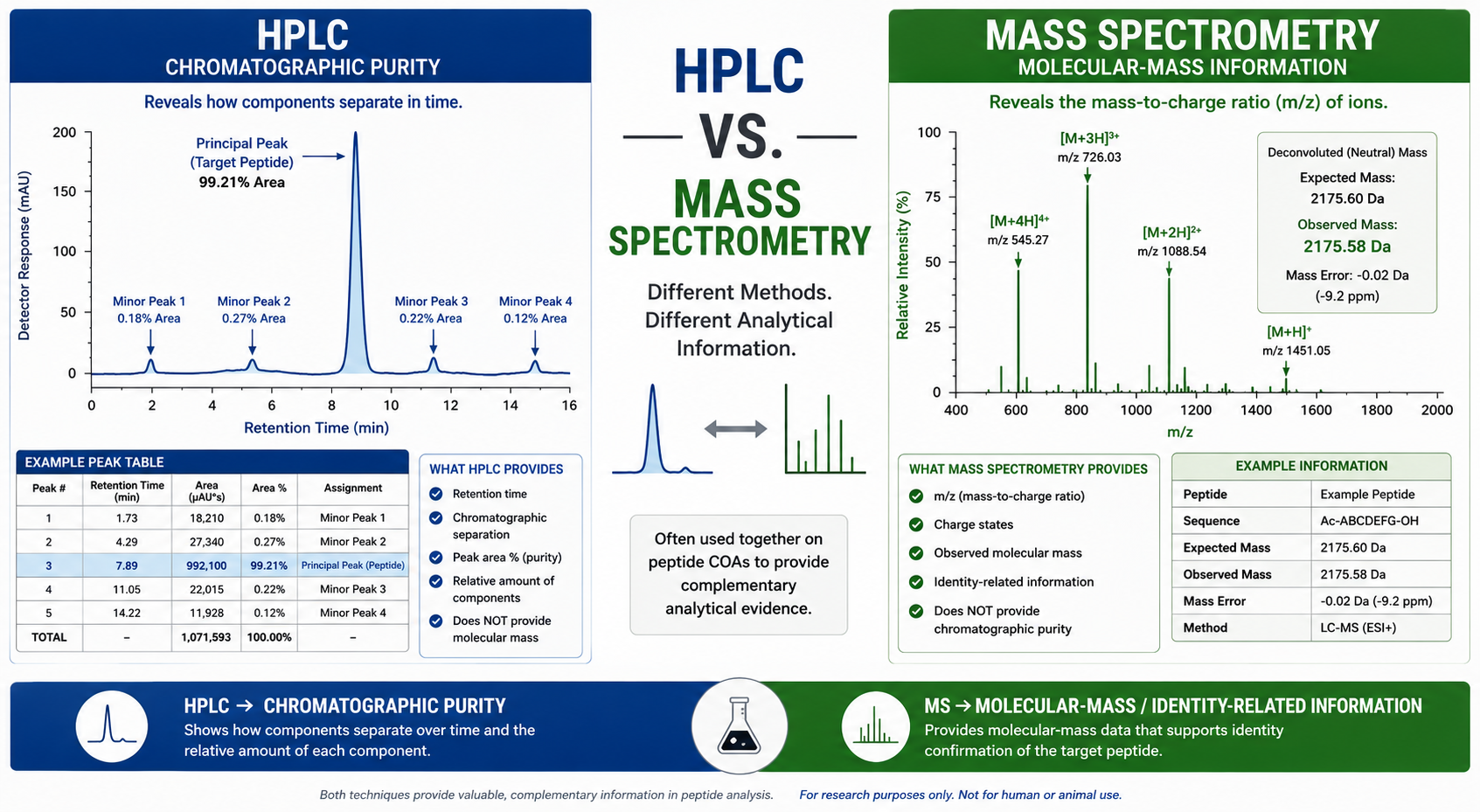
HPLC and mass spectrometry provide different analytical information in peptide research. Learn how HPLC evaluates chromatographic purity, how mass spectrometry provides molecular-mass information, and why both may appear on a peptide Certificate of Analysis.
HPLC vs. Mass Spectrometry for Peptide Analysis
When reviewing a peptide Certificate of Analysis (COA), researchers may encounter two commonly reported analytical techniques:
HPLC and mass spectrometry (MS).
Although these techniques are frequently reported together, they do not provide identical information.
In simplified terms:
HPLC helps evaluate chromatographic separation and relative purity.
Mass spectrometry provides molecular-mass and identity-related information.
Understanding the difference between HPLC and mass spectrometry can help researchers interpret peptide laboratory reports more accurately and avoid treating a single analytical result as evidence for characteristics that were not actually measured.
Research-use notice: This article discusses analytical chemistry and characterization of laboratory research materials only. It does not provide information concerning administration, dosing, reconstitution for administration, clinical use, diagnosis, prevention, treatment, or human or animal use.
What Is HPLC?
HPLC stands for high-performance liquid chromatography.
It is an analytical separation technique.
During HPLC analysis, a sample is introduced into a liquid mobile phase and passes through a chromatographic column containing a stationary phase.
Different components can interact differently with the chromatographic system.
As a result, components may separate and reach the detector at different times.
The resulting detector signals are displayed as an:
HPLC chromatogram
The chromatogram can contain a principal peak and additional minor peaks.
Laboratories can integrate those peaks to evaluate the relative chromatographic composition of the sample.
What Does HPLC Measure in Peptide Analysis?
One common application of HPLC in peptide analysis is evaluating chromatographic purity.
A laboratory report might state:
HPLC Purity: 99.2%
When calculated using relative peak-area normalization, this generally indicates that the principal integrated chromatographic peak accounted for approximately 99.2% of the relevant total integrated peak area under the specified analytical conditions.
HPLC can provide information including:
Retention time
Principal peak
Minor peaks
Peak area
Relative area percentage
Chromatographic separation
Detector response
The resulting information helps researchers evaluate the chromatographic profile of a sample.
What Is Mass Spectrometry?
Mass spectrometry, commonly abbreviated MS, is an analytical technique that measures ions according to their mass-to-charge ratio (m/z).
In simplified terms, the process involves:
Producing ions from molecules in the sample
Separating or analyzing those ions according to mass-to-charge ratio
Detecting the ions
Generating a mass spectrum
The resulting mass spectrum can provide molecular information that can be compared with the expected characteristics of the material being analyzed.
For peptide analysis, mass spectrometry is commonly used to provide evidence related to molecular mass and identity.
What Does Mass Spectrometry Measure?
Mass spectrometry measures the mass-to-charge ratios of detected ions.
A peptide mass spectrum may contain:
m/z values
Multiple charge states
Ion intensity
Molecular-ion information
Deconvoluted molecular mass
The expected molecular mass of a peptide can then be compared with the experimentally observed molecular information.
When the observed result is consistent with the expected molecular mass under the analytical method, it can provide evidence supporting the expected identity.
HPLC vs. Mass Spectrometry: The Main Difference
The simplest distinction is:
HPLC
Mass Spectrometry
Separates sample components
Analyzes ions by mass-to-charge ratio
Produces a chromatogram
Produces a mass spectrum
Reports retention times
Reports m/z values
Can evaluate relative chromatographic purity
Provides molecular-mass information
Shows principal and minor chromatographic peaks
Shows detected ions and charge states
Does not independently establish complete molecular identity
Does not automatically provide HPLC area purity
The techniques answer different analytical questions.
That is why both may appear on the same peptide COA.
Why Are HPLC and Mass Spectrometry Used Together?
Consider two separate research questions.
Question 1: Does the sample contain one dominant chromatographic component?
HPLC can provide useful information.
Question 2: Is the observed molecular mass consistent with the expected peptide?
Mass spectrometry can provide useful information.
Using the two techniques together therefore provides complementary analytical evidence.
One method should not automatically be treated as a replacement for the other.
Example: Why HPLC Alone Doesn’t Tell the Whole Story
Imagine a hypothetical HPLC analysis reports:
Principal Peak Area: 99.3%
This indicates a dominant chromatographic signal under the method used.
But there is another question:
What is the molecular identity of the component associated with that signal?
The fact that a peak accounts for 99.3% of the integrated chromatographic area does not, by itself, establish molecular identity.
An identity-related analytical method provides additional information.
Mass spectrometry can be used to compare experimentally observed molecular information with the expected molecular mass.
This illustrates why purity and identity should remain separate analytical concepts.
Example: Why Mass Spectrometry Alone Doesn’t Tell the Whole Story
Now consider the opposite situation.
A mass spectrum contains molecular information consistent with the expected peptide.
That provides useful identity-related evidence.
However, it does not automatically establish:
99% HPLC chromatographic purity
Mass spectrometry and chromatography provide different measurements.
If chromatographic purity is being claimed, researchers should examine the chromatographic analysis supporting that claim.
What Is a Mass Spectrum?
A mass spectrum is a graphical representation of detected ions.
Typically:
X-axis: mass-to-charge ratio (m/z)
Y-axis: relative ion intensity or abundance
Peptides can carry multiple electrical charges during mass-spectrometric analysis.
As a result, the same peptide molecule may generate several ion signals representing different charge states.
Laboratory software can sometimes use these signals to calculate a deconvoluted molecular mass.
What Is m/z?
The abbreviation:
m/z
means:
mass-to-charge ratio
This is one of the fundamental measurements in mass spectrometry.
For example, an ion with a particular mass carrying multiple charges will appear at a different m/z value than the same molecule carrying a different number of charges.
This is why peptide mass spectra may contain multiple related signals rather than a single peak corresponding directly to the peptide’s intact molecular mass.
What Is a Charge State?
During some mass-spectrometric techniques, peptide molecules can acquire multiple electrical charges.
These are referred to as charge states.
A peptide might produce ions such as:
[M+2H]²⁺
[M+3H]³⁺
[M+4H]⁴⁺
These signals can represent different charged forms associated with the same molecular species.
Analytical software may use the charge-state distribution to calculate an estimate of the neutral molecular mass.
What Is Deconvoluted Mass?
Because peptides can produce multiple charged ions, the raw mass spectrum may contain several m/z signals associated with the same molecule.
Deconvolution is a computational process that uses those signals to produce a simplified representation of molecular mass.
A laboratory report may therefore provide:
Expected Molecular Mass
and
Observed / Deconvoluted Molecular Mass
Researchers can compare these values as part of the analytical interpretation.
Does Matching Molecular Mass Prove Complete Peptide Identity?
Not necessarily.
A molecular-mass match provides important evidence, but molecular mass alone does not necessarily distinguish every possible molecule or structural variant that could share or closely approximate that mass.
The strength of an identity determination depends on:
Analytical method
Mass accuracy
Instrument capabilities
Sample complexity
Resolution
Additional structural information
Other complementary analytical techniques
Researchers should therefore interpret mass-spectrometric results according to the actual method and evidence provided.
HPLC Purity Is Not Molecular Identity
This distinction deserves emphasis.
Suppose an HPLC chromatogram shows:
99.4% principal peak area
That tells researchers something about the chromatographic profile.
It does not automatically tell researchers:
“This peak has exactly the expected molecular structure.”
Additional identity-related analytical evidence is needed to address that question.
For more information, read:
[What Does 99% Peptide Purity Actually Mean?]
Molecular Identity Is Not HPLC Purity
The reverse is also true.
Suppose mass spectrometry produces an observed molecular mass consistent with the expected peptide.
That does not automatically mean:
“The sample is 99% pure by HPLC.”
To make an HPLC purity statement, researchers should examine the actual chromatographic analysis.
What Is LC-MS?
Researchers may also encounter the abbreviation:
LC-MS
LC-MS combines:
Liquid chromatography (LC)
with
Mass spectrometry (MS)
The chromatography portion separates sample components.
The mass spectrometer then provides mass-to-charge information about ions associated with those chromatographic components.
This combination can provide substantially more analytical information than simply looking at a chromatographic peak without corresponding mass information.
Is LC-MS the Same as HPLC?
Not exactly.
Liquid chromatography describes the chromatographic separation, while LC-MS specifically refers to liquid chromatography coupled with mass-spectrometric detection.
An HPLC system may instead use another detector, such as ultraviolet detection.
For example:
HPLC-UV → chromatography with UV detection
LC-MS → liquid chromatography coupled to mass spectrometry
Both involve liquid-phase chromatographic separation, but the detection systems and information generated differ.
HPLC-UV vs. LC-MS
A simplified comparison:
HPLC-UV
LC-MS
Uses UV detector response
Uses mass-spectrometric detection
Produces chromatographic peaks
Produces chromatographic and mass information
Useful for relative chromatographic analysis
Useful for molecular-mass characterization of detected components
Response depends on UV absorbance
Response depends on ionization and MS detection
Does not directly provide m/z
Provides m/z information
Each method has advantages and limitations depending on the analytical objective.
Which Is Better: HPLC or Mass Spectrometry?
This is not usually the most useful question.
The better question is:
What analytical characteristic needs to be measured?
If the objective involves evaluating chromatographic separation and relative peak areas, HPLC can provide relevant information.
If the objective involves obtaining molecular-mass information, mass spectrometry can provide relevant information.
Because these techniques answer different questions, laboratories frequently use them as complementary methods rather than treating one as universally superior.
Can HPLC Detect Peptide Impurities?
HPLC can reveal additional chromatographic peaks when other components are separated and detectable under the method conditions.
However, HPLC should not automatically be assumed to detect every possible impurity.
Detection depends on factors including:
Chromatographic separation
Detector response
Detection wavelength
Concentration
Method selectivity
Sample preparation
Reporting thresholds
Components may also co-elute if the chromatographic method does not adequately separate them.
Can Mass Spectrometry Identify Peptide Impurities?
Mass spectrometry can provide molecular information about detected ions and may assist with characterization of additional components.
However, interpretation depends on the method, instrument, ionization behavior, mass accuracy, sample complexity, and other analytical factors.
The presence of mass-spectrometric analysis should not automatically be interpreted as evidence that every possible impurity has been identified.
What HPLC and Mass Spectrometry Do NOT Automatically Measure
Neither a standard HPLC purity result nor a basic mass-spectrum result should automatically be interpreted as measuring:
Water content
Counterion content
Residual solvents
Elemental impurities
Endotoxin
Sterility
Every possible impurity
Absolute peptide content
These characteristics require appropriate analytical methods when they are part of the testing scope.
HPLC vs. Mass Spectrometry on a Peptide COA
When both HPLC and MS appear on a Certificate of Analysis, researchers can evaluate them separately.
HPLC Section
Look for:
Sample ID
Lot number
Chromatogram
Retention time
Principal peak
Minor peaks
Peak table
Area percentage
Method information
Mass Spectrometry Section
Look for:
Sample ID
Expected molecular mass
Observed molecular information
m/z values
Charge states
Mass spectrum
Deconvoluted mass when provided
Method information
Then confirm that both sections correspond to the same relevant laboratory sample or batch.
Why Sample Identification Matters
Imagine a COA containing:
HPLC Sample ID: ABC-123
but:
MS Sample ID: XYZ-987
That discrepancy should be investigated before assuming both analyses correspond to the same submitted sample.
Researchers should look for consistency among:
Product → Lot → Laboratory Sample → HPLC Data → MS Data → Report
Traceability is an important part of analytical-document review.
HPLC vs. MS vs. Peptide Content
A third distinction is also important:
Neither relative HPLC area purity nor a basic molecular-mass match automatically establishes absolute peptide content.
These three concepts answer different questions:
Measurement
Primary Analytical Question
HPLC Purity
What is the relative chromatographic profile under this method?
Mass Spectrometry
What molecular-mass information is associated with detected ions?
Peptide Content
How much target peptide is present according to the quantitative method?
Researchers should avoid treating these measurements as interchangeable.
How to Evaluate HPLC and Mass Spectrometry Together
When reviewing a laboratory report, consider this sequence:
Step 1 — Verify the Sample
Confirm the product, lot number, and laboratory sample ID.
Step 2 — Review the HPLC Result
Examine the chromatogram, principal peak, minor peaks, and relative area percentage.
Step 3 — Review the MS Result
Examine expected and observed molecular information.
Step 4 — Compare Sample Identifiers
Make sure the analytical records correspond to the appropriate sample.
Step 5 — Check the Methods
Determine which chromatographic and mass-spectrometric techniques were actually performed.
Step 6 — Separate the Conclusions
Do not use the HPLC result to claim information that requires mass spectrometry or vice versa.
Step 7 — Look for Other Tests
Determine whether additional analytical characteristics were evaluated separately.
Common HPLC vs. Mass Spectrometry Misunderstandings
“HPLC and mass spectrometry are basically the same test.”
No. They are different analytical techniques.
“99% HPLC purity proves molecular identity.”
Not by itself.
“A matching mass spectrum proves 99% HPLC purity.”
No. Chromatographic purity requires chromatographic evidence.
“Mass spectrometry tells you exactly how much peptide is present.”
Not automatically. Quantitative analysis requires an appropriately designed quantitative method.
“HPLC detects every possible impurity.”
No analytical method should automatically be assumed to detect every possible component.
“If HPLC and MS are present, no other testing matters.”
Incorrect. Other analytical characteristics require appropriate separate tests.
Frequently Asked Questions About HPLC vs. Mass Spectrometry
What is the difference between HPLC and mass spectrometry?
HPLC separates components chromatographically and can provide relative purity information. Mass spectrometry analyzes ions according to mass-to-charge ratio and can provide molecular-mass information.
Is HPLC or mass spectrometry better for peptide analysis?
Neither is universally better. They answer different analytical questions and may be used together.
Does HPLC confirm peptide identity?
HPLC provides chromatographic information. Molecular identity requires appropriate additional analytical evidence.
Does mass spectrometry measure peptide purity?
Mass spectrometry can provide valuable information about detected molecular species, but it should not automatically be treated as an HPLC area-purity measurement.
Why are HPLC and MS both listed on a peptide COA?
Because they provide complementary analytical information concerning different characteristics of the sample.
What does m/z mean?
m/z means mass-to-charge ratio, a fundamental measurement used in mass spectrometry.
What is LC-MS?
LC-MS combines liquid chromatographic separation with mass-spectrometric detection.
Is LC-MS the same as HPLC-MS?
Terminology can vary depending on the instrumentation and context. Both generally describe liquid chromatographic separation coupled with mass-spectrometric detection, though the exact system and method should be identified from the laboratory documentation.
Understanding HPLC and Mass Spectrometry at First Choice Peptides
At First Choice Peptides, we believe analytical results should be interpreted according to what each laboratory method actually measures.
Researchers evaluating available documentation should consider HPLC and mass-spectrometric results as separate but potentially complementary pieces of analytical information.
Rather than focusing on a single number, examine:
Batch identification
Laboratory information
HPLC chromatogram
HPLC purity result
Mass spectrum
Expected and observed molecular information
Testing dates
Report identifiers
Additional analyses actually performed
Continue learning:
[What Is HPLC Peptide Purity? A Researcher’s Guide]
[How to Read an HPLC Chromatogram for Peptide Research]
[What Does 99% Peptide Purity Actually Mean?]
[Peptide Purity vs. Peptide Content: What’s the Difference?]
[How to Read a Peptide Certificate of Analysis (COA)]
[How to Verify a Peptide COA and Laboratory Test Report]
[Third-Party Peptide Testing: What Researchers Should Look For]
Final Takeaway
The difference between HPLC and mass spectrometry comes down to the analytical question being asked.
HPLC provides information about chromatographic separation and relative detector response.
Mass spectrometry provides information about the mass-to-charge ratios of detected ions and can support molecular-mass and identity-related evaluation.
Neither result should be stretched beyond what the analytical method actually establishes.
When HPLC and mass spectrometry are reported together, researchers can use the two techniques as complementary analytical evidence while still considering the complete laboratory report and any additional testing performed.
Research use only