
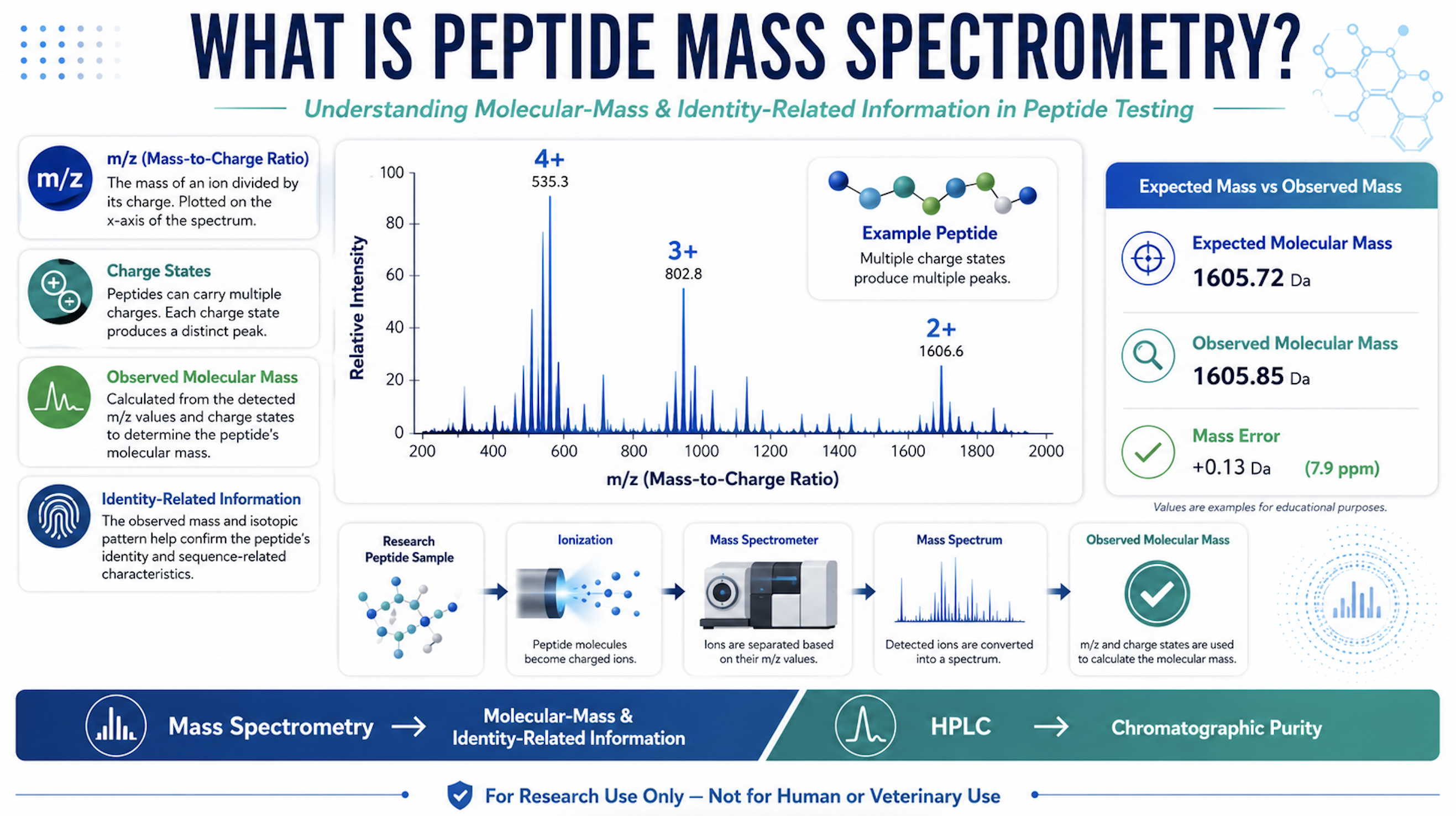
Learn how mass spectrometry is used in peptide testing, including mass-to-charge ratio, molecular mass, charge states, deconvolution, LC-MS, and how researchers interpret mass-spectrometric data on peptide COAs.
What Is Mass Spectrometry in Peptide Testing?
Mass spectrometry (MS) is an analytical technique used to measure ions according to their mass-to-charge ratio, commonly written as m/z.
In peptide research, mass spectrometry can provide valuable molecular information that helps researchers evaluate whether the observed analytical data are consistent with the expected peptide.
A peptide Certificate of Analysis (COA) may include mass-spectrometric information such as:
Expected molecular mass
Observed molecular mass
Mass-to-charge values
Charge states
Mass spectrum
Deconvoluted mass
LC-MS data
Mass error or tolerance
Mass spectrometry is often reported alongside HPLC, but the two techniques answer different analytical questions.
In simplified terms:
HPLC → chromatographic separation and relative purity
Mass spectrometry → molecular-mass and identity-related information
Understanding that distinction is essential when interpreting peptide analytical reports.
Research-use notice: This article discusses analytical chemistry and characterization of laboratory research materials only. It does not provide information or instructions concerning administration, dosing, reconstitution for administration, clinical use, diagnosis, prevention, treatment, or human or veterinary/animal use.
What Does Mass Spectrometry Measure?
Mass spectrometry measures the mass-to-charge ratio of ions.
A molecule must first be converted into an ion before it can be analyzed by a mass spectrometer.
The instrument then separates or distinguishes those ions according to their mass-to-charge characteristics and records their relative signals.
The resulting data are displayed in a:
Mass spectrum
A mass spectrum can provide information about the ions detected in the sample and their corresponding m/z values.
For peptide analysis, these measurements can be compared with the expected molecular characteristics of the peptide being investigated.
What Does m/z Mean?
One of the most important terms in mass spectrometry is:
m/z
This stands for:
Mass-to-charge ratio
The value depends on both:
The mass of the ion
The number of electrical charges carried by the ion
This is particularly important for peptides because peptide molecules can acquire multiple charges during certain forms of mass-spectrometric analysis.
As a result, the same peptide can produce several different m/z signals.
Why Can One Peptide Produce Multiple Mass-Spectrometry Peaks?
A peptide molecule can carry more than one electrical charge.
For example, a peptide might produce ions corresponding conceptually to:
[M+2H]²⁺
[M+3H]³⁺
[M+4H]⁴⁺
These represent different charge states associated with the same molecular species.
Because m/z depends on both molecular mass and charge, each charge state appears at a different position in the mass spectrum.
Researchers should therefore not assume:
One peptide = one MS peak
A single peptide can produce a family of related signals.
What Is a Charge State?
A charge state describes how many electrical charges an ion carries.
For example:
2+ means the ion carries two positive charges.
3+ means the ion carries three positive charges.
4+ means the ion carries four positive charges.
Peptides frequently produce multiple charge states during electrospray ionization.
These signals can then be mathematically processed to estimate the underlying neutral molecular mass.
What Is Molecular Mass?
Molecular mass represents the calculated or measured mass of a molecule based on its chemical composition.
For a peptide, the expected molecular mass can be calculated from:
Amino-acid sequence
Terminal groups
Chemical modifications
Isotopic composition
Other defined structural characteristics
A laboratory can then compare that expected value with experimentally observed mass-spectrometric information.
Expected Mass vs. Observed Mass
A peptide analytical report may contain information such as:
Expected Molecular Mass: 2,175.60 Da
Observed Molecular Mass: 2,175.58 Da
The close agreement between these values may provide evidence that the detected molecular species is consistent with the expected molecular mass.
However, researchers should understand an important limitation:
A matching molecular mass is evidence supporting identity, but molecular mass alone does not necessarily establish complete structural identity.
Additional analytical evidence may be required depending on the research objective.
What Is a Dalton?
Molecular mass in peptide analysis is commonly expressed in:
Daltons (Da)
or sometimes:
kilodaltons (kDa)
One kilodalton equals:
1,000 daltons
Peptides are commonly reported in daltons because their molecular masses fall within a range that is conveniently expressed using these units.
What Is a Mass Spectrum?
A mass spectrum is the graphical output of a mass-spectrometric analysis.
Typically:
X-axis → m/z
Y-axis → relative intensity or abundance
Each vertical signal represents detected ions at a particular mass-to-charge ratio.
A peptide spectrum may contain:
Major ion signals
Multiple charge states
Isotope-related signals
Lower-intensity signals
Background signals
The spectrum should be interpreted together with the analytical method and sample information.
What Does Relative Intensity Mean?
The Y-axis of a mass spectrum commonly represents relative ion intensity.
The most intense detected signal may be assigned:
100% relative intensity
Other signals are then displayed relative to that peak.
This does not mean that the tallest MS peak represents 100% of the physical sample.
Relative ion intensity is a detector-response measurement.
It should not automatically be interpreted as:
Absolute concentration
Absolute peptide content
HPLC purity
Physical mass percentage
These are separate analytical concepts.
What Is Deconvoluted Molecular Mass?
Because peptides can generate multiple charge states, the raw mass spectrum may contain several m/z signals associated with the same molecule.
Software can mathematically process those charge-state signals through a process called:
Deconvolution
The resulting output can provide an estimated neutral molecular mass.
Instead of interpreting several signals such as:
m/z 726
m/z 545
m/z 436
the researcher may see a deconvoluted result such as:
Observed Molecular Mass: 2,175.58 Da
This can make comparison with the expected molecular mass easier.
What Is Mass Error?
Some laboratory reports provide the difference between:
Expected mass
and
Observed mass
This difference may be expressed as:
Daltons
MilliDaltons
Parts per million (ppm)
For example:
Expected Mass: 2,175.60 Da
Observed Mass: 2,175.58 Da
Difference:
-0.02 Da
The acceptable level of mass error depends on the instrument, analytical method, calibration, and research objective.
Researchers should interpret mass accuracy according to the capabilities and specifications of the analytical method used.
Does Matching Molecular Mass Confirm Peptide Identity?
A molecular-mass match can provide strong identity-related evidence, but researchers should avoid overstating what a basic mass measurement proves.
Different molecular species can sometimes:
Have identical nominal masses
Have very similar molecular masses
Contain structural differences not distinguishable by a basic intact-mass measurement
Therefore:
Observed molecular mass consistent with expected mass = identity-supporting evidence
It should not automatically be interpreted as:
Complete structural proof under every analytical circumstance
More detailed structural analysis may require additional techniques.
What Is Tandem Mass Spectrometry?
Researchers may encounter:
MS/MS
or:
Tandem mass spectrometry
In tandem mass spectrometry, selected ions can be fragmented into smaller ions.
The resulting fragment patterns can provide additional structural information.
For peptide analysis, fragment information may support evaluation of the peptide sequence or help characterize particular molecular species.
This provides a different level of analytical information from a basic intact molecular-mass measurement.
Intact Mass vs. MS/MS
These two approaches answer different questions.
AnalysisInformation ProvidedIntact Mass MSMolecular-mass information for the detected intact speciesMS/MSFragment-ion information that can provide additional structural or sequence-related evidence
Researchers should check which type of mass-spectrometric analysis was actually performed rather than assuming all MS reports provide the same information.
What Is Electrospray Ionization?
A common ionization technique used with peptide mass spectrometry is:
Electrospray ionization (ESI)
ESI transfers molecules from a liquid sample into gas-phase ions that can be analyzed by a mass spectrometer.
Peptides frequently acquire multiple charges during this process.
This makes ESI particularly useful for peptide and biomolecular mass analysis.
A report may therefore contain terminology such as:
ESI-MS
or:
LC-ESI-MS
What Is MALDI?
Another technique researchers may encounter is:
MALDI
which stands for:
Matrix-Assisted Laser Desorption/Ionization
MALDI uses a different ionization process from electrospray ionization.
A peptide is combined with a matrix material and exposed to laser energy to generate ions for mass analysis.
MALDI is often paired with time-of-flight mass analysis, producing:
MALDI-TOF MS
Different ionization techniques generate different types of spectra and may be selected according to the analytical objective.
ESI vs. MALDI for Peptide Analysis
A simplified comparison:
ESIMALDIFrequently produces multiply charged peptide ionsFrequently produces predominantly lower-charge ionsEasily coupled with liquid chromatographyCommonly performed from prepared sample spotsOften used in LC-MS workflowsCommonly paired with TOF analyzersProduces charge-state distributionsCan produce simpler charge-state patterns
Neither method is universally “better.”
The appropriate technique depends on the sample and analytical question.
What Is LC-MS?
LC-MS combines:
Liquid Chromatography
with:
Mass Spectrometry
The liquid-chromatography portion separates components of the sample.
The mass spectrometer then provides mass-to-charge information associated with detected components.
Conceptually:
Research Sample
↓
Chromatographic Separation
↓
Individual Chromatographic Components
↓
Mass-Spectrometric Detection
This combination provides information about both:
When a component elutes
and:
What molecular-mass information is associated with it
Why Is LC-MS Useful in Peptide Analysis?
Consider a chromatogram containing:
Principal Peak
and
Several Minor Peaks
HPLC alone may reveal that additional chromatographic components are present.
LC-MS may provide mass-to-charge information associated with those components.
This can help laboratories investigate whether a detected component has molecular characteristics consistent with:
Target peptide
Peptide-related variant
Modified molecular species
Another detectable component
However, interpretation still depends on the analytical method and quality of the data.
Mass Spectrometry vs. HPLC
This distinction is fundamental.
HPLC
HPLC primarily provides information concerning:
Chromatographic separation
Retention time
Principal and minor peaks
Relative peak area
Chromatographic purity
Mass Spectrometry
Mass spectrometry primarily provides information concerning:
m/z
Charge states
Molecular mass
Ion intensity
Identity-related molecular information
They provide complementary analytical evidence.
For a full comparison, read:
[HPLC vs. Mass Spectrometry for Peptide Analysis: What's the Difference?]
Can Mass Spectrometry Determine Peptide Purity?
Mass spectrometry can reveal multiple detected molecular species and provide valuable information about sample composition.
However, a basic mass spectrum should not automatically be interpreted as:
99% HPLC purity
Chromatographic purity and MS ion intensity are not interchangeable measurements.
Ionization efficiencies can differ significantly among different compounds.
One compound may generate a much stronger MS signal than another even when their physical quantities are not proportional to their signal intensities.
Therefore:
MS relative intensity ≠ automatically physical concentration or HPLC purity
Can Mass Spectrometry Measure Peptide Content?
Mass spectrometry can be used quantitatively when an appropriate quantitative method is developed, calibrated, and validated or qualified for that analytical objective.
However, a basic identity-oriented mass spectrum should not automatically be interpreted as an absolute peptide-content measurement.
Quantitative MS may require:
Calibration standards
Internal standards
Defined calibration curves
Appropriate sample preparation
Validated or qualified analytical procedures
Researchers should distinguish between:
Qualitative / identity-related MS
and
Quantitative MS
Can Mass Spectrometry Detect Impurities?
Mass spectrometry can detect additional molecular species when they:
Ionize under the method
Fall within the instrument's detection range
Are present at detectable concentrations
Are not suppressed by other sample components
Produce distinguishable signals
This can help characterize peptide-related variants or additional molecular species.
However:
Mass spectrometry does not automatically detect every possible impurity.
Why Might an Impurity Not Appear in a Mass Spectrum?
Several factors can affect MS detection.
These include:
Poor ionization
Low concentration
Ion suppression
Instrument sensitivity
Mass range
Resolution
Sample preparation
Chromatographic separation
Data-processing thresholds
The absence of a reported mass-spectrometric signal therefore should not automatically be interpreted as proof that a component is completely absent.
What Is Ion Suppression?
Ion suppression occurs when the presence of other components reduces the ionization efficiency of a particular analyte.
This can make a substance produce a weaker MS signal than expected.
Because ionization efficiency varies among compounds, MS signal intensity should not automatically be treated as directly proportional to physical concentration unless the method has been specifically developed for quantitative analysis.
What Is Mass Resolution?
Mass resolution describes an instrument's ability to distinguish ions with similar mass-to-charge ratios.
Higher-resolution instruments can distinguish smaller differences between nearby m/z values.
Resolution can be important when researchers need to distinguish:
Closely related molecular species
Isotopic patterns
Small mass differences
Certain modifications
The instrument's resolution should therefore be considered when interpreting detailed molecular information.
What Is High-Resolution Mass Spectrometry?
Researchers may encounter:
HRMS
or:
High-Resolution Mass Spectrometry
HRMS instruments provide high mass accuracy and resolving power.
This can allow laboratories to distinguish molecular species whose masses differ by relatively small amounts.
High-resolution analysis can provide additional molecular-characterization information compared with lower-resolution measurements.
However, high resolution does not eliminate the need for appropriate interpretation and method design.
What Does Mass Spectrometry Show on a Peptide COA?
A peptide Certificate of Analysis may report:
Expected molecular mass
Observed molecular mass
Mass spectrum
m/z values
Charge states
Deconvoluted mass
Mass error
LC-MS result
Analytical method
Researchers should verify that these data correspond to the same:
Product
Lot
Sample ID
and:
Laboratory report
being evaluated.
How to Read Mass-Spectrometry Data on a Peptide COA
A practical approach is:
Step 1 — Identify the Sample
Confirm:
Product name
Lot number
Laboratory sample number
Step 2 — Find the Expected Molecular Mass
Determine what molecular mass the laboratory expected for the reported material.
Step 3 — Review the Spectrum
Examine the principal m/z signals and charge states.
Step 4 — Find the Observed Mass
Look for a reported intact or deconvoluted molecular mass.
Step 5 — Compare Expected and Observed Values
Determine whether they are consistent within the analytical method's performance.
Step 6 — Check the Analytical Method
Determine whether the report used:
ESI-MS
MALDI-TOF
LC-MS
HRMS
MS/MS
Another technique
Step 7 — Confirm Sample Traceability
Make sure the mass-spectrometric information corresponds with the relevant batch and laboratory report.
Mass Spectrometry Red Flags on a COA
Researchers may want additional information if a report contains:
No sample identifier
No expected molecular mass
No observed molecular information
Unreadable mass spectrum
Cropped spectrum
No testing date
No analytical method
Spectrum with a sample ID that differs from the COA
Identity claim based only on a purity percentage
Mass result that does not correspond with the reported material
Generic spectrum reused for unrelated batches
These observations do not automatically establish that a report is invalid, but they are reasons to seek additional clarification or documentation.
What Mass Spectrometry Does Not Automatically Tell You
A basic peptide MS result should not automatically be interpreted as determining:
HPLC purity
Absolute peptide content
Water content
Counterion content
Residual solvents
Elemental impurities
Endotoxin status
Sterility
Every possible impurity
Complete molecular structure
Those characteristics may require different or additional analytical methods.
Frequently Asked Questions About Peptide Mass Spectrometry
What is mass spectrometry used for in peptide testing?
Mass spectrometry provides mass-to-charge and molecular-mass information that can support characterization and identity-related evaluation of peptide research materials.
What does m/z mean?
m/z means mass-to-charge ratio, the measurement used to position detected ions in a mass spectrum.
Why does one peptide produce several MS peaks?
A peptide can carry multiple charge states, causing the same molecular species to appear at several different m/z values.
What is deconvoluted mass?
Deconvolution mathematically combines information from multiple charge states to estimate the underlying neutral molecular mass.
Does a matching mass prove peptide identity?
It provides important identity-supporting evidence, but molecular mass alone may not establish complete structural identity in every analytical situation.
Can mass spectrometry measure purity?
Mass spectrometry can reveal multiple detected molecular species, but a standard mass spectrum should not automatically be treated as an HPLC area-purity measurement.
What is LC-MS?
LC-MS combines liquid chromatography with mass spectrometry, allowing chromatographic separation to be connected with molecular-mass information.
What is MS/MS?
Tandem mass spectrometry fragments selected ions and analyzes the resulting fragment ions, providing additional structural information.
Is ESI the same as mass spectrometry?
No. ESI is an ionization technique used to produce ions that are then analyzed by a mass spectrometer.
Does mass spectrometry detect every impurity?
No. Detection depends on ionization, concentration, instrument sensitivity, resolution, method conditions, and other analytical factors.
Understanding Mass Spectrometry at First Choice Peptides
At First Choice Peptides, we believe researchers should understand what each analytical result actually represents.
Mass spectrometry can provide valuable molecular information, particularly when considered alongside:
Batch identification
HPLC data
Laboratory report information
Expected molecular mass
Observed molecular mass
Additional testing actually performed
Researchers should evaluate the complete analytical package rather than treating a single mass-spectrum result as evidence for characteristics that were not measured.
Continue learning:
[HPLC vs. Mass Spectrometry for Peptide Analysis: What's the Difference?]
[What Is HPLC Peptide Purity? A Researcher's Guide]
[How to Read an HPLC Chromatogram for Peptide Research]
[What Does 99% Peptide Purity Actually Mean?]
[Common Peptide Impurities: What Analytical Testing Can Detect]
[How to Read a Peptide Certificate of Analysis (COA)]
[How to Verify a Peptide COA and Laboratory Test Report]
Final Takeaway
Mass spectrometry is one of the most informative analytical tools used in peptide characterization, but its results must be interpreted according to the question the method was designed to answer.
For peptide testing, MS can provide information concerning:
Mass-to-charge ratio
Charge states
Observed molecular mass
Expected vs. observed mass
and:
Identity-related molecular characteristics
It does not automatically establish chromatographic purity, absolute peptide content, or analytical characteristics that were not specifically measured.
The most useful approach is therefore to evaluate mass spectrometry together with HPLC, batch-specific documentation, laboratory information, and other appropriate analytical tests.
Research use only