
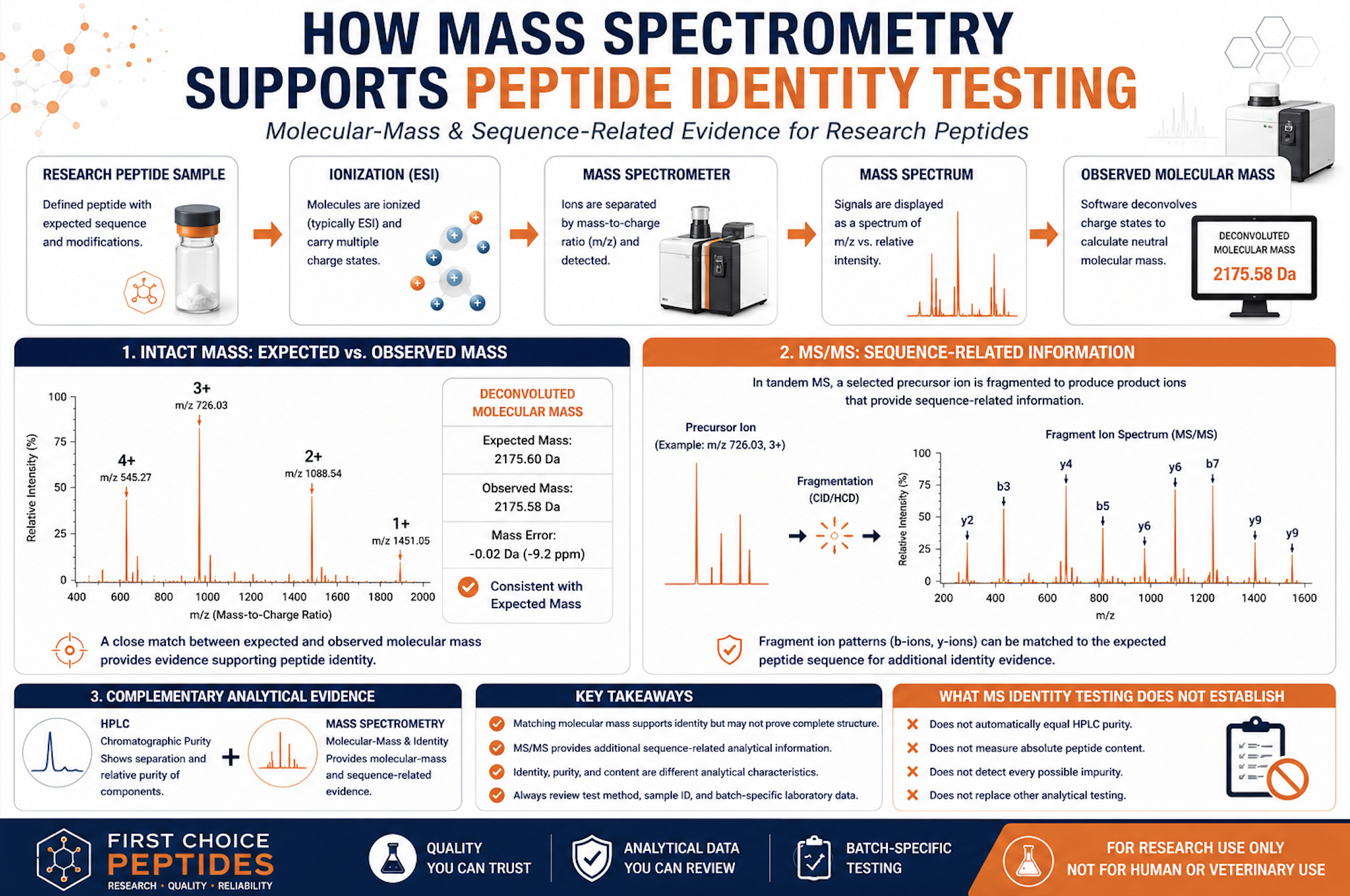
Learn how mass spectrometry supports peptide identity testing by comparing expected and observed molecular mass, evaluating charge states, and using MS/MS fragment data for additional sequence-related analytical information.
How Mass Spectrometry Supports Peptide Identity Testing
Peptide identity testing is an important part of analytical characterization because purity and identity answer different laboratory questions.
A research peptide may produce a chromatogram with one dominant peak, but chromatographic dominance alone does not establish the molecular identity of that component.
Mass spectrometry (MS) provides another form of analytical evidence by measuring ions according to their mass-to-charge ratio (m/z) and allowing experimentally observed molecular information to be compared with expected values. NIST tools for peptide mass analysis, for example, calculate peptide molecular masses and corresponding charged-ion m/z values from sequence information.
In simplified terms:
HPLC asks: How does the sample separate chromatographically?
Mass spectrometry asks: What molecular-mass information is associated with the detected ions?
When interpreted appropriately, mass-spectrometric data can support an analytical conclusion that the detected material is consistent with the expected peptide.
Research-use notice: This article concerns analytical chemistry, laboratory characterization, and research documentation only. The materials discussed are for laboratory research use only and are not for human or veterinary/animal use. This article does not provide instructions concerning administration, dosing, preparation for administration, diagnosis, prevention, treatment, or clinical application.
What Is Peptide Identity Testing?
Peptide identity testing attempts to determine whether analytical evidence is consistent with the expected molecular characteristics of a specified peptide.
Depending on the analytical objective, identity-related evaluation may consider:
Expected molecular mass
Observed molecular mass
Mass-to-charge values
Charge states
Isotopic information
Fragment-ion patterns
Sequence-related MS/MS data
Chromatographic information
Other orthogonal analytical methods
No single measurement should automatically be assumed to provide every possible form of structural information.
Why Purity and Identity Are Different
A common mistake when reading a peptide Certificate of Analysis (COA) is assuming that a high HPLC purity percentage also proves molecular identity.
These are separate measurements.
Consider a hypothetical report showing:
HPLC Purity: 99.2%
This indicates that the principal integrated chromatographic peak accounted for approximately 99.2% of the relevant integrated peak area under the reported method.
The result does not, by itself, answer:
What molecule produced that principal peak?
Identity-related testing provides additional analytical information addressing that question.
How Does Mass Spectrometry Help Evaluate Peptide Identity?
Mass spectrometry converts molecules into ions and measures those ions according to their mass-to-charge ratio.
For a peptide with a defined sequence and chemical form, an expected molecular mass can be calculated.
The laboratory then obtains experimental mass-spectrometric data.
Researchers can compare:
Expected molecular information
with:
Observed molecular information
Agreement within the capabilities of the analytical method can provide evidence that the detected molecular species is consistent with the expected peptide. Peptide mass and m/z relationships for multiple charge states are established features of mass-spectrometric analysis.
Expected Molecular Mass vs. Observed Molecular Mass
A peptide report may contain an example such as:
Expected Molecular Mass: 2,175.60 Da
Observed Molecular Mass: 2,175.58 Da
Difference:
-0.02 Da
The observed result is very close to the expected value.
This provides useful identity-related evidence.
However, the analytical conclusion should still account for factors including:
Instrument mass accuracy
Calibration
Resolution
Sample form
Ionization method
Modifications
Adducts
Counterion considerations where relevant to the reported form
Analytical method
The appropriate tolerance should come from the laboratory method rather than from a universal cutoff.
What Is m/z in Peptide Identity Testing?
Mass spectrometers directly measure mass-to-charge ratio, written:
m/z
Peptides can carry multiple electrical charges during techniques such as electrospray ionization.
As a result, one peptide molecular species can produce several related m/z signals.
For example:
2+ charge state
3+ charge state
4+ charge state
These different signals can all originate from the same molecular species.
Electrospray spectra of peptides commonly contain series of multiply charged ions, and software can use those charge-state series during molecular-mass deconvolution.
Why Multiple Charge States Can Strengthen Interpretation
If several m/z signals correspond mathematically to charge states expected for the same underlying molecular mass, they provide internally related analytical information.
Instead of evaluating only one isolated peak, laboratory software may use an entire charge-state distribution.
For example:
Observed SignalAssigned Chargem/z A4+m/z B3+m/z C2+
These signals may be processed to estimate one underlying molecular mass.
Researchers should rely on the laboratory's actual analytical output rather than attempting to assign charge states solely by visual inspection.
What Is Deconvolution?
Deconvolution is a computational process used to convert multiply charged mass-spectrometric signals into an estimate of the underlying molecular mass.
This is particularly useful with electrospray data because peptides and larger biomolecules can appear as multiple charge states.
Thermo Fisher's intact-mass documentation describes deconvolution as the transformation of multiply charged ion series into molecular-mass information.
A peptide COA may therefore show:
Raw m/z spectrum
followed by:
Deconvoluted observed mass
The deconvoluted value can then be compared with the expected molecular mass.
Does a Matching Molecular Mass Prove Complete Peptide Identity?
Not necessarily.
This is an important limitation.
An intact molecular-mass measurement can show that the experimentally detected mass is consistent with the expected molecular mass.
But different molecular structures can sometimes have the same or very similar masses.
Therefore, a molecular-mass match should be described as:
Evidence supporting molecular identity
rather than automatically:
Complete structural proof
More detailed structural information may require additional analytical approaches.
What Is Tandem Mass Spectrometry?
Tandem mass spectrometry, commonly written:
MS/MS
provides another level of molecular information.
In MS/MS analysis, a selected precursor ion is isolated and fragmented. The resulting fragment ions are then measured.
Fragment-ion patterns can contain sequence-related information because peptide-bond fragmentation can produce characteristic series of ions. Tandem mass spectrometry is widely used for peptide identification, and peptide fragment spectra can be compared with expected or reference patterns.
Intact Mass vs. MS/MS
These methods provide different levels of analytical information.
Analytical ApproachPrimary InformationIntact Mass MSObserved molecular-mass informationMS/MSFragment-ion and sequence-related informationHPLCChromatographic separation and relative purity
This distinction matters.
A laboratory report stating:
Mass consistent with expected peptide
does not necessarily mean that a full MS/MS sequence analysis was performed.
Researchers should determine which test actually appears on the report.
How Does MS/MS Provide Sequence-Related Information?
During tandem MS, fragmentation can occur along the peptide backbone.
This creates families of fragment ions.
By evaluating the masses of those fragments, analytical software can compare the experimental spectrum with expected peptide-fragment information.
Official mass-spectrometry software documentation describes peptide fragment-ion spectra as sequence-specific information produced through peptide-bond cleavage.
The resulting evidence can provide more detailed structural information than intact molecular mass alone.
What Are b-Ions and y-Ions?
Researchers reviewing peptide MS/MS reports may encounter terms such as:
b-ions
and:
y-ions
These refer to common classes of peptide fragment ions generated through peptide-backbone fragmentation.
A series of detected fragments can provide information related to the amino-acid sequence.
Research comparing high-accuracy tandem spectra has demonstrated the use of matching b- and y-ion series to support peptide identification.
Researchers do not need to assume that every COA includes this level of analysis.
If MS/MS sequencing was performed, it should be identifiable from the laboratory documentation.
What Is a Precursor Ion?
In MS/MS analysis, the ion selected for additional fragmentation is commonly called the:
Precursor ion
The instrument isolates a selected ion and subjects it to a fragmentation process.
The resulting ions are:
Product ions
or:
Fragment ions
Those fragment ions are then measured to create the tandem mass spectrum.
This enables the laboratory to obtain molecular information beyond the intact precursor mass.
What Is Mass Accuracy?
Mass accuracy describes how closely an experimentally measured mass corresponds to an expected or reference value.
It may be reported using units such as:
Daltons (Da)
or:
parts per million (ppm)
The meaning of a particular error value depends on:
Instrument type
Calibration
Resolution
Analytical method
Data-processing approach
Researchers should therefore interpret mass accuracy using the method specifications provided by the laboratory.
What Is High-Resolution Mass Spectrometry?
High-resolution mass spectrometry (HRMS) can distinguish ions having relatively small differences in mass-to-charge ratio.
Greater resolving power and mass accuracy can provide more detailed molecular information when closely spaced signals must be distinguished.
However:
Higher resolution does not eliminate the need for appropriate analytical interpretation.
The method and research objective still determine what conclusions are supported by the data.
Why Is Chromatography Often Combined With Mass Spectrometry?
Researchers frequently encounter:
LC-MS
or:
LC-MS/MS
These methods combine liquid chromatographic separation with mass-spectrometric detection.
The workflow can be conceptualized as:
Research Sample
↓
Chromatographic Separation
↓
Detected Component
↓
Mass-Spectrometric Analysis
This allows molecular-mass information to be associated with chromatographically separated components.
LC-MS/MS is extensively used in peptide analysis because chromatographic separation and tandem-MS molecular information can be combined in one analytical workflow.
Why HPLC and MS Provide Complementary Evidence
Consider a hypothetical analytical package.
HPLC Result
Principal chromatographic peak: 99.3% area
This provides chromatographic information.
Mass Spectrometry Result
Observed molecular mass consistent with expected molecular mass
This provides identity-related molecular information.
Together, these results address two different questions:
How dominant is the principal chromatographic component?
and:
Is the observed molecular mass consistent with the expected material?
Neither result should be stretched beyond the analytical characteristic it actually measures.
Why Identity Testing Should Be Batch-Specific
Analytical identity data are most useful when they can be connected to the actual research batch being documented.
Researchers should be able to follow a traceability chain:
Research Material
↓
Lot Number
↓
Laboratory Sample ID
↓
Mass-Spectrometry Analysis
↓
Laboratory Report
The mass-spectrum data should correspond to the relevant sample and report.
A spectrum from another batch should not automatically be assumed to characterize a different batch.
What Should Researchers Look for on a Peptide Identity Report?
When reviewing mass-spectrometric identity documentation, consider whether the report includes:
Material name
Lot or batch number
Laboratory sample ID
Laboratory report number
Analysis date
Analytical method
Expected molecular mass
Observed molecular information
Mass spectrum
Charge-state information when applicable
Deconvoluted mass when applicable
MS/MS information if sequence-related analysis was performed
The exact format varies among laboratories.
The key objective is traceability and clarity about what testing was actually performed.
Does HPLC Purity Confirm Peptide Identity?
No—not by itself.
HPLC and mass spectrometry answer different analytical questions.
HPLC can provide:
Retention time
Chromatographic separation
Principal and minor peaks
Relative peak area
Chromatographic purity
Mass spectrometry can provide:
m/z values
Charge states
Molecular-mass information
Identity-related evidence
Fragment-ion information when MS/MS is performed
For a detailed comparison, see:
[HPLC vs. Mass Spectrometry for Peptide Analysis]
Does Mass Spectrometry Confirm HPLC Purity?
No.
The reverse is also true.
A mass spectrum containing molecular information consistent with the expected peptide does not automatically establish:
99% HPLC chromatographic purity
A chromatographic purity claim should be supported by the corresponding chromatographic analysis.
Does Mass Spectrometry Establish Peptide Content?
Not automatically.
A standard identity-oriented mass spectrum is not necessarily a quantitative assay.
Quantitative mass spectrometry requires an analytical method specifically designed for quantitative measurement, potentially including standards, calibration procedures, and other method controls.
Therefore:
Identity-related MS ≠ automatically peptide-content testing
Does Mass Spectrometry Detect Every Impurity?
No.
A molecular species must be detectable under the analytical method to produce useful mass-spectrometric information.
Detection can be influenced by:
Ionization efficiency
Concentration
Ion suppression
Instrument sensitivity
Resolution
Sample preparation
Mass range
Data processing
The absence of a reported ion should therefore not automatically be interpreted as proof that every possible other component is absent.
Peptide Identity Testing vs. Purity vs. Content
These three terms should remain distinct.
Analytical CharacteristicQuestionIdentityIs the observed molecular evidence consistent with the expected material?PurityWhat is the relative chromatographic profile under the reported method?ContentHow much target analyte is present according to a quantitative method?
A complete analytical package may contain information addressing more than one of these questions.
But one result should not automatically be substituted for another.
Common Peptide Identity-Testing Misunderstandings
“99% HPLC purity proves identity.”
No. HPLC purity and molecular identity are separate analytical characteristics.
“If the molecular mass matches, every structural feature has been proven.”
Not necessarily. Intact mass provides important molecular-mass evidence but may not establish complete structural identity in every circumstance.
“All mass spectrometry includes peptide sequencing.”
No. Intact-mass MS and tandem MS/MS provide different levels of information.
“A mass spectrum tells you how much peptide is present.”
Not automatically. Quantitative analysis requires an appropriately designed quantitative method.
“Mass spectrometry detects every possible impurity.”
No. Detection depends on the analytical method and characteristics of the component.
“One COA can automatically represent every batch.”
No. Analytical documentation should be evaluated for batch and sample traceability.
Frequently Asked Questions About Peptide Identity Testing
How is peptide identity tested using mass spectrometry?
Mass-spectrometric data can be compared with expected molecular-mass and m/z information. When additional structural information is required, tandem MS may provide fragment-ion data related to peptide sequence.
Is molecular mass the same as peptide identity?
Molecular mass is an important identity-related characteristic, but a mass match alone does not necessarily establish complete molecular structure.
What is the difference between intact mass and MS/MS?
Intact mass analysis evaluates molecular-mass information associated with the whole detected molecular species. MS/MS fragments selected ions and provides additional fragment-ion and sequence-related information.
Can HPLC identify a peptide?
HPLC provides chromatographic information. Molecular identity should be evaluated using appropriate identity-related analytical evidence.
Why are HPLC and mass spectrometry often reported together?
They provide complementary analytical information: HPLC addresses chromatographic separation and relative purity, while mass spectrometry provides molecular-mass and identity-related information.
Does matching expected and observed mass prove 100% identity?
No. It provides evidence consistent with the expected molecular mass. The strength of the identity conclusion depends on the analytical method and the amount of structural evidence available.
What does MS/MS add to peptide identity testing?
MS/MS provides fragment-ion information that can support sequence-related identification beyond an intact molecular-mass measurement. Tandem-MS peptide identification commonly relies on relationships between experimental fragment spectra and expected peptide fragments.
Understanding Peptide Identity Testing at First Choice Peptides
At First Choice Peptides, analytical documentation should be evaluated according to what each laboratory method actually measures.
Researchers reviewing available batch documentation should distinguish among:
Identity
Chromatographic purity
Content
and:
Other separately measured analytical characteristics
Mass spectrometry provides molecular information that can support peptide identity evaluation, particularly when interpreted together with the complete laboratory report and complementary analytical data.
Continue learning:
[What Is Mass Spectrometry in Peptide Testing? A Researcher's Guide]
[HPLC vs. Mass Spectrometry for Peptide Analysis]
[What Is HPLC Peptide Purity? A Researcher's Guide]
[How to Read an HPLC Chromatogram for Peptide Research]
[What Does 99% Peptide Purity Actually Mean?]
[Common Peptide Impurities: What Analytical Testing Can Detect]
[How to Read a Peptide Certificate of Analysis (COA)]
[How to Verify a Peptide COA and Laboratory Test Report]
Final Takeaway
Mass spectrometry supports peptide identity testing by providing experimentally measured molecular information that can be compared with the expected characteristics of a research material.
An intact-mass result can provide evidence that the observed molecular mass is consistent with the expected value.
When additional structural information is needed, tandem mass spectrometry (MS/MS) can provide fragment-ion information related to peptide sequence.
Most importantly:
Identity is not the same as purity.
Purity is not the same as content.
And no single analytical test should be described as proving characteristics that it was not designed to measure.
Researchers should interpret peptide identity data using the complete, batch-specific laboratory documentation and the scope of testing actually performed.
Research use only