
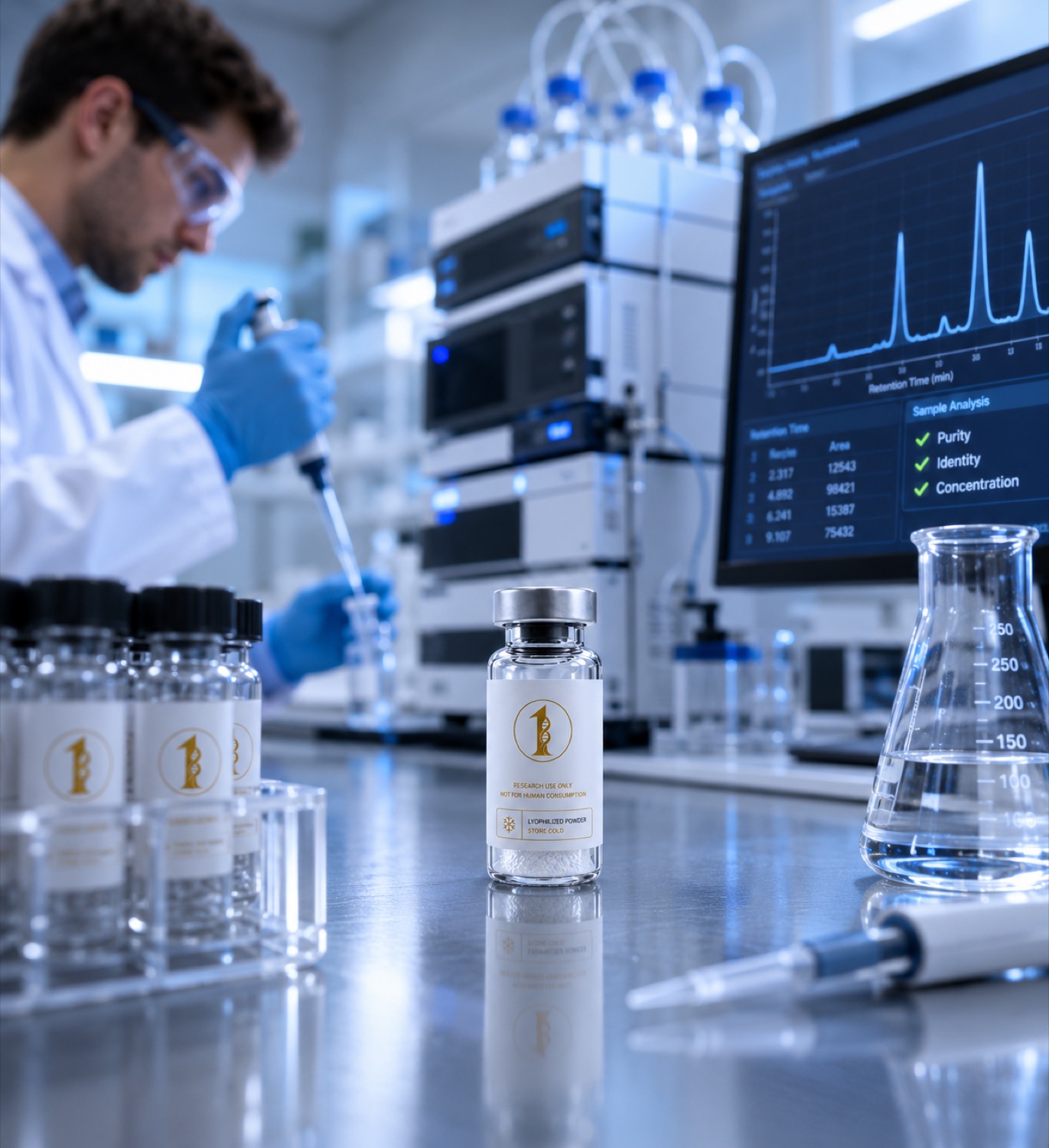
What does third-party peptide testing actually mean? Learn how researchers can evaluate independent laboratory testing, HPLC purity, mass spectrometry, batch-specific COAs, laboratory accreditation, and analytical documentation.
Third-Party Peptide Testing: What Researchers Should Look For
Third-party peptide testing refers to analytical testing performed by a laboratory or testing organization that is separate from the supplier of the research material.
Independent testing can provide an additional layer of analytical documentation, but the phrase “third-party tested” should not be treated as a complete quality assessment by itself.
For researchers, more useful questions are:
Which laboratory performed the testing?
Which batch was tested?
Which analytical methods were used?
What did those methods actually measure?
Can the laboratory report be traced to the material being evaluated?
This guide explains what researchers should look for when evaluating third-party laboratory testing and peptide Certificates of Analysis (COAs).
Research-use notice: This article discusses analytical testing and documentation for laboratory research materials only. It does not provide information or instructions concerning administration, dosing, reconstitution for administration, clinical use, diagnosis, prevention, treatment, or human or animal use.
What Is Third-Party Peptide Testing?
Third-party testing generally means that analytical testing is performed by an organization independent of the supplier whose material is being evaluated.
For example:
Supplier → Research material → Independent laboratory → Analytical report
The laboratory receives a sample and performs one or more analytical tests according to the requested scope of work.
Depending on the testing requested, the laboratory may evaluate characteristics such as:
Chromatographic purity
Molecular identity
Water or moisture content
Counterion content
Residual solvents
Endotoxin
Selected elemental impurities
Other specified analytical characteristics
The resulting documentation may be provided as a Certificate of Analysis, laboratory report, analytical report, or test certificate.
The important point is that third-party testing describes who performed the testing.
It does not, by itself, describe what was tested or how thoroughly it was tested.
Why Does Independent Laboratory Testing Matter?
Independent analytical testing separates the organization performing the analysis from the organization supplying the research material.
That separation can provide additional confidence in the independence of the reported analytical results.
However, independence alone does not determine the scientific quality of a test.
Researchers should still examine:
Laboratory identity
Sample identification
Batch or lot number
Analytical method
Testing date
Report number
Specifications
Numerical results
Underlying analytical data
Laboratory accreditation when relevant
A third-party report is most useful when these elements create a clear and traceable analytical record.
“Third-Party Tested” Is Not a Test Method
This is one of the most important concepts to understand.
Third-party testing is not an analytical method.
It simply describes the relationship between the supplier and testing organization.
For example, these statements provide very different levels of information:
“Third-party tested.”
versus:
“This batch was analyzed by an independent laboratory using HPLC and mass spectrometry, with the batch-specific analytical report available for review.”
The second statement provides significantly more information because it identifies the type of analytical testing and connects the analysis to a particular batch.
Researchers should look beyond the phrase third-party tested and examine the actual laboratory documentation.
What Tests May Be Included in Third-Party Peptide Testing?
There is no single standardized package of tests automatically included whenever a material is described as third-party tested.
The scope depends on what testing was requested and performed.
Several analytical methods may appear on peptide laboratory reports.
HPLC Purity Testing
High-performance liquid chromatography (HPLC) is commonly used to separate and evaluate components in a sample.
A laboratory may report:
HPLC Purity: 99.2%
This commonly represents the relative chromatographic area associated with the principal integrated peak under the laboratory’s analytical conditions.
Researchers should understand that:
HPLC purity is not automatically the same as absolute peptide content.
A high relative HPLC area percentage also does not independently establish molecular identity.
Researchers reviewing HPLC data may look for:
Chromatogram
Principal peak
Minor peaks
Retention times
Peak table
Area percentages
Detection wavelength
Sample identification
Analytical method information
For more detail, see:
[Peptide Purity vs. Peptide Content: What’s the Difference?]
Mass Spectrometry for Peptide Identity
Mass spectrometry (MS) provides molecular information based on the mass-to-charge ratio of detected ions.
A peptide laboratory report may include:
Expected molecular mass
Observed molecular mass
Mass-to-charge values
Charge states
Deconvoluted mass
Mass spectrum
LC-MS data
Agreement between expected and observed molecular information can provide evidence consistent with the expected identity.
Mass spectrometry and HPLC answer different analytical questions.
In simplified terms:
HPLC → chromatographic separation and relative purity
Mass spectrometry → molecular-mass and identity-related information
This is why researchers should not automatically treat a purity percentage as proof of identity.
Why HPLC and Mass Spectrometry Are Often Used Together
Consider two questions:
Question 1: Is there one dominant chromatographic component?
HPLC can provide relevant information.
Question 2: Is the molecular mass consistent with the expected peptide?
Mass spectrometry can provide relevant information.
Using complementary analytical methods provides more information than either measurement alone.
This does not mean that HPLC plus mass spectrometry establishes every possible quality characteristic.
It means the methods address different analytical questions.
What Is Batch-Specific Peptide Testing?
Batch-specific testing means the analytical documentation can be connected to a particular batch or lot of material.
This is important because analytical testing is performed on a specific submitted sample.
A useful traceability chain looks like:
Research material → Lot number → Laboratory sample → Report number → Analytical results
Researchers should compare the lot or batch number associated with the research material with the identifier shown on the laboratory report.
If they do not correspond, the report should not automatically be assumed to represent that batch.
Why a Generic COA Provides Less Information
Suppose a supplier displays a Certificate of Analysis that says:
Product: Research Peptide X
Purity: >99%
but provides:
No lot number
No laboratory name
No sample identifier
No report number
No analysis date
There is limited information connecting that certificate to a particular batch or laboratory analysis.
By comparison, a report containing:
Product → Lot → Laboratory → Sample ID → Report Number → Date → Method → Result
provides substantially greater analytical traceability.
What Should Be on a Third-Party Laboratory Report?
A useful third-party laboratory report may contain:
Name of the material
Lot or batch number
Laboratory sample ID
Laboratory report number
Laboratory name
Testing date
Report date
Analytical method
Specification, when applicable
Numerical result
Units
Supporting chromatogram or spectrum when provided
Authorized laboratory approval
Not every laboratory uses the same report format.
The important question is whether enough information is present to understand and trace the analysis.
How Can Researchers Verify the Testing Laboratory?
When reviewing independent laboratory testing, researchers can determine whether the laboratory itself is identifiable.
Consider checking:
Does the laboratory have an official website?
Does its business information correspond with the report?
Does it publicly describe relevant analytical capabilities?
Does it provide report verification?
Is the report number traceable?
Does it identify an accreditation body when claiming accreditation?
Can its accreditation scope be reviewed?
Researchers should obtain verification information from the laboratory’s official source when possible.
A laboratory logo copied onto a PDF does not independently establish authenticity.
What Does ISO/IEC 17025 Mean?
Researchers may encounter laboratories describing themselves as ISO/IEC 17025 accredited.
ISO/IEC 17025 is an international standard concerning the competence of testing and calibration laboratories.
Accreditation can provide information about a laboratory’s management system and technical competence.
However, there is an important qualification:
Accreditation applies to a defined scope.
A laboratory may offer many tests while only certain methods or activities are included within its accredited scope.
Therefore, researchers should not assume:
“ISO/IEC 17025 laboratory = every test it performs is accredited.”
Instead, examine the laboratory’s current accreditation certificate and scope of accreditation when this distinction matters.
How to Check a Laboratory’s Accreditation
When a laboratory claims accreditation, researchers can look for:
Accreditation body’s name
Accreditation certificate number
Laboratory location
Effective dates
Scope of accreditation
Applicable methods or testing areas
The International Laboratory Accreditation Cooperation (ILAC) maintains information concerning accreditation bodies participating in international recognition arrangements.
Researchers can use the relevant accreditation body’s official directory to investigate the laboratory’s current status and scope.
Does Third-Party Testing Mean Every Batch Was Tested?
Not necessarily.
The phrase third-party tested does not by itself indicate:
Which batch was tested
How frequently testing occurs
Whether every batch is tested
Which tests were performed
Whether the report corresponds to currently available material
This is why batch-specific analytical documentation is important.
If a supplier states that every batch receives particular testing, researchers should be able to examine documentation associated with the applicable batch.
Does Third-Party Testing Prove Purity?
Third-party testing can produce a purity measurement if an appropriate purity test was actually performed.
However:
The words “third-party tested” do not themselves establish a purity result.
Researchers should examine the laboratory report to determine:
Whether purity was measured
Which method was used
What result was reported
Which sample was analyzed
Which batch the sample represents
The actual analytical result matters more than the marketing phrase.
Does Third-Party Testing Prove Identity?
Again, it depends on what testing was performed.
If an independent laboratory performed an appropriate identity analysis, the report may provide evidence concerning molecular identity.
If the laboratory performed only HPLC purity analysis, researchers should not assume that molecular identity was independently established.
The scope of the report determines what conclusions can reasonably be drawn.
What About Endotoxin Testing?
Endotoxin analysis is separate from HPLC purity and mass spectrometry.
A high HPLC purity result does not establish endotoxin status.
Likewise, molecular identity data from mass spectrometry does not provide an endotoxin result.
When endotoxin analysis is part of a research protocol, researchers should look for an actual endotoxin test and its reported result.
The same principle applies to other analytical characteristics:
Do not infer a test result from an unrelated analytical method.
Third-Party Testing vs. In-House Testing
Both third-party and in-house laboratories can generate useful analytical data.
The key difference concerns organizational independence.
Third-Party Testing
Testing is performed by an independent laboratory separate from the supplier.
In-House Testing
Testing is performed within the supplier’s or manufacturer’s own laboratory organization.
Third-party testing provides greater organizational separation between the supplier and analytical laboratory.
However, researchers should still evaluate the scientific quality and traceability of either type of testing based on the methods, laboratory competence, sample identification, and documentation.
What Makes a Strong Third-Party Peptide COA?
A strong analytical report generally allows a researcher to answer:
WHAT was tested?
The material is clearly identified.
WHICH BATCH was tested?
A lot or batch number is present.
WHO tested it?
The laboratory is identifiable.
WHEN was it tested?
Relevant dates are available.
HOW was it tested?
Analytical methods are identified.
WHAT were the results?
Numerical findings are reported.
CAN the report be traced?
A sample or report identifier connects the documentation to the laboratory.
This approach provides considerably more information than a standalone statement such as “lab tested.”
Third-Party Peptide Testing Red Flags
Researchers may want additional information when they encounter:
No laboratory identified
No lot or batch number
No laboratory report number
No sample ID
No testing date
No analytical method
Purity claims without corresponding laboratory results
Identity claims without identity testing
Claims for tests absent from the report
Cropped chromatograms
Unreadable analytical data
Conflicting sample numbers
Generic COAs reused for multiple batches
Accreditation claims that cannot be independently confirmed
QR codes leading to unrelated websites
Marketing graphics presented in place of laboratory reports
None of these items alone necessarily establishes that analytical data is invalid, but they are reasonable reasons to seek additional documentation.
Questions Researchers Can Ask About Third-Party Testing
When evaluating analytical documentation, consider these questions:
Which laboratory performed the testing?
Is the laboratory independent of the supplier?
Which batch was tested?
Does the COA lot number correspond to the research material?
Which analytical methods were performed?
Was chromatographic purity evaluated?
Was molecular identity evaluated separately?
Are the underlying chromatograms or spectra available?
Is there a unique laboratory report number?
When was the sample tested?
Can the laboratory or report be independently verified?
If accreditation is claimed, does the relevant test fall within the laboratory’s accredited scope?
These questions focus on evidence and traceability rather than marketing terminology.
How to Verify a Third-Party Peptide COA
A practical verification process can follow this sequence:
Step 1 — Match the Product
Confirm that the material identified on the report corresponds with the research material.
Step 2 — Match the Lot
Compare the lot number on the COA with the batch being evaluated.
Step 3 — Identify the Laboratory
Confirm the laboratory is a real, identifiable testing organization.
Step 4 — Check the Report Number
Look for a unique laboratory report or sample identifier.
Step 5 — Review the Tests
Determine exactly which analytical methods were performed.
Step 6 — Examine the Results
Review numerical results, chromatograms, spectra, specifications, and reporting limits where available.
Step 7 — Check Internal Consistency
Make sure sample numbers, dates, product information, and report identifiers correspond throughout the documentation.
Step 8 — Verify Independently When Available
Use the laboratory’s official verification system or contact information when report verification is offered.
For a more detailed walkthrough, see:
[How to Verify a Peptide COA and Laboratory Test Report]
Frequently Asked Questions About Third-Party Peptide Testing
What is third-party peptide testing?
Third-party peptide testing generally means that analytical testing is performed by a laboratory or testing organization independent of the supplier.
Is third-party testing the same as HPLC?
No. Third-party describes who performed the analysis. HPLC is a specific analytical technique.
Does third-party tested mean every batch was tested?
Not necessarily. Researchers should examine batch-specific documentation to determine which material was actually analyzed.
What tests should appear on a peptide COA?
The appropriate tests depend on the research material and analytical objective. Common analytical documentation may include HPLC and mass spectrometry, while additional characteristics require separate tests.
Should the COA show the testing laboratory?
An identifiable laboratory provides greater traceability than an anonymous analytical claim.
What is batch-specific testing?
Batch-specific testing connects analytical results to a particular lot or batch rather than relying on generic documentation.
Does HPLC verify peptide identity?
HPLC can provide valuable chromatographic information, but an HPLC purity percentage alone should not automatically be treated as molecular identity confirmation.
Is ISO/IEC 17025 accreditation important?
It can provide useful evidence concerning laboratory competence. Researchers should also review the laboratory’s applicable accreditation scope rather than assuming every test offered is covered.
Third-Party Analytical Documentation at First Choice Peptides
At First Choice Peptides, our approach to analytical transparency is centered on providing researchers with access to available batch-related laboratory documentation.
Researchers should evaluate the complete analytical record rather than relying solely on a headline purity percentage or the phrase “third-party tested.”
When reviewing available documentation, consider:
Batch identification
Laboratory identification
HPLC results
Mass spectrometry data
Testing dates
Report identifiers
Additional analyses actually performed
For more research education, continue with:
[What Is a Certificate of Analysis (COA) for Research Peptides?]
[How to Read a Peptide Certificate of Analysis (COA)]
[How to Verify a Peptide COA and Laboratory Test Report]
[Peptide Purity vs. Peptide Content: What’s the Difference?]
[Certificate of Analysis Library]
[Quality & Testing]
Final Takeaway
Third-party peptide testing is valuable because it separates the testing organization from the supplier—but independence alone does not tell researchers what was actually tested.
A more useful evaluation asks:
Which laboratory?
Which batch?
Which analytical method?
Which result?
Which report?
Can the documentation be traced and verified?
A statement such as “third-party tested” provides only the beginning of that information.
The underlying laboratory report provides the analytical details researchers need to understand what testing was actually performed.
Research use only