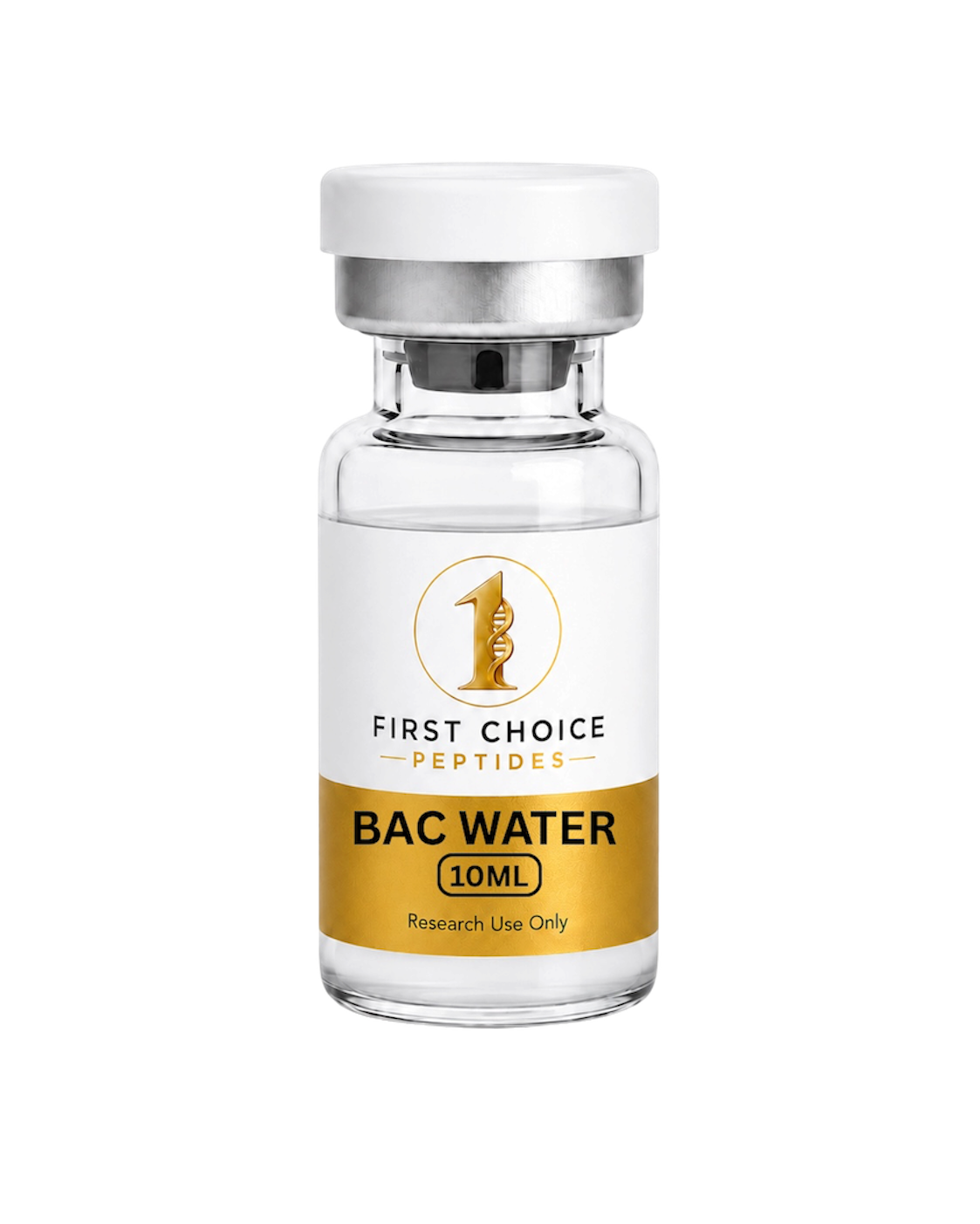

Bacteriostatic water is sterile water containing 0.9% benzyl alcohol as a bacteriostatic preservative, supplied as a laboratory diluent. Research use only.
What bacteriostatic water is
Bacteriostatic water is a sterile aqueous solution containing a bacteriostatic preservative, commonly benzyl alcohol at 0.9 percent, supplied for controlled laboratory and research applications. It is not a compound in the sense that the rest of this catalogue uses the word. It is a prepared solution with two components, and its purpose is not to be studied but to dissolve something else. The catalogue stocks it in 10 mL and 30 mL presentations, and it appears in the catalogue as BAC WATER.
The difference between this material and plain sterile water is entirely the preservative. Sterile water carries nothing that inhibits microbial growth, so once its container has been opened and entered, any organism introduced at that moment can multiply in it. The benzyl alcohol in a bacteriostatic preparation is bacteriostatic rather than bactericidal, meaning it suppresses the multiplication of bacteria introduced during handling rather than sterilising the contents on contact. That property is what makes a container suitable for more than one withdrawal, and it is the reason this diluent, rather than plain sterile water, is the one normally stocked alongside lyophilized research materials that will be drawn on across several sessions.
The exact composition and the sterility claims that apply to any given lot are those stated on the manufacturer's labelling and certificate documentation, and the labelling on the container supplied is the controlling record rather than this page. Bacteriostatic water is supplied strictly for laboratory research use. It is not for human or veterinary use, and it is not for consumption, administration, diagnostic use or therapeutic use.
Structure and identifiers
Because this item is a solution of two components rather than a single molecular entity, no CAS registry number, molecular formula or molecular weight is catalogued for it, and no such value is stated here. Its identity is a composition rather than a structure.
The bulk of that composition is water prepared to a sterile standard. The second component, benzyl alcohol, is a simple aromatic alcohol present at a nominal 0.9 percent, and it is present for one function only, namely to inhibit bacterial growth in a container that will be entered more than once. Two consequences follow from having an organic co-solvent in the diluent. First, the resulting solution is not pure water, so any calculation, spectroscopic measurement or chromatographic method that assumes a purely aqueous matrix has an additional component to account for. Second, the preservative is not inert toward every material it might be used with, and compatibility with a given peptide or protein is a property of that material rather than of the diluent. Where compatibility is unknown, or where the downstream analysis is sensitive to organic content, plain sterile water or a defined buffer is the usual alternative, at the cost of the multi-withdrawal handling that the preservative permits.
The catalogue records no synonyms for this item beyond the abbreviated catalogue name and the plain description of its composition.
What the published literature has examined
There is no bibliographic reference set on this page, and none is invented. The published record relevant to a preserved diluent is largely pharmacopoeial and regulatory rather than experimental: it consists of compendial monographs defining composition and preservative content, and of preservative-effectiveness test methodology, which is standards work rather than a research literature about a compound. The catalogue lists this item as a laboratory research material only, and nothing on this page should be read as a claim about what the solution does in any living system.
Where this material appears in published methods sections, it appears as an incidental reagent, that is, as the stated diluent used to prepare a solution of something else. That is the correct way to regard it in a laboratory record as well: the diluent, its concentration of preservative and the volume used are part of the description of how a preparation was made, and they belong in the notebook entry for that preparation.
Storage and handling as a laboratory reagent
Unopened containers are held at controlled room temperature, protected from light and from freezing, in accordance with the manufacturer's labelling. Refrigeration is not required for the sealed container, and freezing is avoided.
The handling that distinguishes this material from other reagents concerns the multi-withdrawal container. The elastomeric closure is designed to be entered more than once, and standard practice on each entry is to wipe the closure with an alcohol swab and allow it to dry, to use a fresh sterile needle and syringe for every withdrawal, and never to return withdrawn liquid to the container. The date of first entry is written on the label, because the useful in-use period of a preserved container is counted from that date rather than from the manufacturing date. The preservative suppresses bacterial multiplication; it does not compensate for a contaminated needle, it is not reliably active against fungi and spores, and it does not extend indefinitely. A container that is cloudy, discoloured, particulate or past its labelled expiry is discarded rather than assessed.
Once a lyophilized material has been dissolved in this diluent, the storage rules of that material govern the resulting solution, not the rules of the diluent. In practice that means the reconstituted preparation is refrigerated at 2 to 8 C for short-term laboratory use and repeated freeze-thaw cycling is avoided, while the diluent container itself stays at room temperature. Working out how much diluent to add is the step where errors propagate furthest, since the resulting concentration governs every volume drawn afterward, and the reconstitution calculator performs that conversion from a vial size and a chosen volume.
Analytical verification
A preserved diluent is documented rather than assayed in this catalogue: the manufacturer's labelling and lot documentation are the record of its composition and sterility standard, and no purity figure, lot number or laboratory result is stated here beyond what that documentation carries.
The verification that matters most in practice concerns what is dissolved in it. Lyophilized peptide research materials in this catalogue have their purity determined by third-party high-performance liquid chromatography and their identity confirmed by mass spectrometry against the expected molecular weight, with a certificate of analysis issued for each lot and filed in the certificate library. Two background articles set out how those documents are read: how to verify a peptide certificate of analysis covers what a certificate contains and how its claims tie back to a specific lot, and HPLC peptide purity explains what a chromatographic purity figure describes and what it leaves out. Both concern the material in the vial before any diluent is added, which is the point at which identity and purity are fixed.
Published literature
Papers in which BAC WATER has been the subject of laboratory or preclinical study. Listed for bibliographic reference only.
Research and educational purposes only. These references are provided for bibliographic context. They are not evidence of safety or efficacy, and nothing here is medical advice or a claim about any use in humans or animals.
Journal of pharmaceutical sciences
Effects of benzyl alcohol on aggregation of recombinant human interleukin-1-receptor antagonist in reconstituted lyophilized formulations
American journal of hospital pharmacy
Incompatibility of ifosfamide with benzyl-alcohol-preserved bacteriostatic water for injection
Research use only