
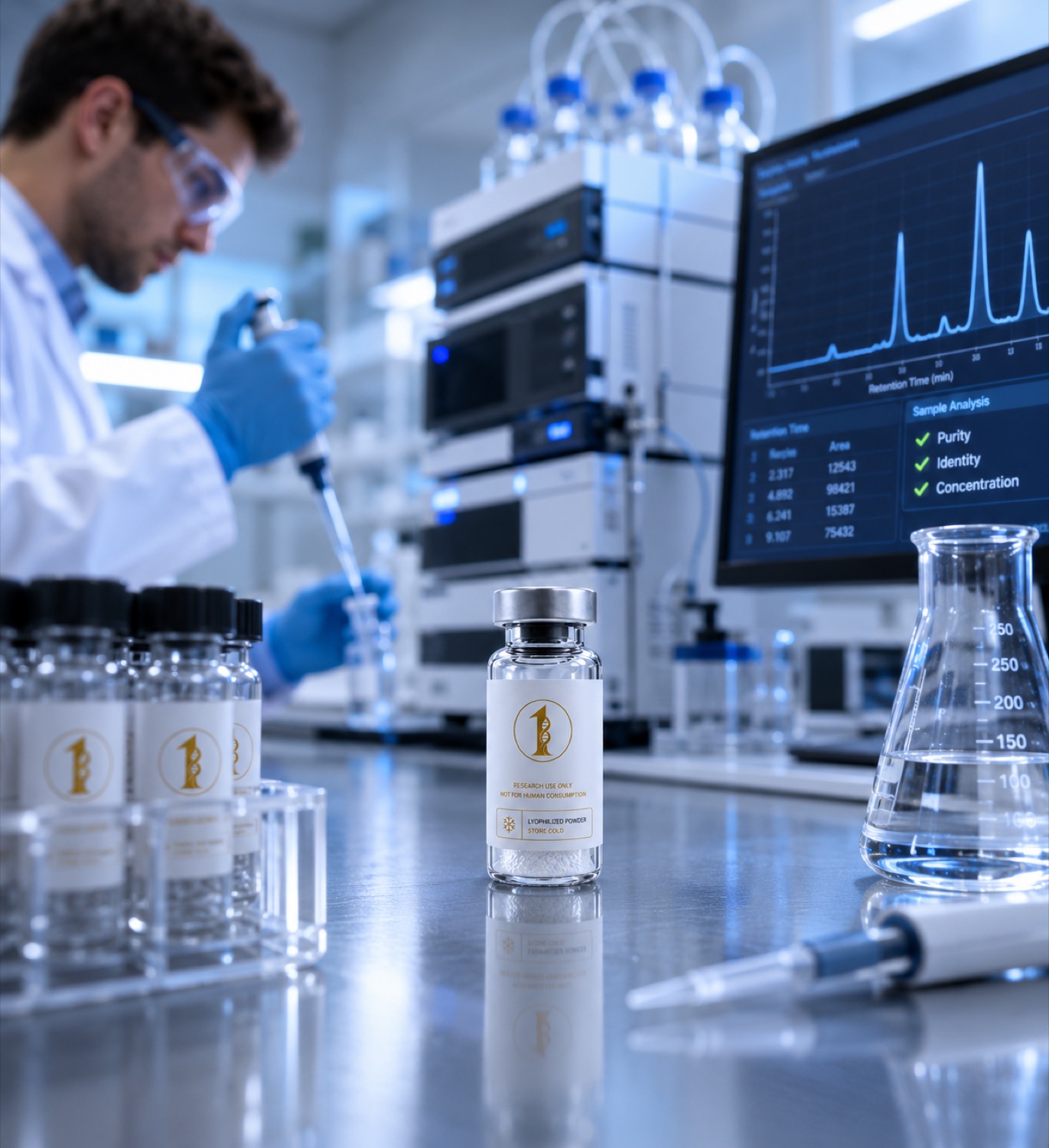
Freeze-drying explained: sublimation, the amorphous cake, bulking agents and cryoprotectants, and why research peptides ship dry. Research use only.
Short answer
Lyophilized means freeze-dried. The peptide is dissolved, frozen solid, and then the ice is removed by sublimation under vacuum rather than by melting, leaving a dry porous cake in the vial. The point of the exercise is stability: almost every reaction that destroys a peptide needs water, and lyophilization takes the water away without ever heating the material through a liquid phase. A vial that arrives as a white or off-white powder, sometimes as a thin disc and sometimes as loose flakes, is the normal and intended presentation. All compounds discussed are supplied strictly as laboratory research materials. They are not for human or veterinary use, and nothing here is medical advice.
How freeze-drying actually works
Lyophilization runs in three stages, and each one changes the material in a way that matters later.
Freezing
The solution is cooled until it solidifies. Ice crystals nucleate and grow, and everything that is not water is pushed into the shrinking unfrozen fraction, where it becomes highly concentrated before it too solidifies. The size and shape of the ice crystals set the pore structure of the finished cake, which is why freezing rate influences both drying time and how quickly the cake later dissolves. A review of freezing and freeze-drying in pharmaceutical formulations covers this stage and its downstream consequences in detail (PMID 30288720).
Primary drying
Pressure is dropped and a small amount of heat is supplied so that ice sublimes directly to vapour without passing through liquid. This is the long stage, and it must be run below the collapse temperature of the frozen matrix. Exceed that temperature and the structure slumps, giving a shrunken, glassy or partly melted cake instead of an open porous one.
Secondary drying
Once the ice is gone, water still remains bound to the solid. Secondary drying raises the temperature modestly under continued vacuum to strip that residual moisture down to a low percentage. This stage sets the residual moisture content, which is one of the strongest predictors of how the dried material will behave in storage.
The cycle finishes with closure. Vials are commonly stoppered inside the chamber before the vacuum is released, either under reduced pressure or under an inert gas such as nitrogen, so that the headspace above the finished cake is not simply room air. That detail is easy to overlook and directly relevant later, because oxygen in the headspace is the default oxidant for methionine, cysteine and tryptophan residues. It is also part of why a vial that has been opened several times is in a measurably different condition from a sealed one, regardless of how carefully it was resealed.
Why research peptides ship dry rather than in solution
Shipping a peptide as a solution would require an unbroken cold chain, would expose the material to agitation at an air to liquid interface for the whole journey, and would start the hydrolysis and deamidation clock at the moment of manufacture rather than at the moment of use. A dry cake tolerates ambient transit for the short duration of shipping, arrives in a state whose degradation routes are largely closed, and leaves the choice of diluent, concentration and aliquot size to the laboratory that will actually run the experiment. The dry form also makes the material far easier to characterise and re-characterise, since a stable solid can be sampled for chromatography and mass measurement months apart and compared meaningfully.
Why the cake looks the way it does
Appearance carries information. A well-executed cake is an intact, evenly coloured, porous plug that occupies roughly the volume of the original fill and dissolves readily. Variations that are still normal include a thin film or disc at the vial bottom when the fill volume was small, and loose flakes that have broken up in transit, since a porous cake is mechanically fragile and shipping vibration routinely fractures it.
Signs that a cake has been through conditions it should not have include marked shrinkage away from the vial wall, a glassy or melted-looking layer, browning, and a powder that has become sticky or has visibly taken up moisture. Those observations belong in the notebook, because they describe the storage history of the vial rather than the identity of the compound.
Fill mass is also worth understanding. A vial labelled with a few milligrams of peptide contains very little solid, and once that solid is spread as a porous film it can be almost invisible against the glass. A vial that looks empty is far more often a small fill than a missing one, and weighing is a poor way to check it because the cake is hygroscopic and the vial is tared with stopper and seal.
Excipients: what else is in the vial
Freeze-dried formulations frequently contain more than the active molecule. Bulking agents such as mannitol give a small fill enough solid to form a mechanically sound cake. Disaccharides such as sucrose and trehalose act as cryoprotectants and lyoprotectants, replacing hydrogen bonds normally made with water and forming the glassy matrix that immobilises the molecule during storage. Buffer salts hold pH during freezing, and surfactants limit interface-driven aggregation. Work on protein-loaded nanoparticle formulation via freeze-drying illustrates how heavily the outcome depends on this excipient selection rather than on the drying cycle alone (PMID 39342023).
Excipients are not inert with respect to the finished article. They determine the glass transition temperature of the cake, the residual moisture it holds, how fast it reconstitutes, and how it looks. They also mean that the total solid in a vial is not the same quantity as the peptide in it, which is why the certificate of analysis and the label, rather than an assumption about the visible powder, define what is present. That distinction is unpacked in what 99 percent peptide purity means.
Freeze-drying is not the only route to a powder
Sublimation is the dominant industrial method for peptides, but it is not the only one. Spray drying atomises a solution into a heated gas stream so that the solvent evaporates from each droplet, producing particles directly. A study of peptide isolation via spray drying examined particle formation, process design and implementation for the production of spray dried glucagon, which shows the approach applied to a real peptide rather than to a model protein (PMID 33319329). Spray drying is continuous and fast, whereas lyophilization is a batch process that is gentler on thermally sensitive molecules, and that trade governs which method a manufacturer selects.
What lyophilization does not do
Three misreadings are common enough to state plainly. Freeze-drying is not sterilisation: it removes water, and it neither kills nor removes microorganisms, which is why a preserved diluent exists as an option for multi-draw vials. Freeze-drying is not purification: whatever impurities were in the solution before drying are in the cake afterwards, so purity is established by chromatography and mass measurement rather than by the drying step, as described in HPLC peptide purity and mass spectrometry peptide testing. And freeze-drying does not make a peptide permanently stable: it slows degradation by orders of magnitude, but temperature, residual moisture, light and air still move the rate.
Practical laboratory handling
The following are handling practices for research material and carry no implication about use in a person.
- Inspect before opening. Note cake appearance, colour and integrity while the vial is still sealed, and record it.
- Equilibrate the sealed vial to room temperature. Opening cold glass in humid air condenses water onto the cake and undoes the drying that protects it.
- Centrifuge or tap down first. Fragments dislodged in transit often sit in the stopper; a brief spin or a firm tap on the bench brings the solid to the bottom before the stopper is pierced.
- Add diluent down the vial wall. A slow stream against the glass, then quiet standing with gentle inversion. Vortexing introduces air interfaces and promotes aggregation.
- Calculate before reconstituting. Fill mass and target concentration set the volume, and both can be worked through with the reconstitution calculator. Diluent specifications are described on the bacteriostatic water guide, and the item is listed under bacteriostatic water.
- Aliquot immediately. Split the reconstituted solution into single-use volumes so that no aliquot is ever thawed twice.
- Label completely. Compound, lot, concentration, diluent, date and preparer initials on every tube.
Reading the paperwork that comes with the powder
Because a dry cake reveals almost nothing about identity or purity by inspection, the lot documentation carries that information instead. It should state the compound, the lot, the analytical methods used and their results. Reading one critically is covered in how to verify a peptide certificate of analysis, and lot documents for catalogue items are published on the certificates page. Storage guidance for the powder once it is in the freezer, and for the solution once it is made, is set out in the article on peptide storage and stability.
All compounds discussed are supplied strictly as laboratory research materials. They are not for human or veterinary use, and nothing here is medical advice.
References
- Applications of Freezing and Freeze-Drying in Pharmaceutical Formulations. Advances in experimental medicine and biology, 2018. PMID 30288720
- Formulation of protein-loaded nanoparticles via freeze-drying. Drug delivery and translational research, 2024. PMID 39342023
- Peptide Isolation via Spray Drying: Particle Formation, Process Design and Implementation for the Production of Spray Dried Glucagon. Pharmaceutical research, 2020. PMID 33319329
Research use only