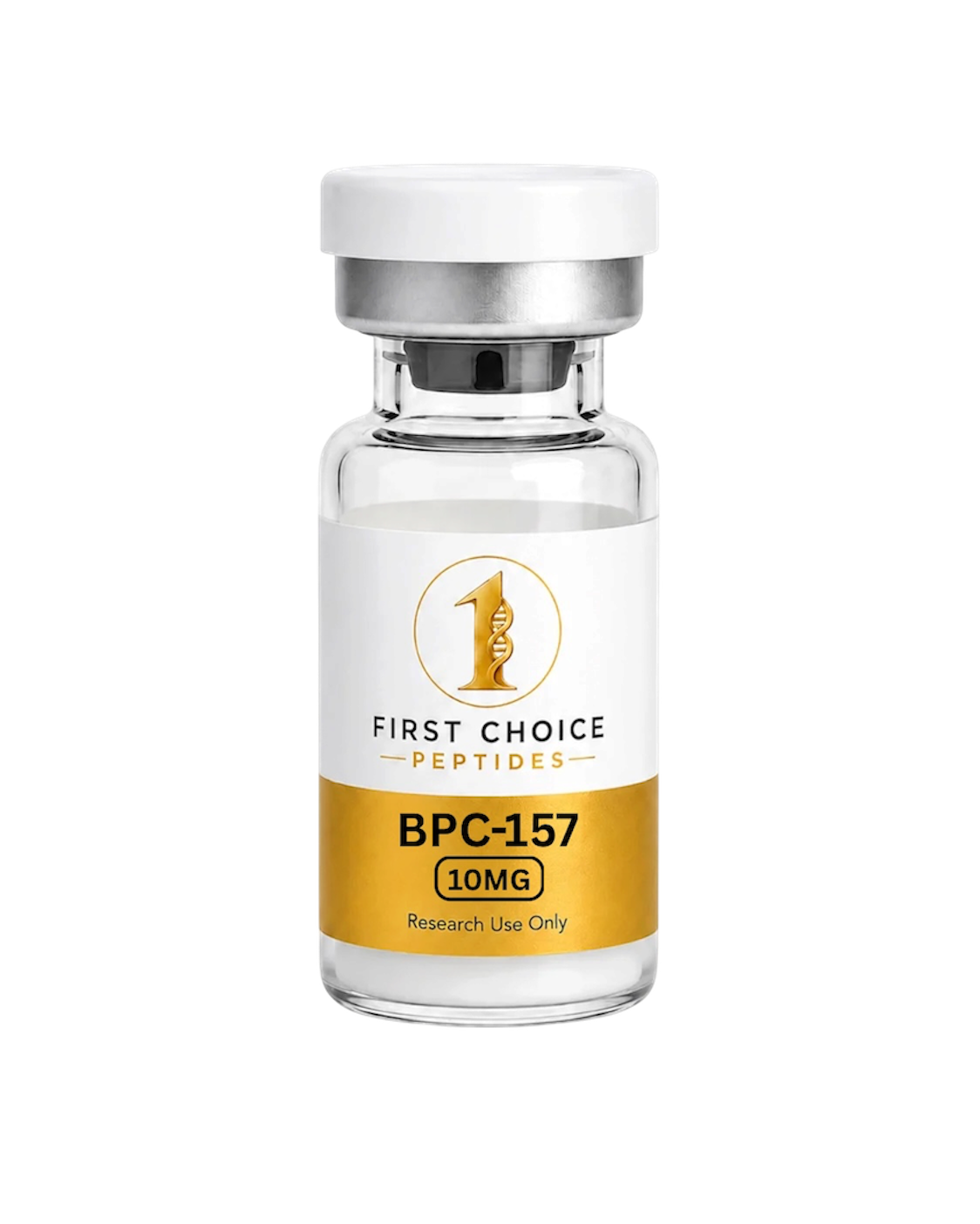
BPC-157 is a synthetic 15-residue peptide (CAS 137525-51-0, C62H98N16O22). Sequence, identifiers, storage and literature. Research use only.
BPC-157 at a glance
- CAS number
- 137525-51-0
- Molecular formula
- C62H98N16O22
- Molecular weight
- 1419.50 g/mol
What BPC-157 is
BPC-157 is a synthetic 15-residue peptide whose sequence corresponds to a fragment of body protection compound, a protein sequence described in human gastric juice. It is a short, fully synthetic peptide supplied as a lyophilized powder for bench work. The catalogue files it under regenerative biology and lists Body Protection Compound and PL 14736 as synonyms. Both of those names appear in the published literature and in patent documents for the same sequence, so all three labels point at one material, which is worth noting when comparing a specification sheet against a paper that uses a different name.
The peptide has been the subject of published laboratory and preclinical research since the 1990s, and it also appears in the peptide-chemistry literature as a reference sequence for synthesis and analytical method development. The catalogue presentation is a single 10 mg vial. First Choice Peptides supplies BPC-157 strictly for laboratory research. It is not a drug, not a dietary product, and it is not for human or veterinary use.
Structure and identifiers
In single-letter notation the sequence is written GEPPPGKPADDAGLV. That pentadecapeptide carries a proline-rich central region and a pair of adjacent acidic aspartate residues, structural features that shape its behaviour on a reversed-phase column and its fragmentation pattern in tandem mass spectrometry. The catalogue entry records no salt form and no terminal acetylation or amidation for this material, so analytical identity work is run against the plain sequence.
It is catalogued under CAS 137525-51-0 with the molecular formula C62H98N16O22 and a molecular weight of 1419.50 g/mol. Those three values are the ones that appear on the specification sheet and on the certificate of analysis for a lot: the registry number ties the entry to a single chemical identity, the formula fixes the elemental composition, and the molecular weight is the expected mass that identity testing is measured against. Figures that the catalogue entry does not record, such as an alternative salt-form mass, are left unstated here rather than estimated.
What the published literature has examined
Published work has examined BPC-157 in in-vitro cell-culture systems and in rodent models within regenerative biology, gastrointestinal research and peptide pharmacology. The papers listed on this page are bibliographic references only; they are not evidence of safety or efficacy and describe laboratory findings, not any use in people or animals.
Several of the listed references are reviews rather than primary reports. A 2025 review in Pharmaceuticals surveys the published record together with the patent literature for the sequence, and reviews in Current Pharmaceutical Design and Frontiers in Pharmacology map the preclinical body of work as it stood in 2018 and in 2021. Reviews of that kind are useful mainly as bibliographies: they show which model systems have been used and which groups have published on the sequence, without adding measurements of their own.
The primary literature behind those reviews sits in a small number of model families. Rodent models dominate, covering gastrointestinal tissue, connective tissue such as tendon and ligament, bone, and the central nervous system. Cell-culture work covers fibroblast and endothelial cultures, cell migration and adhesion assays, and angiogenesis-associated endpoints examined alongside standard angiogenic growth factors. The analytical endpoints reported in these papers are largely histological scoring, immunohistochemistry, gene and protein expression profiling and vascular density counts.
A second and smaller strand of the literature is chemical and analytical: characterisation of the synthetic sequence, stability behaviour in biological matrices, and method development for detection and quantification. That strand is the part most relevant to a laboratory reference material, because it defines the retention behaviour and the mass spectra against which a new lot is compared. None of the work described in this section is a statement about outcomes in people or animals, and none of it is offered here as one.
Storage and handling as a laboratory reagent
The catalogue storage table for this entry lists two states. Lyophilized peptide is held at -20 C and protected from light. Reconstituted solution is held at 2 to 8 C and treated as a short-term laboratory reagent rather than a stock to be kept indefinitely. A sealed vial is best brought to room temperature before it is opened, so that condensation does not settle on the powder, and a brief spin down is sensible when powder has shifted onto the stopper in transit.
After reconstitution, single-use aliquots are preferable to repeated withdrawals, and repeated freeze-thaw cycling is avoided: every cycle is an opportunity for aggregation and for loss of intact sequence. Aliquots are best labelled with the lot number and the date, so that any analytical result stays traceable to one certificate of analysis. Concentration arithmetic for a given vial mass and diluent volume can be worked through with the reconstitution calculator, and the usual laboratory diluent for a lyophilized peptide of this type is bacteriostatic water.
Analytical verification
Purity and identity for this material are verified by third-party HPLC and mass spectrometry, with one certificate of analysis issued per lot. Reversed-phase HPLC reports purity as a percentage of integrated peak area, and mass spectrometry confirms identity by matching the measured mass against the expected molecular weight of 1419.50 g/mol. The documents for a given lot are filed in the certificate library.
Reading the two reports together matters more than either figure on its own, because a chromatogram can look clean while the main peak is the wrong molecule, and a correct mass can sit beside a poorly resolved impurity profile. Background on how those numbers are produced, and on what they do and do not cover, is set out in HPLC peptide purity and in how to verify a peptide certificate of analysis. Nothing beyond the HPLC purity result, the mass spectrometry identity result and the per-lot certificate is claimed for this material.
Published literature
Papers in which BPC-157 has been the subject of laboratory or preclinical study. Listed for bibliographic reference only.
Research and educational purposes only. These references are provided for bibliographic context. They are not evidence of safety or efficacy, and nothing here is medical advice or a claim about any use in humans or animals.
Pharmaceuticals (Basel, Switzerland)
Multifunctionality and Possible Medical Application of the BPC 157 Peptide-Literature and Patent Review
Frontiers in pharmacology
Stable Gastric Pentadecapeptide BPC 157 and Wound Healing
Current Pharmaceutical Design
BPC 157 and the central nervous system
Cell and tissue research
Gastric pentadecapeptide body protection compound BPC 157 and its role in accelerating musculoskeletal soft tissue healing
Journal of Physiology-Paris
Stable gastric pentadecapeptide BPC 157 and wound healing
Current pharmaceutical design
BPC 157 and Standard Angiogenic Growth Factors. Gastrointestinal Tract Healing, Lessons from Tendon, Ligament, Muscle and Bone Healing
Research use only