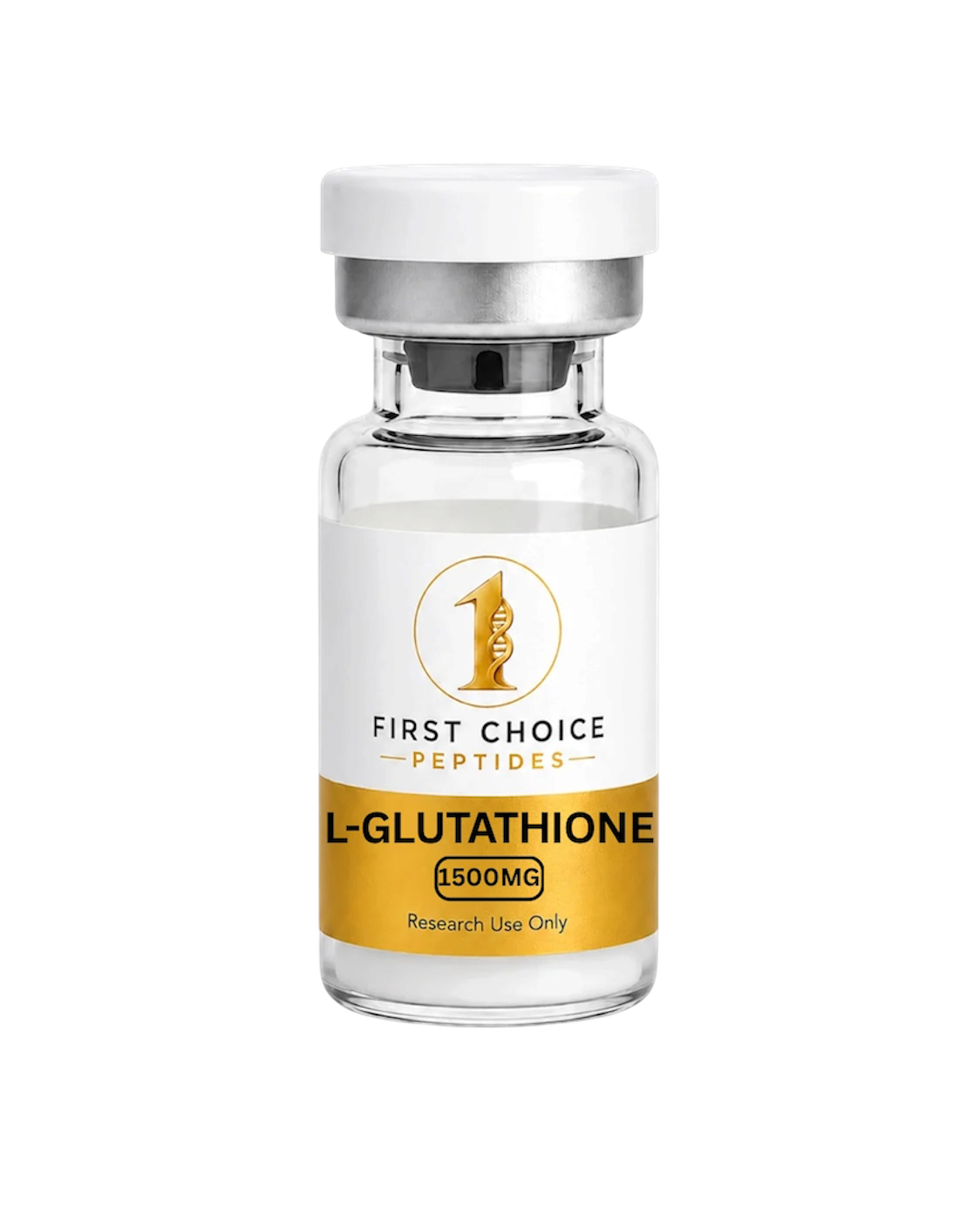

L-Glutathione (GSH) is a reduced gamma-glutamyl tripeptide, gamma-Glu-Cys-Gly, CAS 70-18-8, C10H17N3O6S. Identity, storage and literature. Research use only.
L-Glutathione at a glance
- CAS number
- 70-18-8
- Molecular formula
- C10H17N3O6S
- Molecular weight
- 307.33 g/mol
What L-Glutathione is
L-Glutathione is a three-residue peptide whose sequence corresponds to the endogenous gamma-glutamyl tripeptide present in the cells of essentially every aerobic organism. The catalogue supplies it in the reduced form, which is why it appears in the literature and in the catalogue synonyms as GSH and as L-glutathione reduced. The distinction between the reduced form and its oxidised disulfide dimer, written GSSG, is the single most important fact about this material as a reagent, and most of what follows about handling and verification comes back to it.
Unlike most items in a peptide catalogue, glutathione is not an analogue or a designed sequence. It is the native molecule itself, produced synthetically for laboratory use, and it is among the most thoroughly characterised small biomolecules in biochemistry. The catalogue files it under cell-biology research materials and stocks it in 600 mg and 1500 mg presentations, quantities considerably larger than those used for signalling peptides, which reflects its role as a bulk reagent in redox chemistry, thiol-dependent reactions, enzymatic assays, oxidative-stress model systems and analytical method development rather than as a receptor ligand.
The compound has been the subject of published laboratory research for many decades, and the reference set on this page draws from the modern portion of that record. The material is supplied strictly for laboratory research use. It is not for human or veterinary use, and it is not for consumption, administration, diagnostic use or therapeutic use.
Structure and identifiers
The sequence is written gamma-Glu-Cys-Gly: glutamate, cysteine, glycine. The prefix gamma is the defining structural feature. The bond joining the first residue to the second is formed not from the alpha-carboxyl group used in ordinary peptide bonds but from the side-chain carboxyl of glutamate, producing an isopeptide linkage. That single difference is the reason glutathione resists the aminopeptidases that would readily cleave a conventional tripeptide, and it is the reason its breakdown proceeds through a dedicated enzymatic route rather than through general proteolysis.
The central cysteine carries a free sulfhydryl group, and that thiol is the chemically active centre of the molecule. In the reduced form supplied here the thiol is free. On oxidation, two molecules join through a disulfide bond to give the dimer GSSG, and the catalogued formula and mass below apply to the reduced monomer, not to that dimer. Because the exchange between the two forms is readily driven by dissolved oxygen, trace metal ions and elevated pH, the ratio of the two species in a prepared solution is a function of how the solution was made and stored rather than a fixed property of the material.
L-Glutathione is catalogued under CAS 70-18-8 with the molecular formula C10H17N3O6S and a molecular weight of 307.33 g/mol. The single sulphur atom in that formula is the cysteine thiol. The catalogue lists GSH and L-glutathione reduced as synonyms.
What the published literature has examined
Published work has examined glutathione in enzymological, cell-biological and subcellular-compartment model systems within redox biology, thiol chemistry and cell-death research. The papers listed on this page are bibliographic references only; they are not evidence of safety or efficacy and describe laboratory findings, not any use in people or animals.
Two of the listed reviews concern the enzymology built around the molecule. A 2023 review in Molecules surveys glutathione-related enzymes and proteins, the family that includes the glutathione S-transferases, the glutathione peroxidases, the glutaredoxins and the enzymes of its own biosynthesis. A 2017 review in Antioxidants and Redox Signaling addresses degradation, that is, the gamma-glutamyl cycle and the enzymatic routes that dismantle the isopeptide bond described above. Read together, these two define the metabolic frame in which the tripeptide sits: a molecule with a dedicated synthetic pathway, a dedicated catabolic pathway and a large family of enzymes that use it as a cofactor or substrate.
The remaining two references concern where the molecule is found and what processes it participates in. A 2013 paper in Biochimica et Biophysica Acta addresses nuclear glutathione, that is, the question of subcellular compartmentalisation and how pools in different compartments are measured and distinguished. A 2016 review in Cellular and Molecular Life Sciences covers the mechanisms of ferroptosis, an iron-dependent form of regulated cell death in which glutathione-dependent enzymology is one of the studied variables. The analytical methods running through this literature are the standard tools of the field: enzymatic recycling assays, chromatographic separation of the reduced and oxidised forms, thiol-reactive fluorescent probes, and mass spectrometric quantitation of both species in cell and tissue extracts.
Storage and handling as a laboratory reagent
The catalogue records two conditions. In lyophilized form the material is stored at -20 C and protected from light. Reconstituted solutions are stored refrigerated at 2 to 8 C for short-term laboratory use, and repeated freeze-thaw cycling is avoided.
Handling of this particular compound centres on the free thiol. Solutions of the reduced form oxidise on exposure to air, and the process is accelerated by neutral to alkaline pH and by trace transition metal contamination in buffers or glassware. Laboratory practice therefore treats reconstituted glutathione as a short-lived preparation rather than a stock to be kept: solutions are commonly prepared fresh for each session, kept closed and cold, and where the reduced fraction matters to the readout, that fraction is measured rather than assumed. Lyophilized material held dry, cold and dark is comparatively stable, so the freezer, not the refrigerator, is where the useful shelf life sits. The reconstitution calculator converts a vial size and diluent volume into a working concentration, and bacteriostatic water is the diluent stocked alongside lyophilized research materials.
Analytical verification
Purity is determined by third-party high-performance liquid chromatography and identity is confirmed by mass spectrometry against the expected molecular weight of 307.33 g/mol. A certificate of analysis is issued for each lot and filed in the certificate library, where it can be matched to the lot number on the container.
Two background articles explain how to read that documentation. How to verify a peptide certificate of analysis sets out what a certificate contains and how its claims tie back to a specific lot, which matters here because the reduced and oxidised forms differ in mass and a certificate is the record of which was measured. HPLC peptide purity explains what a chromatographic purity figure describes, and for this compound it is worth noting that the reduced and oxidised species separate chromatographically, so the method by which the two are resolved is part of what the purity number means.
Published literature
Papers in which L-Glutathione has been the subject of laboratory or preclinical study. Listed for bibliographic reference only.
Research and educational purposes only. These references are provided for bibliographic context. They are not evidence of safety or efficacy, and nothing here is medical advice or a claim about any use in humans or animals.
Molecules (Basel, Switzerland)
Glutathione-Related Enzymes and Proteins: A Review
Antioxidants & redox signaling
Glutathione Degradation
Cellular and molecular life sciences : CMLS
Mechanisms of ferroptosis
Biochimica et biophysica acta
Nuclear glutathione
Research use only