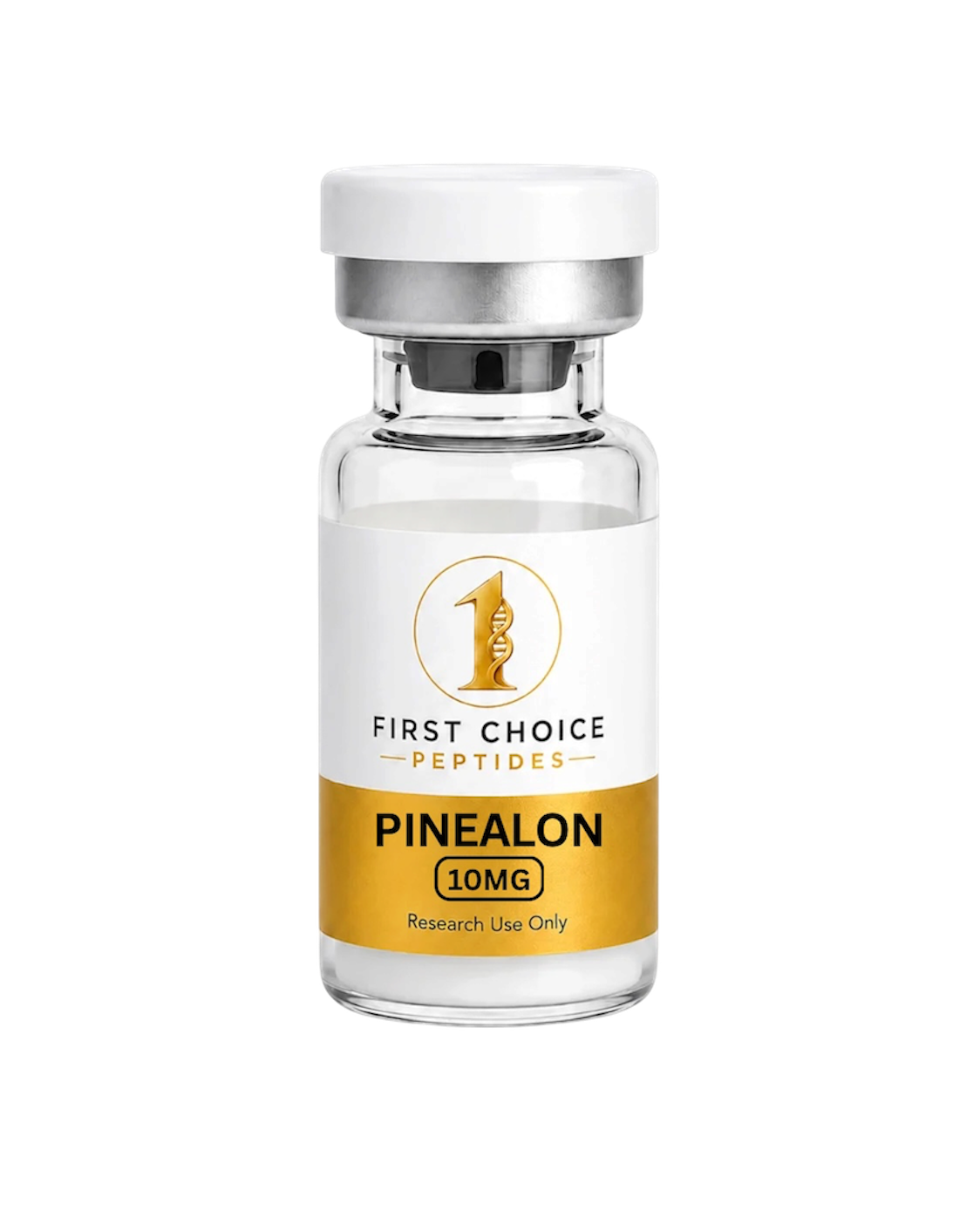

Pinealon is a synthetic 3-residue peptide (Glu-Asp-Arg), also called the EDR peptide. Sequence, laboratory storage and the published literature. Research use only.
What Pinealon is
Pinealon is a synthetic 3-residue peptide whose sequence corresponds to the tripeptide L-glutamic acid, L-aspartic acid and L-arginine, written Glu-Asp-Arg. In the single-letter amino-acid code that reads as EDR, which is why the research literature commonly calls the molecule the EDR peptide. The catalogue lists it in the neurobiology section and records no other catalogue synonyms for it.
The compound belongs to the group of short synthetic peptides usually described as peptide bioregulators, a class defined in the Russian-language gerontology literature of the late twentieth century. Peptides in that group are very short, typically two to four residues, are assembled by ordinary solid-phase or solution-phase synthesis rather than isolated from tissue, and are studied on the premise that a short peptide can interact directly with nucleic acids and chromatin. Pinealon is the member of the group associated with neuronal and gene-expression research, and its name reflects the pineal-tissue context in which the wider bioregulator programme was originally framed.
Being three residues long, the molecule has no secondary structure in solution in any meaningful sense, and its behaviour as a reagent is closer to that of a small polar organic compound than to that of a folded peptide. Two of the three side chains are acidic and one is strongly basic, which gives the molecule a net charge across most of the ordinary buffer range and makes it freely soluble in aqueous media. Pinealon is supplied strictly as a laboratory research material and is not for human or veterinary use, nor for consumption, administration, diagnostic use or therapeutic use.
Structure and identifiers
The sequence is Glu-Asp-Arg, a linear tripeptide with a free N-terminal amine on the glutamic-acid residue and a free C-terminal carboxyl on the arginine residue. No acetylation, amidation, D-amino acid or other modification is recorded for the catalogue material, and none is asserted here. The peptide carries three ionisable side-chain or terminal groups beyond the backbone: two carboxylates from the glutamic-acid and aspartic-acid residues and one guanidinium group from arginine.
The catalogue entry records no numerical identifiers for this material. A CAS registry number is not catalogued here, a molecular formula is not catalogued here, and a molecular weight is not catalogued here, so none of the three is stated on this page. The sequence above is the identity information the entry carries, and the certificate of analysis issued with each lot reports the mass measured for that lot, which is the appropriate numerical reference for identity work.
The material is offered in a single 20 mg vial format and is supplied lyophilized. Lyophilized peptides of this type are handled as dry solids until they are reconstituted in an appropriate laboratory diluent.
What the published literature has examined
Published work has examined Pinealon in neuronal cell culture and rodent models within neurobiology, gerontology and gene-expression research. The papers listed on this page are bibliographic references only; they are not evidence of safety or efficacy and describe laboratory findings, not any use in people or animals.
The reference set for this material is small and its language distribution is unusual. Much of it was published in Russian, in journals such as Advances in Gerontology, and reaches the international indexes only as a translated title and abstract. The four references attached to this entry span the years 2008 to 2015 and sit in gerontology and rejuvenation-research journals rather than in general neuroscience titles, so the field context is the peptide-bioregulator programme described above rather than mainstream neuropharmacology.
The model systems those references use fall into two groups. The first is cell culture: cultured cells examined for viability and proliferative state, with free-radical and oxidative-stress levels as the measured variable. Assays of that shape typically combine a viability or metabolic-activity readout with a fluorescent probe for reactive oxygen species and a proliferation marker. The second group is whole-animal rodent work, including a prenatal model in rat offspring built on experimentally induced hyperhomocysteinemia, an antihypoxic screening model applied to a set of short peptides, and a study in aged rats combining hypoxia and hypothermia with behavioural and neurochemical measures. Cortexin, a separate peptide preparation, appears as a comparator in that last reference.
Analytical and experimental methods that appear across this body of work include cell-viability and cytotoxicity assays, fluorescent detection of reactive oxygen species, immunocytochemistry and microscopy of neuronal cultures for dendritic and apoptosis-associated markers, gene-expression and protein-synthesis measurement, standard rodent behavioural test batteries, and neurochemical assay of tissue homogenates. This paragraph and the two before it describe fields, models and methods only. No result or endpoint value from any of the cited studies is stated on this page, and none of them establishes safety or efficacy for any use.
Storage and handling as a laboratory reagent
No compound-specific storage rows are recorded in the catalogue entry, so the general handling profile for lyophilized research peptides applies. In lyophilized form the vial is held at -20 C, protected from light, and kept sealed until it is opened in the laboratory. Allowing a cold vial to reach room temperature before it is opened keeps condensation from forming on the dry solid, which matters for a small, highly polar peptide that takes up atmospheric moisture readily.
Once reconstituted, the material is a short-lived laboratory reagent rather than a stock. Reconstituted solutions are held refrigerated at 2 to 8 C for short-term laboratory use, kept out of direct light, and protected from repeated freeze-thaw cycling, which is a common cause of drifting concentration in peptide work. Dividing a reconstituted solution into single-use aliquots at the point of reconstitution avoids warming the whole volume more than once.
Concentrations are worked out before diluent goes into the vial. The reconstitution calculator converts a vial mass and a target concentration into a diluent volume, and bacteriostatic water is the diluent most commonly catalogued for laboratory vials that will be entered more than once.
Analytical verification
Identity and purity for this material are established analytically. Purity is assessed by third-party reverse-phase HPLC, where the chromatogram separates the target peptide from synthesis-related species such as deletion sequences and incompletely deprotected intermediates, and purity is reported as the target peak area relative to the total integrated peak area. A very short, very polar peptide is a demanding case for reverse-phase separation, since it elutes early and close to the void volume, which is one reason the identity check runs alongside the purity check rather than after it. Identity is assessed by mass spectrometry against the expected molecular weight for the Glu-Asp-Arg sequence. A certificate of analysis is issued for each lot, and the certificates are held in the certificate library.
Two related articles cover how those documents are read. HPLC peptide purity explains how a chromatogram becomes a purity percentage and what the shape of a trace indicates about the synthesis behind it. How to verify a peptide certificate of analysis sets out which fields on a certificate carry weight, including lot identity, test dates and the identity of the testing laboratory. Purity and identity information on this page is limited to exactly that: third-party HPLC and mass spectrometry, with one certificate per lot. No purity figure, lot number or testing-laboratory name is stated here, because those values belong to individual lots and are reported on the certificate for the lot supplied.
Published literature
Papers in which Pinealon has been the subject of laboratory or preclinical study. Listed for bibliographic reference only.
Research and educational purposes only. These references are provided for bibliographic context. They are not evidence of safety or efficacy, and nothing here is medical advice or a claim about any use in humans or animals.
Advances in gerontology = Uspekhi gerontologii
[Pinealon and Cortexin influence on behavior and neurochemical processes in 18-month aged rats within hypoxia and hypothermia]
International journal of clinical and experimental medicine
Pinealon protects the rat offspring from prenatal hyperhomocysteinemia
Rejuvenation research
Pinealon increases cell viability by suppression of free radical levels and activating proliferative processes
Advances in gerontology = Uspekhi gerontologii
[Investigation of antihypoxic properties of short peptides]
Research use only