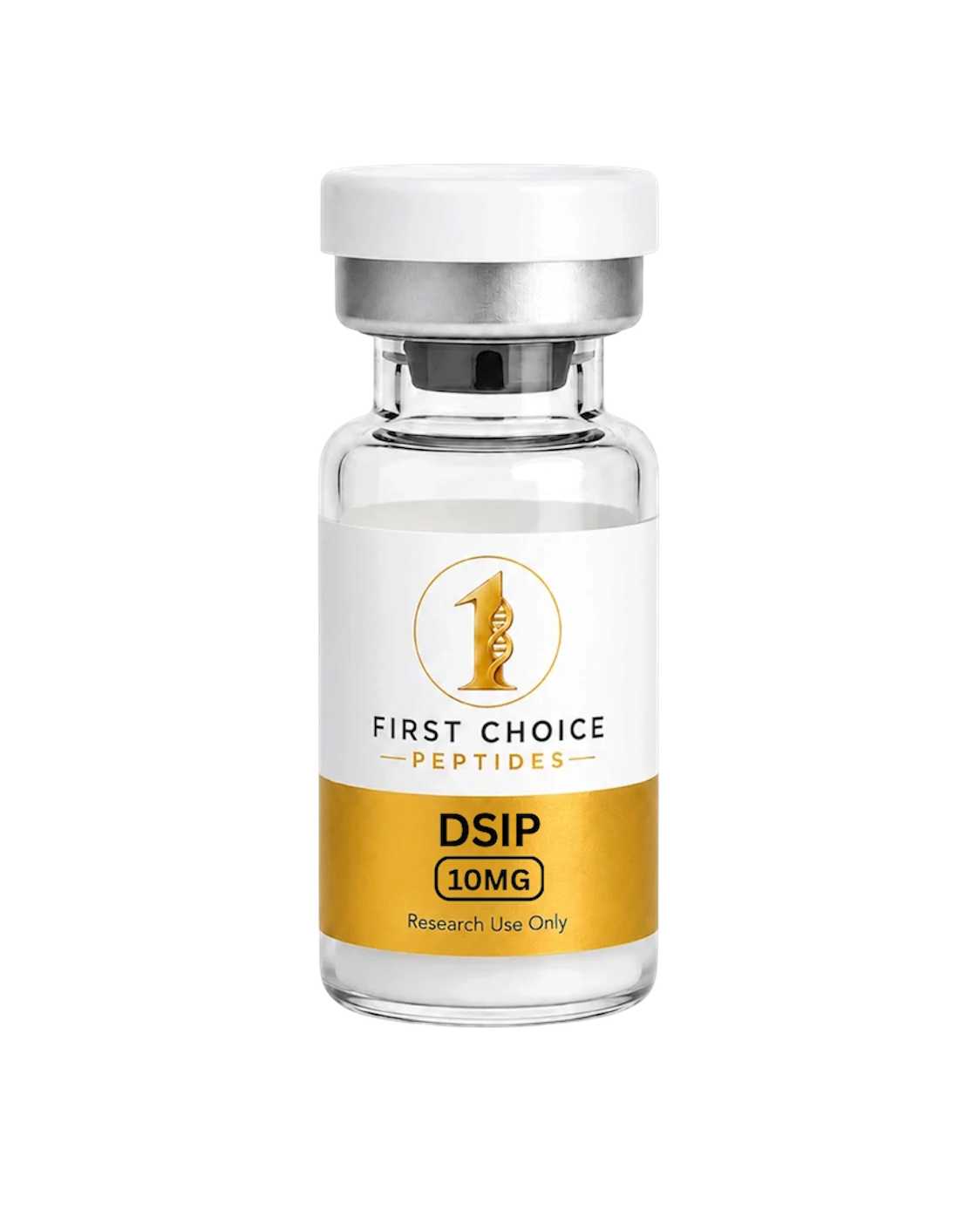
DSIP, delta sleep-inducing peptide, is a synthetic nine-residue peptide (CAS 62568-57-4, C35H48N10O15). Sequence, identifiers and literature. Research use only.
DSIP at a glance
- CAS number
- 62568-57-4
- Molecular formula
- C35H48N10O15
- Molecular weight
- 848.80 g/mol
What DSIP is
DSIP is a synthetic nine-residue peptide whose sequence corresponds to the neuropeptide described in the older neurobiology literature as delta sleep-inducing peptide, the name the catalogue also lists as its synonym. The abbreviation DSIP is drawn from that name, which reflects the experimental setting in which the peptide was first described rather than any property of the material as supplied. In catalogue terms it is a short, linear, unmodified peptide with no metal coordination, no acetylation and no D-amino acid substitutions, which places it among the simpler synthetic neuropeptides held as laboratory reference materials.
The catalogue files DSIP under chronobiology, and it is stocked in 5 mg and 10 mg presentations. It is used as a reference material in experimental neurobiology and chronobiology work, in studies of peptide signalling and circadian-associated processes, in electrophysiological research, and in analytical peptide characterisation where a well-defined short sequence is needed as a standard. The peptide has been the subject of published laboratory and preclinical research for several decades, and the review literature summarised further down this page spans roughly three decades of that record.
DSIP is supplied strictly for laboratory research use. It is not for human or veterinary use, and it is not for consumption, administration, diagnostic use or therapeutic use.
Structure and identifiers
The sequence of DSIP is Trp-Ala-Gly-Gly-Asp-Ala-Ser-Gly-Glu, giving the single-letter notation WAGGDASGE. All nine residues are standard L-configuration proteinogenic amino acids, and the chain carries a free amino terminus and a free carboxy terminus, with no amidation or acetylation recorded. Two features of that sequence are worth noting for anyone handling the material analytically. The single tryptophan at position one is the only strongly ultraviolet-absorbing residue in the chain, which makes it the dominant contributor to absorbance in the 280 nm region and the residue most sensitive to light exposure during storage. The two acidic residues, aspartate at position five and glutamate at position nine, give the peptide a net negative charge at neutral pH and govern much of its chromatographic behaviour on reversed-phase columns.
The chain also contains three glycine residues, at positions three, four and eight. A glycine-rich short peptide has comparatively few side-chain constraints on its backbone, and the resulting conformational flexibility is one of the reasons DSIP has been a recurring subject of structural and physicochemical characterisation rather than a solved structural problem.
DSIP is catalogued under CAS 62568-57-4 with the molecular formula C35H48N10O15 and a molecular weight of 848.80 g/mol. That formula and mass correspond to the free peptide; material supplied as a salt will carry counter-ions that are not represented in the formula, and the certificate of analysis for a given lot is the record of what was actually measured.
What the published literature has examined
Published work has examined DSIP in neurobiological, chronobiological and electrophysiological model systems within neuropeptide research, and in analytical and biochemical characterisation work. The papers listed on this page are bibliographic references only; they are not evidence of safety or efficacy and describe laboratory findings, not any use in people or animals.
The reference set for this compound is unusual in that it consists almost entirely of review articles rather than primary reports. A 1984 review in Neuroscience and Biobehavioral Reviews, an update published in Peptides in 1986, a short review in the European Journal of Anaesthesiology in 2001 and a 2006 review in the Journal of Neurochemistry titled as a still unresolved riddle together trace how the field has treated the peptide over three decades. The framing of the most recent of those titles is itself the most informative thing about the literature: after thirty years of published work, the review literature continued to describe the subject as open rather than settled.
The model systems and methods those reviews draw together are the standard toolkit of twentieth-century neuropeptide research. They include electrophysiological recording in rodent preparations, radioimmunoassay and immunochemical detection of peptide material in tissue and biological fluids, chromatographic separation of peptide fractions from brain extracts, and studies of the chemical stability and enzymatic degradation of the nine-residue chain in vitro. Later work in the set concerns the analytical difficulty of identifying an endogenous counterpart to the synthetic sequence, and the structural chemistry of the peptide itself.
No outcome of any of that work is described here. The reviews are cited because they define the research fields in which the peptide has been used and the methods by which it has been characterised, not because they establish anything about its behaviour in a person or an animal.
Storage and handling as a laboratory reagent
The catalogue records two storage conditions for this material. In lyophilized form it is stored at -20 C and protected from light. Light protection matters more for this sequence than for many others of comparable length, because the amino-terminal tryptophan is photosensitive and is the residue most likely to be altered by prolonged exposure. Vials are allowed to reach ambient temperature before opening so that atmospheric moisture does not condense onto the lyophilized cake.
Once reconstituted, the solution is stored refrigerated at 2 to 8 C for short-term laboratory use. Repeated freeze-thaw cycling is avoided; where a reconstituted stock is to be used across several sessions, dividing it into single-use aliquots at the time of preparation keeps each portion to one cycle. The reconstitution calculator converts a vial size and a diluent volume into a working concentration, and bacteriostatic water is the diluent normally stocked for reconstituting lyophilized peptide research materials.
Analytical verification
Purity for each lot of DSIP is determined by third-party high-performance liquid chromatography, and identity is confirmed by mass spectrometry against the expected molecular weight of 848.80 g/mol. A certificate of analysis is issued for every lot and filed in the certificate library, where it can be matched against the lot number on the vial label.
Two background articles set out how to read those documents. How to verify a peptide certificate of analysis covers what a certificate is expected to contain and how its claims tie back to a specific lot, and peptide identity testing by mass spectrometry explains how an observed mass is compared with a calculated one and why identity and purity are separate questions answered by separate instruments. For a short, unmodified sequence such as this one, the calculated mass is unambiguous, which makes the mass spectrometric comparison a direct check rather than an interpretive one.
Published literature
Papers in which DSIP has been the subject of laboratory or preclinical study. Listed for bibliographic reference only.
Research and educational purposes only. These references are provided for bibliographic context. They are not evidence of safety or efficacy, and nothing here is medical advice or a claim about any use in humans or animals.
Journal of neurochemistry
Delta sleep-inducing peptide (DSIP): a still unresolved riddle
European journal of anaesthesiology
Delta sleep-inducing peptide
Peptides
Delta-sleep-inducing peptide (DSIP): an update
Neuroscience and biobehavioral reviews
Delta-sleep-inducing peptide (DSIP): a review
Research use only