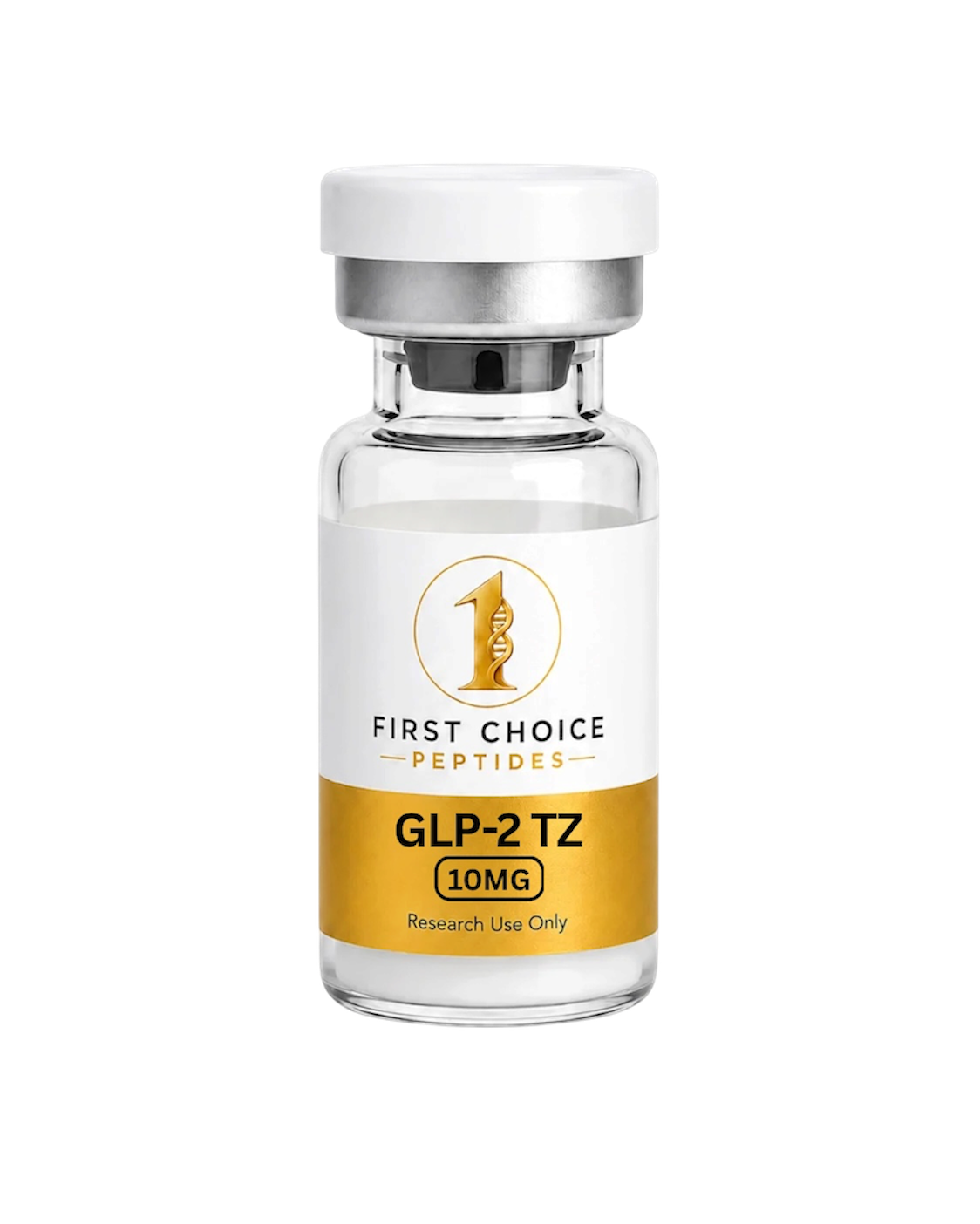

GLP-2 TZ is a synthetic 39-residue dual GIP and GLP-1 receptor agonist peptide analogue (C225H348N48O68). Identity, storage and literature. Research use only.
GLP-2 TZ at a glance
- Molecular formula
- C225H348N48O68
What GLP-2 TZ is
GLP-2 TZ is a synthetic 39-residue peptide whose sequence corresponds to a chemically modified incretin backbone, the family that includes glucose-dependent insulinotropic polypeptide, usually abbreviated GIP, and glucagon-like peptide-1. The catalogue classes the material as a dual GIP and GLP-1 receptor agonist peptide analogue: a single synthetic chain designed to carry affinity for two related class B G-protein-coupled receptors rather than for one, which is what distinguishes it structurally from a single-receptor analogue.
Peptides of this class are assembled by solid-phase synthesis and are commonly modified in two ways at once. Non-natural residues, including alpha-aminoisobutyric acid, are substituted at positions that are otherwise cleavage-sensitive, and a fatty-acid or fatty-diacid moiety is attached through a linker to a lysine side chain. Both are general strategies in peptide chemistry: the first raises resistance to proteolysis in in-vitro degradation assays, the second promotes reversible association with serum albumin. The catalogue entry for GLP-2 TZ does not enumerate which substitutions it carries or where they sit, so no specific modification pattern is asserted here.
The material is listed in the cell-biology section of the catalogue, and no alternative catalogue synonyms are recorded for it. It is supplied strictly as a laboratory research material and is not for human or veterinary use, nor for consumption, administration, diagnostic use or therapeutic use.
Structure and identifiers
The catalogue describes GLP-2 TZ as a chemically modified 39-amino-acid peptide. Its full residue sequence and the exact positions of its modifications are not recorded in the catalogue entry, so this guide states no sequence and no substitution list. The identifier that is recorded is the molecular formula, C225H348N48O68, a composition consistent with a single-chain peptide of this length carrying a non-peptidic side-chain extension.
A CAS registry number is not catalogued here, and a molecular weight is not catalogued here either, so neither value appears on this page. The certificate of analysis issued with each lot reports the mass measured for that specific material, which is the appropriate numerical reference for identity work rather than a figure quoted from a catalogue description.
The material is offered in a single 10 mg vial format and is supplied lyophilized. Lyophilized peptides of this type are handled as dry solids until they are reconstituted in an appropriate laboratory diluent, and the dry state is the form in which the identifiers above apply.
What the published literature has examined
Published work has examined peptides of this class in receptor-signaling, ligand-binding and peptide-stability models within molecular endocrinology and cell biology. The papers listed on this page are bibliographic references only; they are not evidence of safety or efficacy and describe laboratory findings, not any use in people or animals.
No bibliographic references are attached to this catalogue entry. The published literature on dual incretin receptor agonist peptide analogues is predominantly clinical and regulatory in character, and the catalogue therefore treats GLP-2 TZ as a research material only. It lists no reference set for the material, and no findings from that clinical or regulatory literature are summarised, quoted or otherwise described anywhere on this page.
The research context recorded for the material is narrower than that wider literature. The catalogue description places GLP-2 TZ in GIP and GLP-1 receptor signaling, ligand binding and peptide stability. A dual-agonist design makes the comparative form of those experiments unavoidable: the same molecule is profiled against each receptor separately, so recombinant GIP receptor and GLP-1 receptor preparations are expressed in parallel transfected cell lines and read on matched assays. Formats used in that work include cyclic-AMP accumulation and beta-arrestin recruitment reporters, radioligand and fluorescent competition-binding assays, receptor internalisation imaging, and cell-free enzymatic incubations with dipeptidyl peptidase-4 or with plasma fractions followed by a chromatographic readout.
Analytical methods that appear in work of this kind include reverse-phase HPLC for separation, liquid chromatography coupled to mass spectrometry for fragment identification, circular dichroism for secondary-structure assessment, and surface plasmon resonance for binding kinetics. The preceding two paragraphs describe methodology and study design only. No result, potency value, selectivity ratio or comparison from any study is stated here.
Storage and handling as a laboratory reagent
No compound-specific storage rows are recorded in the catalogue entry, so the general handling profile for lyophilized research peptides applies. In lyophilized form the vial is held at -20 C, protected from light, and kept sealed until it is opened in the laboratory. Allowing a cold vial to reach room temperature before it is opened keeps condensation from forming on the dry solid, which is the ordinary practice for a hygroscopic lyophilisate.
Once reconstituted, the material is a short-lived laboratory reagent rather than a stock. Reconstituted solutions are held refrigerated at 2 to 8 C for short-term laboratory use, kept out of direct light, and protected from repeated freeze-thaw cycling, which is a common cause of aggregation and of drifting concentration in peptide work. Where a solution has to be held beyond a short working window, dividing it into single-use aliquots at the point of reconstitution avoids warming the whole volume more than once.
Concentrations are worked out before diluent goes into the vial. The reconstitution calculator converts a vial mass and a target concentration into a diluent volume, and bacteriostatic water is the diluent most commonly catalogued for laboratory vials that will be entered more than once.
Analytical verification
Identity and purity for this material are established analytically rather than by description. Purity is assessed by third-party reverse-phase HPLC, where the chromatogram separates the target peptide from synthesis-related species such as deletion sequences, incompletely deprotected intermediates and oxidation products, and purity is reported as the target peak area relative to the total integrated peak area. Identity is assessed by mass spectrometry against the expected molecular weight for the peptide and its modifications, so that the measured mass confirms the molecule present is the one the catalogue entry names. That check carries extra weight for a long acylated chain, where a deletion of one residue changes the mass by a small fraction of the total. A certificate of analysis is issued for each lot, and the certificates are held in the certificate library.
Two related articles cover how those documents are read. Mass spectrometry peptide testing explains how an observed mass is matched to an expected one and why charge states and adducts appear in the spectrum. How to verify a peptide certificate of analysis sets out which fields on a certificate carry weight, including lot identity, test dates and the identity of the testing laboratory. Purity and identity information on this page is limited to exactly that: third-party HPLC and mass spectrometry, with one certificate per lot. No purity figure, lot number or testing-laboratory name is stated here, because those values belong to individual lots and are reported on the certificate for the lot supplied.
Published literature
Papers in which GLP-2 TZ has been the subject of laboratory or preclinical study. Listed for bibliographic reference only.
Research and educational purposes only. These references are provided for bibliographic context. They are not evidence of safety or efficacy, and nothing here is medical advice or a claim about any use in humans or animals.
Bioorganic & medicinal chemistry
Design of a novel long-acting dual GLP-1/GIP receptor agonist
International journal of molecular sciences
The Effects of Dual GLP-1/GIP Receptor Agonism on Glucagon Secretion-A Review
Research use only