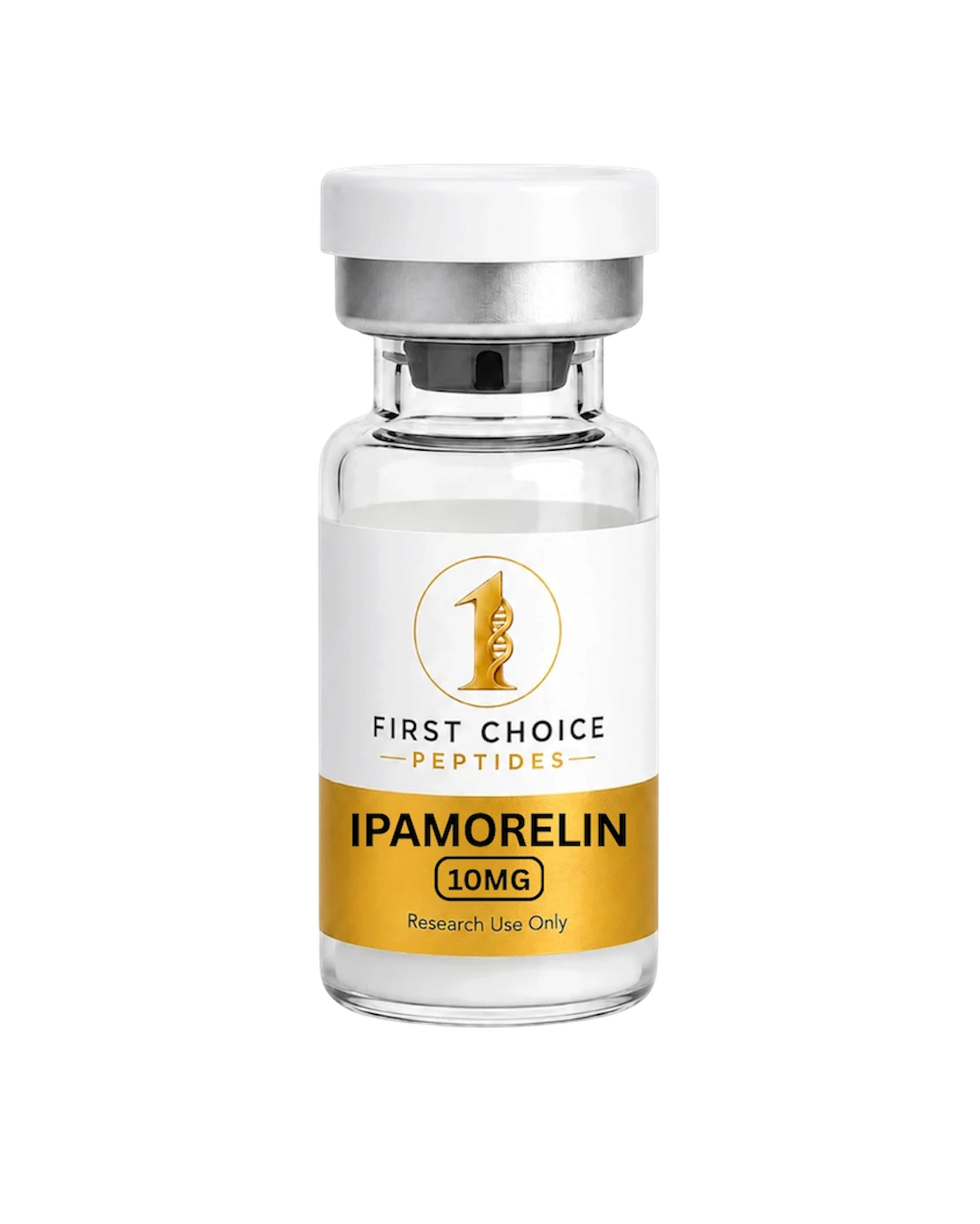

Ipamorelin is a synthetic pentapeptide (CAS 170851-70-4, C38H49N9O5, 711.90 g/mol). Sequence, identifiers, storage and literature. Research use only.
Ipamorelin at a glance
- CAS number
- 170851-70-4
- Molecular formula
- C38H49N9O5
- Molecular weight
- 711.90 g/mol
What Ipamorelin is
Ipamorelin is a synthetic 5-residue peptide whose sequence corresponds to no natural protein: it is a designed pentapeptide built from a mixture of natural, non-natural and D-configured amino acids, developed as a ligand for the ghrelin receptor, also called the growth hormone secretagogue receptor. That places it in a different category from the sequence-derived entries in this catalogue. It is not a fragment of a larger protein but a synthetic construct whose composition was chosen residue by residue.
The catalogue files the entry under cell biology and records no synonyms, so Ipamorelin is the only name attached to this material here. It has been the subject of published laboratory and preclinical research within receptor pharmacology, and it appears in analytical work as a reference compound for peptides containing non-standard residues.
The catalogue presentation is a 10 mg vial of lyophilized powder. First Choice Peptides supplies Ipamorelin exclusively as a reference compound for controlled analytical, biochemical and cell-based laboratory research. It is not for human or veterinary use.
Structure and identifiers
The sequence is written Aib-His-D-2-Nal-D-Phe-Lys-NH2. Three features of that notation carry most of the chemistry. Aib is 2-aminoisobutyric acid, a non-natural residue with two methyl groups on the alpha carbon, which constrains backbone flexibility. D-2-Nal and D-Phe are D-configured aromatic residues, that is, mirror images of the natural L forms, which is why an amino-acid analysis of a hydrolysate has to be chiral to be meaningful for this molecule. The C-terminal NH2 denotes an amide rather than a free carboxylic acid, so the C terminus carries no negative charge at neutral pH.
It is catalogued under CAS 170851-70-4 with the molecular formula C38H49N9O5 and a molecular weight of 711.90 g/mol. The formula contains no sulfur, consistent with a sequence carrying no cysteine or methionine, and the single lysine side chain supplies the main basic centre in the molecule. The molecular weight of 711.90 g/mol is the expected mass against which identity testing is run, and at this size the peptide is usually observed as a singly or doubly charged ion rather than as a broad charge envelope. Salt form and counter-ion content are not recorded in the catalogue entry and are not stated here.
What the published literature has examined
Published work has examined Ipamorelin within receptor pharmacology and endocrine research, in the context of the ghrelin receptor, also called the growth hormone secretagogue receptor, and the associated receptor-signalling pathways. The papers listed on this page are bibliographic references only; they are not evidence of safety or efficacy and describe laboratory findings, not any use in people or animals.
The single reference listed for this entry is a 2020 review in Translational Andrology and Urology that surveys growth hormone secretagogues as a class within the clinical endocrinology literature. It is a review rather than a primary laboratory report, and it is listed as a bibliographic pointer to that class literature, not as a description of anything this material does. No result from it is restated here.
The laboratory literature that surrounds a compound of this type is mainly receptor pharmacology and analytical chemistry. Receptor work is done in cell lines expressing the growth hormone secretagogue receptor, using radioligand or fluorescent binding assays and second-messenger readouts such as calcium mobilisation or inositol phosphate accumulation, together with structure-activity comparisons across analogues that vary a single residue. Analytical work concerns synthesis and purification of sequences containing non-natural and D residues, chiral analysis, and detection methods that separate the intended pentapeptide from close structural relatives. Those are the questions to which this material is a suitable reference standard.
Storage and handling as a laboratory reagent
The catalogue storage table lists two states for this entry. Lyophilized peptide is held at -20 C and protected from light. Reconstituted solution is held at 2 to 8 C and treated as a short-term laboratory reagent rather than a long-term stock.
A sealed vial is best equilibrated to room temperature before opening, so that condensation does not settle on the powder, and a brief spin down collects any material that has moved to the stopper during transit. After reconstitution, single-use aliquots are preferable to repeated withdrawals from one vial, and repeated freeze-thaw cycling is avoided, since each cycle is an opportunity for aggregation and for loss of intact peptide. The two aromatic residues make light exposure worth limiting for solutions left on the bench, and aliquots labelled with lot number and date keep every analytical result traceable to a single certificate of analysis. Concentration arithmetic for a given vial mass and diluent volume can be worked through with the reconstitution calculator, and the usual laboratory diluent for a lyophilized peptide of this type is bacteriostatic water.
Analytical verification
Purity and identity are verified by third-party HPLC and mass spectrometry, with one certificate of analysis issued per lot. Reversed-phase HPLC reports purity as a percentage of integrated peak area, and mass spectrometry confirms identity by matching the measured mass against the expected molecular weight of 711.90 g/mol. Documents for a given lot are filed in the certificate library.
For a designed pentapeptide the identity test does specific work that a purity number cannot do alone. A diastereomer in which a D residue has been replaced by its L form has the same molecular weight as the intended compound, so mass alone does not resolve it, while the chromatographic method is what separates the two. Reading the chromatogram and the mass spectrum together is therefore the point, and the reasoning behind each is set out in HPLC peptide purity and in peptide identity testing by mass spectrometry. Nothing beyond the HPLC purity result, the mass spectrometry identity result and the per-lot certificate is claimed for this material.
Published literature
Papers in which Ipamorelin has been the subject of laboratory or preclinical study. Listed for bibliographic reference only.
Research and educational purposes only. These references are provided for bibliographic context. They are not evidence of safety or efficacy, and nothing here is medical advice or a claim about any use in humans or animals.
Translational andrology and urology
Beyond the androgen receptor: the role of growth hormone secretagogues in the modern management of body composition in hypogonadal males
The Journal of pharmacology and experimental therapeutics
Efficacy of ipamorelin, a novel ghrelin mimetic, in a rodent model of postoperative ileus
European journal of endocrinology
Ipamorelin, the first selective growth hormone secretagogue
Research use only