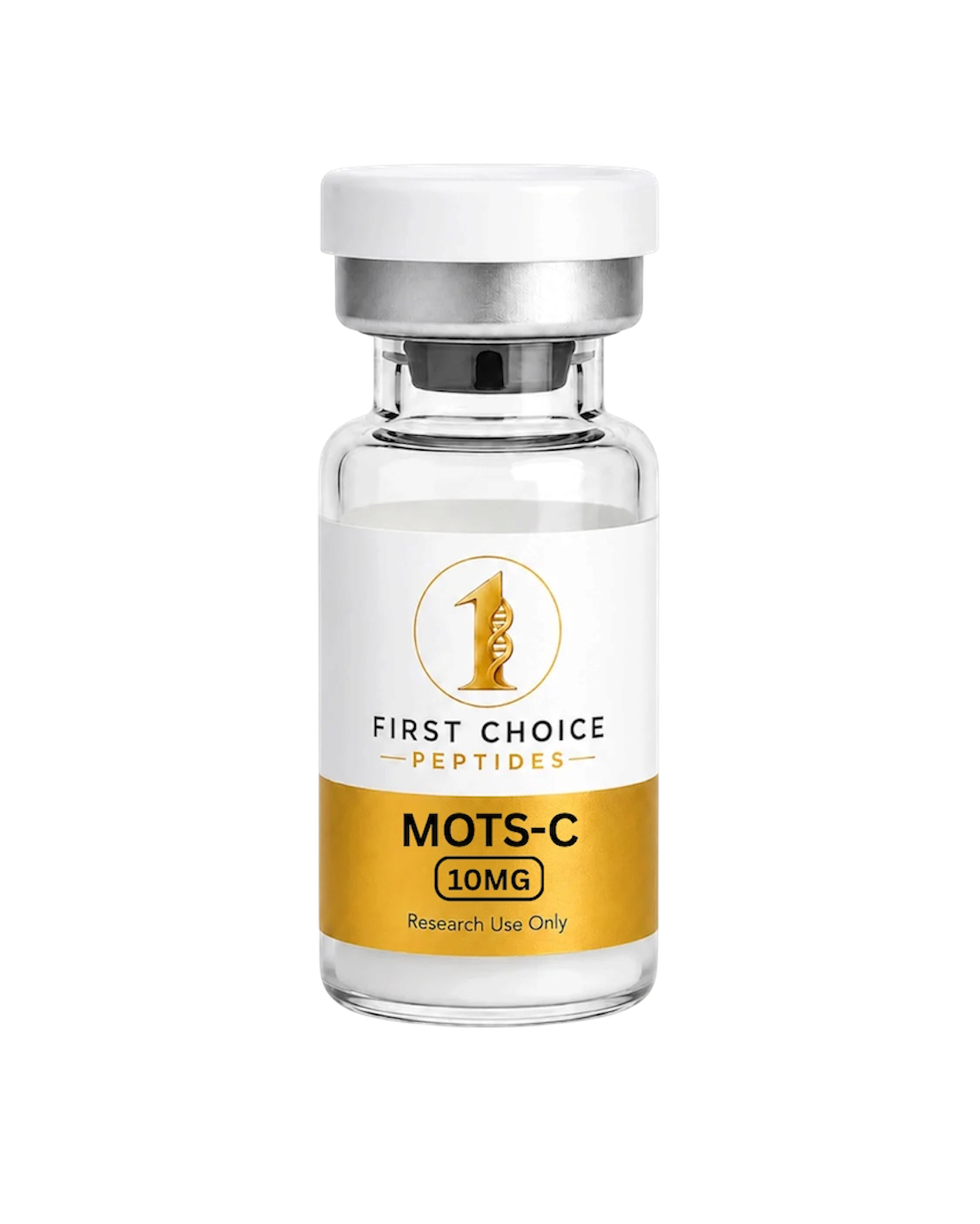

MOTS-c is a 16-residue mitochondrial-derived peptide (CAS 1627580-64-6, C101H152N28O22S2). Sequence, identity and storage. Research use only.
MOTS-C at a glance
- CAS number
- 1627580-64-6
- Molecular formula
- C101H152N28O22S2
- Molecular weight
- 2174.60 g/mol
What MOTS-c is
MOTS-c is a synthetic 16-residue peptide whose sequence corresponds to a mitochondrial-derived peptide, an open reading frame encoded within the mitochondrial genome rather than in nuclear DNA. That origin is what makes the sequence interesting as a class: mitochondrial-derived peptides are studied as a small family of short sequences read from mitochondrial DNA, and MOTS-c is one of the most frequently cited members of it. The material supplied here is chemically synthesised, not extracted from cells.
The catalogue files the entry under cell biology, records no synonyms and lists two presentations, a 10 mg vial and a 40 mg vial, both as lyophilized powder. The peptide has been the subject of published laboratory and preclinical research in mitochondrial biology, cellular bioenergetics and metabolic research, and it appears in that literature both as a subject of study and as a synthetic reference sequence.
First Choice Peptides supplies MOTS-c strictly for laboratory research use. It is not a drug, not a dietary product, and it is not for human or veterinary use.
Structure and identifiers
In single-letter notation the sequence is written MRWQEMGYIFYPRKLR. It is a 16-residue chain with two methionine residues, two arginines near the C terminus plus a lysine, and three aromatic residues, tryptophan and two tyrosines, alongside a phenylalanine. The basic residues give the peptide a net positive charge at neutral pH, and the aromatic content means it absorbs usefully at 280 nm, which is convenient for concentration checks by ultraviolet absorbance.
It is catalogued under CAS 1627580-64-6 with the molecular formula C101H152N28O22S2 and a molecular weight of 2174.60 g/mol. The two sulfur atoms in that formula correspond to the two methionine residues in the sequence, which is a useful internal consistency check between the written sequence and the catalogued composition. Methionine is also the residue most prone to oxidation in a stored peptide, and an oxidised species appears in a mass spectrum as a mass increase of 16 units per oxidised residue, so a lot report for this sequence is read with that in mind. The molecular weight of 2174.60 g/mol is the expected mass against which identity testing is run. Salt form and counter-ion content are not recorded in the catalogue entry and are not stated here.
What the published literature has examined
Published work has examined MOTS-c in cultured cell systems and in rodent models within mitochondrial biology, cellular bioenergetics, metabolic research and gene-regulation research. The papers listed on this page are bibliographic references only; they are not evidence of safety or efficacy and describe laboratory findings, not any use in people or animals.
The largest share of the listed record is review literature. A 2019 essay in BioEssays frames the peptide as a mitochondrially encoded regulator that acts on the nucleus, which is the retrograde-signalling question: how signals originating in the mitochondrion reach nuclear gene expression. A 2023 review in Frontiers in Endocrinology and a 2023 review in the Journal of Translational Medicine survey the same field more broadly, covering cellular-stress and metabolic-regulation models. Reviews of this type are best used as bibliographies of which model systems and which measurement techniques have been applied.
The primary work behind those reviews sits mostly in cell culture and in rodent models. A 2016 paper in Free Radical Biology and Medicine belongs to the metabolic-regulation literature, and a 2023 review in Frontiers in Physiology covers bone-tissue metabolism models specifically, which shows how the same sequence is examined across different tissue systems. The recurring techniques across this literature are cell culture with gene and protein expression profiling, measurements of mitochondrial function such as oxygen consumption and membrane potential, metabolite quantification by mass spectrometry, and transcriptome-scale sequencing.
A further part of the record is analytical and methodological: detecting and quantifying a short mitochondrial-derived sequence in complex biological matrices is a chromatography and mass-spectrometry problem in its own right, and the synthetic peptide is the reference material those methods are calibrated against. No outcome from any of the listed studies is described on this page.
Storage and handling as a laboratory reagent
The catalogue entry carries no storage table of its own, so the standard handling for a lyophilized research peptide applies. Lyophilized material is held at -20 C and protected from light. Reconstituted solution is held at 2 to 8 C and treated as a short-term laboratory reagent rather than a long-term stock.
A sealed vial is best equilibrated to room temperature before opening, so that condensation does not settle on the powder, and a brief spin down collects powder that has moved onto the stopper in transit. After reconstitution, single-use aliquots are preferable to repeated withdrawals, and repeated freeze-thaw cycling is avoided, since each cycle is an opportunity for aggregation and for loss of intact peptide. A methionine-containing sequence also rewards attention to oxidation: limited headspace air, protection from light and minimal time at room temperature all reduce the chance that a solution drifts away from the composition on its certificate. Aliquots labelled with lot number and date keep results traceable to a single certificate of analysis. Concentration arithmetic for a given vial mass and diluent volume can be worked through with the reconstitution calculator, and the usual laboratory diluent for a lyophilized peptide of this type is bacteriostatic water.
Analytical verification
Purity and identity are verified by third-party HPLC and mass spectrometry, with one certificate of analysis issued per lot. Reversed-phase HPLC reports purity as a percentage of integrated peak area, and mass spectrometry confirms identity by matching the measured mass against the expected molecular weight of 2174.60 g/mol. Documents for a given lot are filed in the certificate library.
For this sequence the two reports are complementary in a specific way: an oxidised methionine variant shifts the measured mass while often eluting close to the main peak, so the chromatogram and the mass spectrum are read together rather than separately. How a purity figure is generated and what it does and does not cover is set out in what 99 percent peptide purity means, and the structure of the accompanying lot document is covered in how to verify a peptide certificate of analysis. Nothing beyond the HPLC purity result, the mass spectrometry identity result and the per-lot certificate is claimed for this material.
Published literature
Papers in which MOTS-C has been the subject of laboratory or preclinical study. Listed for bibliographic reference only.
Research and educational purposes only. These references are provided for bibliographic context. They are not evidence of safety or efficacy, and nothing here is medical advice or a claim about any use in humans or animals.
Frontiers in endocrinology
MOTS-c: A promising mitochondrial-derived peptide for therapeutic exploitation
Frontiers in physiology
Role of MOTS-c in the regulation of bone metabolism
Diabetes & metabolism journal
Mitochondrial-Encoded Peptide MOTS-c, Diabetes, and Aging-Related Diseases
Journal of translational medicine
Mitochondria-derived peptide MOTS-c: effects and mechanisms related to stress, metabolism and aging
BioEssays : news and reviews in molecular, cellular and developmental biology
MOTS-c: A Mitochondrial-Encoded Regulator of the Nucleus
Free radical biology & medicine
MOTS-c: A novel mitochondrial-derived peptide regulating muscle and fat metabolism
Research use only