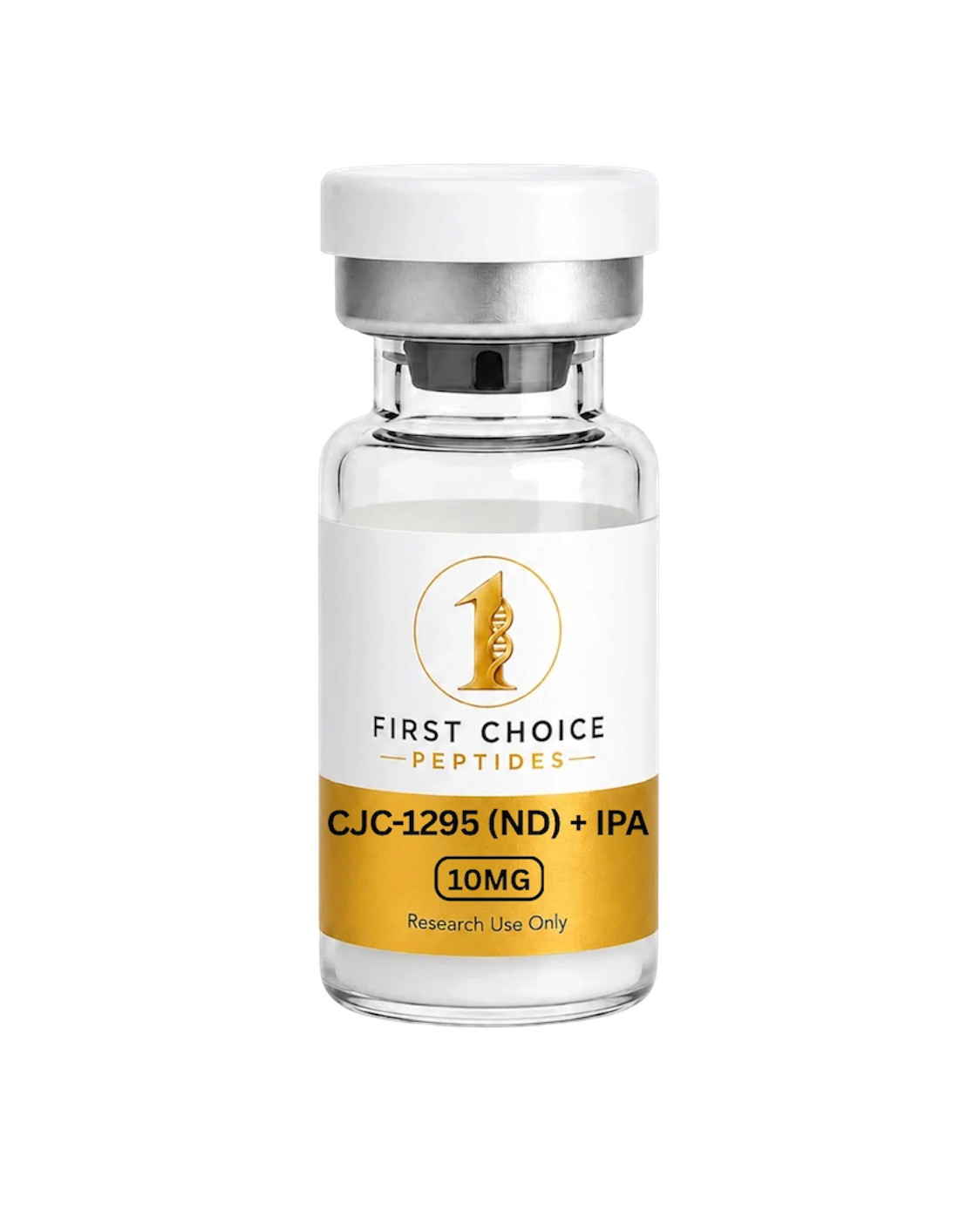

CJC-1295 (ND) + Ipamorelin is a two-peptide research blend: a tetrasubstituted GHRH(1-29) analogue and a synthetic pentapeptide ghrelin mimetic. Research use only.
What CJC-1295 (ND) + Ipamorelin is
CJC-1295 (ND) + Ipamorelin is a two-component research blend supplied as a single lyophilized preparation that contains two distinct synthetic peptides, each with its own structural identity and its own body of published laboratory research. The catalogue lists the blend in 10 mg and 20 mg presentations, with the two constituents present in equal amounts, and files it under cell-biology research materials. The blend exists so that a laboratory holds both peptides as one catalogue reference rather than two separate items when both are required in the same experimental series.
The first constituent, CJC-1295 without the drug affinity complex, is a synthetic analogue of growth hormone releasing hormone, the hypothalamic peptide usually abbreviated GHRH and also written in the older literature as growth hormone releasing factor, or GRF. Its chain corresponds to the 29-residue amino-terminal fragment of that parent hormone, the fragment written as GHRH(1-29), and it carries four amino-acid substitutions relative to the native sequence, which is why it is described as a tetrasubstituted analogue. The letters ND in the product name mark the absence of the drug affinity complex modification, so the material supplied here is the substituted GHRH(1-29) chain on its own. CJC-1295 is not stocked as a separate catalogue product, so no standalone reference page exists for it.
The second constituent, ipamorelin, is a synthetic pentapeptide and a ghrelin mimetic, meaning its structure was designed to engage the growth hormone secretagogue receptor, a receptor distinct from the GHRH receptor that the first constituent addresses. Ipamorelin is stocked as a standalone catalogue product and has its own reference page at ipamorelin, where its identifiers and literature are set out in full. Holding both peptides in one vial gives a laboratory two structurally unrelated ligands for two separate receptor systems that sit within the same endocrine axis.
The blend is supplied strictly for laboratory research use. It is not for human or veterinary use, and it is not for consumption, administration, diagnostic use or therapeutic use.
Structure and identifiers
Ipamorelin is a short chain built from five residues, several of which are not standard proteinogenic amino acids. Its sequence is written Aib-His-D-2-Nal-D-Phe-Lys-NH2. The first position is alpha-aminoisobutyric acid, a non-natural residue abbreviated Aib that constrains the local backbone geometry. The third and fourth positions are D-amino acids, D-2-naphthylalanine and D-phenylalanine, and the carboxy terminus is present as an amide rather than a free acid, indicated by the trailing NH2. That combination of a non-natural residue, two D-configuration residues and a terminal amide is a common design signature in small synthetic secretagogue chemistry, and it is the reason ipamorelin is far shorter than the peptide it is blended with.
CJC-1295 without the drug affinity complex is the longer of the two constituents at 29 residues. Its four substitutions sit against the native GHRH(1-29) background, and because the drug affinity complex is absent, the chain carries no appended reactive group of the kind used in the modified form of the analogue. The specific substituted positions are not recorded in this catalogue entry and are therefore not stated here.
Because the item is a blend of two separate peptides rather than a single molecular entity, the catalogue does not record one CAS registry number, one molecular formula or one molecular weight for it, and no such combined value is stated here. The identifiers that apply to ipamorelin as a standalone material are listed on its own catalogue page. Each constituent retains its own expected mass, and that is the basis on which the blend is checked analytically, as described further below. The catalogue lists no additional synonyms for the blend as supplied.
What the published literature has examined
Published work has examined the two constituents of this blend in receptor-pharmacology and cell-signalling models within neuroendocrinology, peptide chemistry and analytical method development. Work on the GHRH analogue class sits within studies of GHRH receptor signalling and of how substitutions in a short hormone fragment alter the behaviour of a synthetic chain in vitro, while work on ipamorelin sits within studies of the growth hormone secretagogue receptor and of ghrelin mimetic structure-activity relationships. Any papers cited elsewhere in this catalogue are bibliographic references only; they are not evidence of safety or efficacy and describe laboratory findings, not any use in people or animals.
No bibliographic references are listed on this page for the blend as supplied. The literature that exists addresses the individual constituents rather than the combination, and a substantial part of the published record for both peptide classes is clinical or regulatory in nature and therefore outside the scope of a research-material reference page. The catalogue lists this item as a research material only, and no references are invented to fill the gap. Readers looking for the reference set that accompanies the standalone constituent will find it on the ipamorelin page.
Storage and handling as a laboratory reagent
The blend arrives as a lyophilized powder under vacuum. In that form it is held at -20 C and protected from light, which is the standard condition for short synthetic peptides in a laboratory freezer. Vials are brought to ambient temperature before opening so that condensation does not settle on the cake, since introduced moisture is the most common avoidable cause of degradation in a lyophilized preparation.
Once reconstituted, the solution is kept refrigerated at 2 to 8 C for short-term laboratory use, and repeated freeze-thaw cycling is avoided; aliquoting a single reconstitution into working volumes at the point of preparation is the usual way to keep the number of cycles at one. Because this item contains two peptides of very different length, a single reconstitution volume governs the concentration of both, which makes the arithmetic worth recording before the first withdrawal rather than after. The reconstitution calculator works out the resulting concentration for a given vial size and diluent volume, and bacteriostatic water is the diluent normally stocked alongside lyophilized peptide materials for this purpose.
Analytical verification
Identity and purity for this blend are established by third-party analysis. Purity is measured by high-performance liquid chromatography, and identity is confirmed by mass spectrometry against the expected molecular weight of each constituent, so that both peptides are accounted for rather than the mixture being treated as one unresolved peak. A certificate of analysis is issued for each lot and is filed in the certificate library, where it can be matched to the lot number printed on the vial.
Two background articles explain what those two measurements do and do not establish. The chromatographic side is covered in HPLC peptide purity, which sets out what a purity figure describes and what it leaves out, and the mass side is covered in mass spectrometry peptide testing, which explains how an observed mass is compared with an expected one. Both are worth reading together, because a blend is the case where a purity number alone is least informative and the mass evidence carries most of the identity claim.
Published literature
Papers in which CJC-1295 (ND) + Ipamorelin has been the subject of laboratory or preclinical study. Listed for bibliographic reference only.
Research and educational purposes only. These references are provided for bibliographic context. They are not evidence of safety or efficacy, and nothing here is medical advice or a claim about any use in humans or animals.
Drug testing and analysis
Advances in the detection of growth hormone releasing hormone synthetic analogs
Endocrinology
Human growth hormone-releasing factor (hGRF)1-29-albumin bioconjugates activate the GRF receptor on the anterior pituitary in rats: identification of CJC-1295 as a long-lasting GRF analog
Research use only