
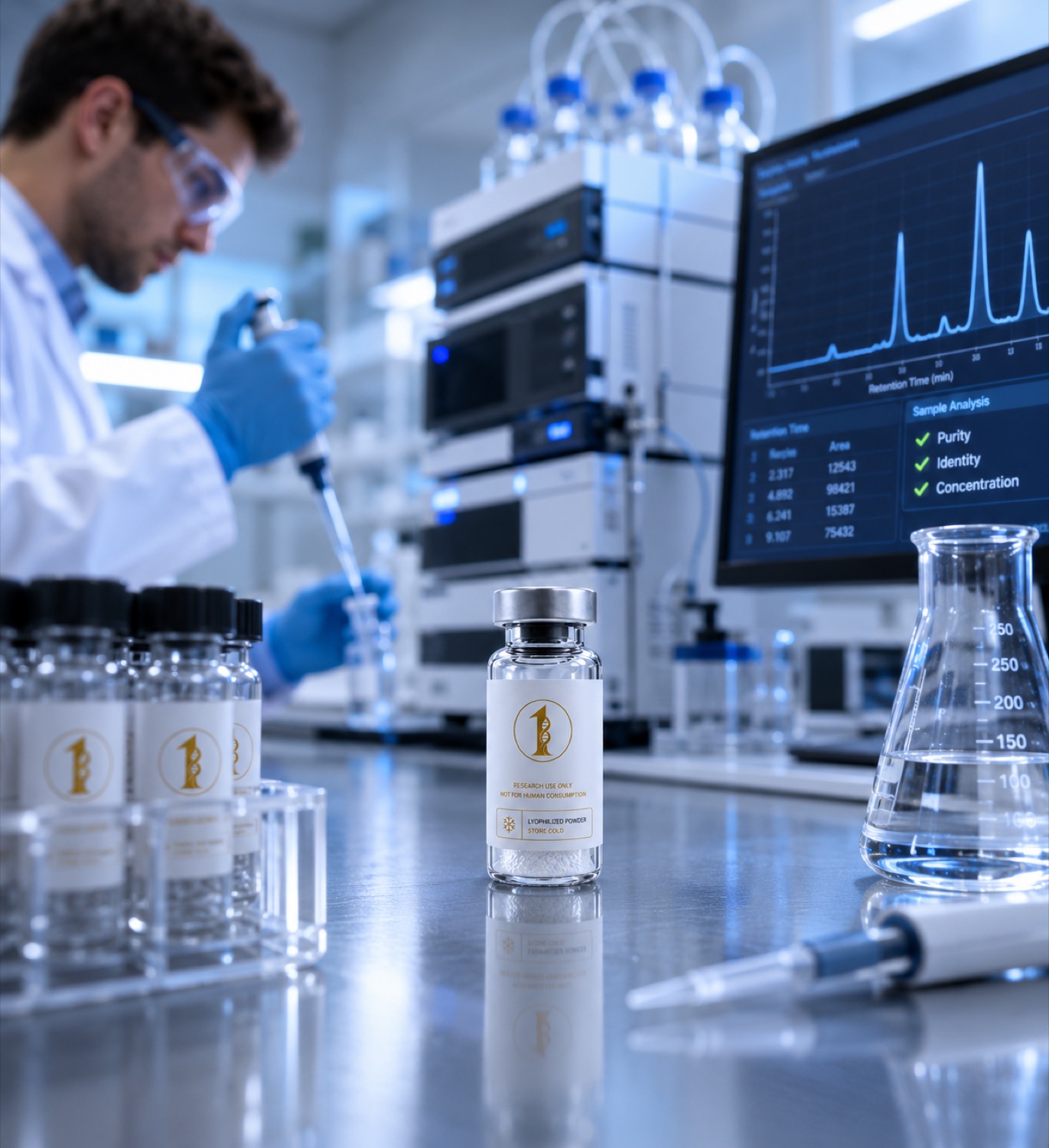
What sets the shelf life of a freeze-dried peptide: moisture, temperature, light, sequence chemistry and handling in the laboratory. Research use only.
Short answer
A lyophilized peptide sealed in its original vial and held cold, dark and dry is the most stable form the material will ever take. Freeze-dried peptide powders are generally handled as stable for many months at refrigerator temperature and for a year or longer at minus 20 degrees Celsius or below, while the same sequence dissolved in water degrades on a scale of days to weeks. Shelf life is therefore not a single number printed on a label. It is the product of the sequence itself, the residual moisture left in the cake, the storage temperature, exposure to light and air, and how often the vial is opened and warmed. All compounds discussed are supplied strictly as laboratory research materials. They are not for human or veterinary use, and nothing here is medical advice.
Why the dry state buys time
Almost every reaction that destroys a peptide needs water, either as a reactant or as a plasticiser that gives the backbone enough local mobility to rearrange. Freeze-drying removes both roles at once. A review of solid-state chemical stability in proteins and peptides sets out the general picture: degradation in the dry solid is far slower than in solution, but it is not zero, and its rate tracks residual moisture content and the mobility of the amorphous matrix rather than the simple concentration terms that govern solution kinetics (PMID 10229638).
The cake left behind after primary and secondary drying is usually an amorphous glass rather than a crystalline solid. Below the glass transition temperature of that matrix the material is rigid and molecular motion is slow. Above it the matrix softens, mobility rises, and chemical degradation and physical collapse accelerate together. Formulation work on lyophilized recombinant human interleukin-11 compared disaccharide and hydroxyethyl starch mixtures and measured how the excipient choice changed storage stability of the dried solid, which is a direct demonstration that the matrix around the peptide, and not only the peptide, sets the storage clock (PMID 14762907).
The degradation routes that set the clock
Shelf life is easier to reason about when it is broken into the specific chemical routes available to a given sequence. Stability studies on recombinant human parathyroid hormone fragment 1-34 characterised the modes of degradation and the resulting impurities across storage conditions, and the same route map applies to research peptides in general (PMID 22293522).
Hydrolysis
Water attacks the amide backbone and cleaves it into shorter fragments. Aspartyl residues are the classic weak point, particularly Asp-Pro and Asp-Gly pairs, and acidic conditions accelerate the reaction. In a properly dried cake there is very little water available, which is why hydrolysis dominates in reconstituted solutions and is a minor route in the sealed powder.
Deamidation and isomerisation
Asparagine and glutamine side chains lose ammonia and convert to aspartate or glutamate, frequently by way of a cyclic succinimide intermediate that can also open to the iso-aspartyl form. The result is a molecule with the same nominal mass region but a different chromatographic retention time and a changed charge state. Neutral to slightly alkaline pH and elevated temperature both accelerate it, and it proceeds slowly even in the solid state when residual moisture is high (PMID 10229638).
Oxidation
Methionine, cysteine, tryptophan and to a lesser degree histidine and tyrosine are oxidised by dissolved oxygen, by peroxide traces in excipients, and by metal-catalysed pathways. Light exposure accelerates the process. A vial with a large air headspace, opened repeatedly, gives oxidation more opportunity than a sealed vial opened once.
Aggregation and physical change
Physical failure does not change the covalent structure but does change what is in the tube. Partially unfolded or self-associating molecules form dimers, oligomers and eventually visible particulate. In the dried state the equivalent failure is cake collapse, browning or a powder that has taken up water and turned sticky, all of which are visual signals that the storage condition was breached.
Conditions that move the rate
- Temperature. The single largest lever. Colder storage slows every chemical route described above. Long-term holding of lyophilized material is conventionally at minus 20 degrees Celsius or lower, with refrigeration used for working stock.
- Residual moisture. Water is both reactant and plasticiser, so a cake that was under-dried, or one that absorbed atmospheric moisture through a compromised stopper, degrades faster than a well-dried cake at the same temperature (PMID 10229638).
- Light. Ultraviolet and strong visible light drive oxidation of aromatic and sulfur-containing residues. Amber glass, an outer box, or a dark freezer shelf all address the same problem.
- Air and headspace. Oxygen in the vial headspace is the oxidant of first resort. Vials filled under an inert gas blanket, and vials that are opened as few times as possible, retain purity longer.
- Condensation on handling. Warming a cold vial in ambient humid air deposits water on the cold glass and on the cake. Allowing the sealed vial to equilibrate to room temperature before the stopper is pierced avoids introducing moisture that the drying process was designed to remove.
Reconstituted material runs on a different clock
Once solvent is added, the question changes entirely. Work on lyophilized teriparatide, the parathyroid hormone 1-34 fragment, examined stability specifically after reconstitution and measured how the dissolved material behaved over storage rather than how the powder behaved (PMID 26620825). The general finding across the peptide stability literature is consistent: solutions are the short-lived form, refrigeration extends the window, and repeated warming and cooling shortens it.
Bacteriostatic water containing benzyl alcohol is a common laboratory diluent because the preservative suppresses microbial growth in a multi-draw vial. The preservative is not chemically inert with respect to the peptide, and its interaction with protein and peptide solutions is covered in a companion article on cloudy solutions. Sterile water without preservative gives a solution with no antimicrobial protection at all, which makes single-use aliquots the sensible pairing. Reconstitution volumes and resulting concentrations can be worked out with the reconstitution calculator, and diluent specifications are described on the bacteriostatic water guide.
Sequence features worth noting
Two peptides stored side by side in the same freezer can have very different useful lives, because the residues present decide which degradation routes are open. MOTS-c, sequence MRWQEMGYIFYPRKLR, carries two methionine residues and a tryptophan, so oxidation is a route that exists for that molecule and does not exist for a peptide without sulfur or aromatic residues. BPC-157, sequence GEPPPGKPADDAGLV, contains an aspartate-glycine pair, which is the canonical deamidation and isomerisation motif. GHK-Cu is supplied as a copper(II) complex rather than a bare tripeptide, so its handling questions include the coordination chemistry of the metal as well as the peptide backbone. Composition alone does not predict a shelf life, but it does say which analytical impurity to look for first.
Practical laboratory handling
The handling rules that follow are laboratory practice for research materials and say nothing about use in a person.
- Aliquot once. Reconstitute, split into single-use volumes, and freeze. One thaw per aliquot removes freeze-thaw cycling as a variable entirely.
- Label completely. Compound, lot, concentration, diluent, date of reconstitution and the initials of whoever prepared it. An unlabelled tube in a shared freezer is an unknown, not a stock.
- Equilibrate before opening. Bring the sealed vial to room temperature, then open. Reversing the order deposits condensation on the cake.
- Keep it dark and keep it dry. Original carton, closed freezer, desiccant where the storage box permits it.
- Do not top up an old vial. Adding fresh diluent to a partly used vial resets nothing and merely mixes two ages of material.
- Record the appearance. A cake that has shrunk, browned or slumped, or a solution that has gone hazy, is a stability observation and belongs in the notebook alongside the assay data.
Verifying stability rather than assuming it
Storage guidance is a prediction. Analysis is a measurement. Reversed-phase chromatography resolves the degradation products described above from intact material, so a purity trace run on receipt and again after storage turns an assumption into a number; the method is described in the article on HPLC peptide purity. Mass measurement identifies what the new peaks actually are, since deamidation, oxidation and hydrolysis each shift mass in a characteristic direction, and that approach is set out in the article on mass spectrometry peptide testing. The lot documentation supplied with the material is the baseline both comparisons are made against, and reading one critically is covered in how to verify a peptide certificate of analysis. Lot documents for catalogue items are published on the certificates page, and the diluent itself is listed under bacteriostatic water.
All compounds discussed are supplied strictly as laboratory research materials. They are not for human or veterinary use, and nothing here is medical advice.
References
- Solid-state chemical stability of proteins and peptides. Journal of pharmaceutical sciences, 1999. PMID 10229638
- Modes of Degradation and Impurity Characterization in rhPTH (1-34) during Stability Studies. PDA journal of pharmaceutical science and technology, 2011. PMID 22293522
- Optimizing storage stability of lyophilized recombinant human interleukin-11 with disaccharide/hydroxyethyl starch mixtures. Journal of pharmaceutical sciences, 2004. PMID 14762907
- Stability of lyophilized teriparatide, PTH(1-34), after reconstitution. European journal of pharmaceutics and biopharmaceutics : official journal of Arbeitsgemeinschaft fur Pharmazeutische Verfahrenstechnik e.V, 2016. PMID 26620825
Research use only