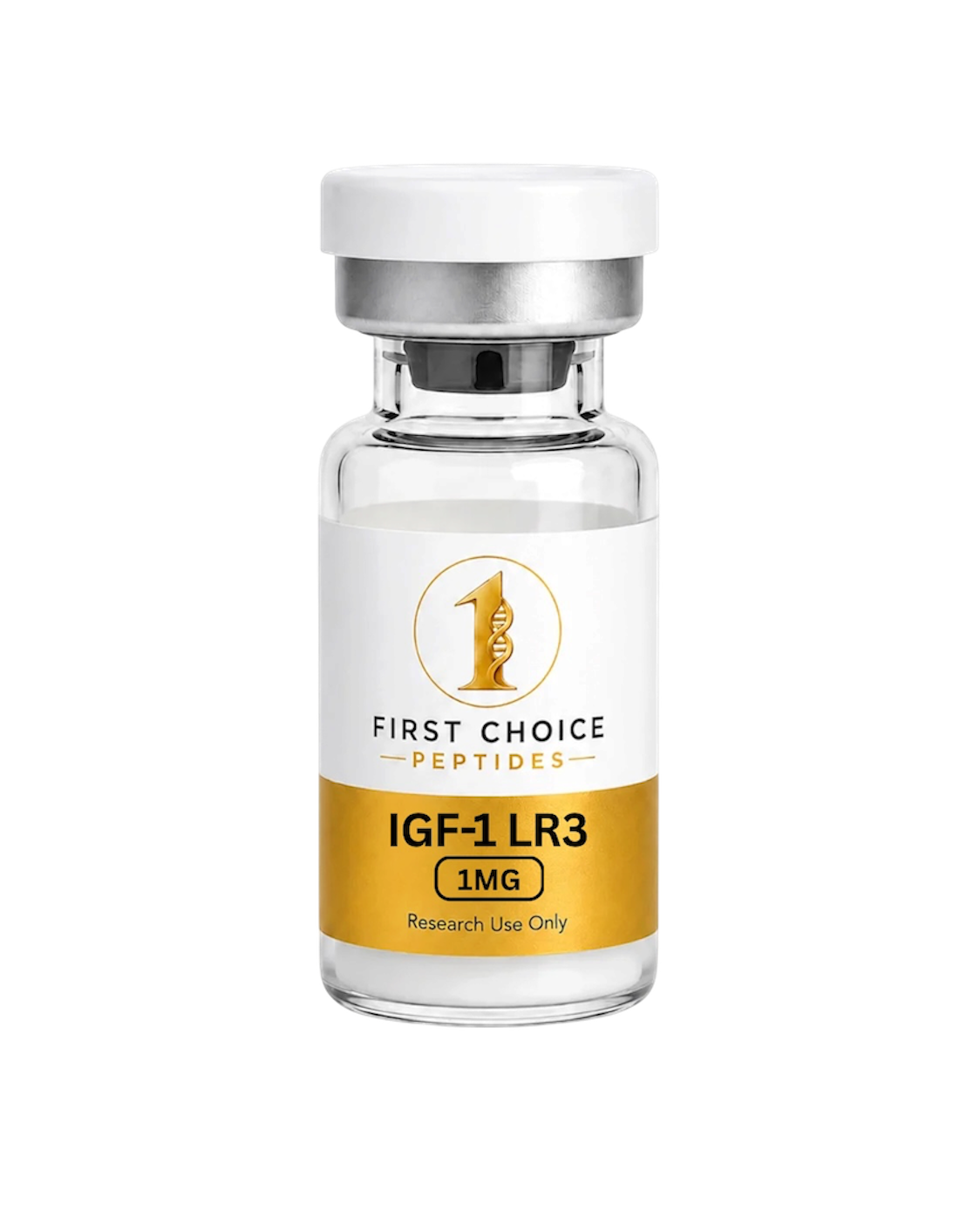

IGF-1 LR3 is an 83-residue synthetic analogue of human IGF-1 (C400H625N111O115S9) with an N-terminal extension and an arginine at position three. Research use only.
IGF-1 LR3 at a glance
- Molecular formula
- C400H625N111O115S9
What IGF-1 LR3 is
IGF-1 LR3 is a synthetic 83-residue peptide whose sequence corresponds to human insulin-like growth factor 1 carrying two deliberate structural changes: an extension added at the amino terminus and an arginine substitution at position three. The name records both changes. The L stands for the long form produced by the amino-terminal extension, and the R3 stands for the arginine at the third position, which is what distinguishes this analogue from the unmodified growth factor. Because the analogue is longer than the parent chain, it is sometimes written in the literature as Long R3 IGF-I, and papers from the 1990s onward use that spelling with and without hyphens.
The parent molecule, insulin-like growth factor 1, is a single-chain polypeptide of the insulin superfamily, structurally related to proinsulin and folded through internal disulfide bonds. It is one of the most heavily studied growth factors in cell biology, and a large part of that literature concerns not the factor alone but its interaction with the family of insulin-like growth factor binding proteins that associate with it in biological fluids and in culture medium. IGF-1 LR3 was designed as a variant of that chain, and its place in the research catalogue is as a comparator against native IGF-1 in experiments where binding-protein interactions are a variable of interest.
The catalogue files IGF-1 LR3 under cell-biology research materials and stocks it in a 1 mg presentation. It has been the subject of published laboratory and preclinical research since the mid-1990s, chiefly in growth-factor receptor and binding-protein model systems. It is supplied strictly for laboratory research use. It is not for human or veterinary use, and it is not for consumption, administration, diagnostic use or therapeutic use.
Structure and identifiers
The full 83-residue sequence of this analogue is not reproduced here. What the catalogue records about its structure is the residue count, the presence of an amino-terminal extension relative to native human IGF-1, and the arginine substitution at position three. Those two modifications sit at the same end of the molecule, within the amino-terminal region that the binding-protein literature treats as the principal contact surface, which is why this analogue and the native factor are so often run side by side in the same experiment.
Structurally, the chain is closer to a small protein than to the short synthetic peptides that make up most of a peptide catalogue. At 83 residues it folds rather than remaining extended in solution, and it carries the internal disulfide bonding characteristic of the insulin superfamily. That has practical consequences for handling: the material is sensitive to conditions that disturb tertiary structure, and its behaviour in solution depends on pH and on the composition of the buffer far more than a nine-residue or fifteen-residue peptide would.
The catalogue lists the molecular formula C400H625N111O115S9. The nine sulphur atoms in that formula reflect the cysteine and methionine content of the chain, and the cysteines are the residues that form its internal disulfide bonds. A CAS registry number is not recorded for this material in the catalogue, and no molecular weight value is catalogued here either, so neither is stated on this page. The expected mass used for analytical comparison is the one calculated from the formula above, and the certificate of analysis for a given lot is the record of what was measured. The catalogue lists no additional synonyms beyond the long-form spelling described above.
What the published literature has examined
Published work has examined IGF-1 LR3 in cultured myogenic cell systems, in recombinant binding-protein assays and in whole-animal comparative endocrinology models within growth-factor and endocrine research. The papers listed on this page are bibliographic references only; they are not evidence of safety or efficacy and describe laboratory findings, not any use in people or animals.
Two of the listed papers, published in the Journal of Cellular Physiology in 2004 and the Journal of Endocrinology in 2005, are cell-culture studies in which the analogue was used alongside native IGF-I in the presence or absence of a recombinant binding protein. The model systems in those papers are the L6 myogenic cell line and primary porcine embryonic myoblast cultures, and the measured endpoints are proliferation and differentiation markers in culture. The binding proteins produced and characterised in that work are IGFBP-3 and IGFBP-5, both expressed recombinantly for the purpose. Papers of this kind are essentially assay-design work: the analogue is present as a second ligand so that the contribution of the binding protein to the readout can be separated from the contribution of the growth factor itself.
Two further papers, in the Journal of Endocrinology in 1995 and 1997, are whole-animal endocrinology studies in guinea pig and pig models. Their measured variables are circulating concentrations of IGF-I, IGF-II, growth hormone and IGF binding protein-3, together with organ and tissue mass measurements. A fifth paper, published in Growth Factors in 2002, concerns intestinal absorption methodology and uses 3-O-methyl-D-glucose transport alongside measurements of gut mucosal tissue as its analytical endpoints. The direction and magnitude of the findings in all five papers are outside what this page describes; the citations are here to identify the fields, models and measurement techniques in which the analogue appears.
Storage and handling as a laboratory reagent
The material is supplied lyophilized and is stored in that form at -20 C, protected from light. Vials are equilibrated to ambient temperature before opening so that moisture does not condense onto the cake. For a folded 83-residue chain the handling margin is narrower than for a short synthetic peptide: mechanical agitation, extremes of pH and adsorption to container surfaces all matter more here than they would for a nine-residue sequence, and gentle mixing rather than vortexing is the usual practice on reconstitution.
Reconstituted solutions are held refrigerated at 2 to 8 C for short-term laboratory use, and repeated freeze-thaw cycling is avoided, with aliquoting at the point of preparation the standard way to hold each portion to a single cycle. The reconstitution calculator converts a vial size and diluent volume into a working concentration, and bacteriostatic water is the diluent normally stocked alongside lyophilized research materials of this kind.
Analytical verification
Purity is determined by third-party high-performance liquid chromatography and identity is confirmed by mass spectrometry against the expected molecular weight calculated from the catalogued formula. A certificate of analysis accompanies each lot and is filed in the certificate library, matched to the lot number on the vial.
Two background articles explain what those numbers mean for a material of this size. What 99 percent peptide purity means sets out what a chromatographic purity figure describes and what it necessarily leaves out, a distinction that matters more for a long folded chain than for a short one, since closely related species are harder to resolve as chain length grows. Mass spectrometry peptide testing covers how an observed mass is compared with a calculated one and why identity and purity remain separate questions answered by separate instruments.
Published literature
Papers in which IGF-1 LR3 has been the subject of laboratory or preclinical study. Listed for bibliographic reference only.
Research and educational purposes only. These references are provided for bibliographic context. They are not evidence of safety or efficacy, and nothing here is medical advice or a claim about any use in humans or animals.
The Journal of endocrinology
Production of recombinant porcine IGF-binding protein-5 and its effect on proliferation of porcine embryonic myoblast cultures in the presence and absence of IGF-I and Long-R3-IGF-I
Journal of cellular physiology
Effect of recombinant porcine IGFBP-3 on IGF-I and long-R3-IGF-I-stimulated proliferation and differentiation of L6 myogenic cells
Growth factors (Chur, Switzerland)
Effects of insulin-like growth factor-I and its analogue, long-R3-IGF-I, on intestinal absorption of 3-O-methyl-D-glucose are less pronounced than gut mucosal growth responses
The Journal of endocrinology
Long [R3] insulin-like growth factor-I reduces growth, plasma growth hormone, IGF binding protein-3 and endogenous IGF-I concentrations in pigs
The Journal of endocrinology
Long R3 insulin-like growth factor-I (IGF-I) infusion stimulates organ growth but reduces plasma IGF-I, IGF-II and IGF binding protein concentrations in the guinea pig
Research use only