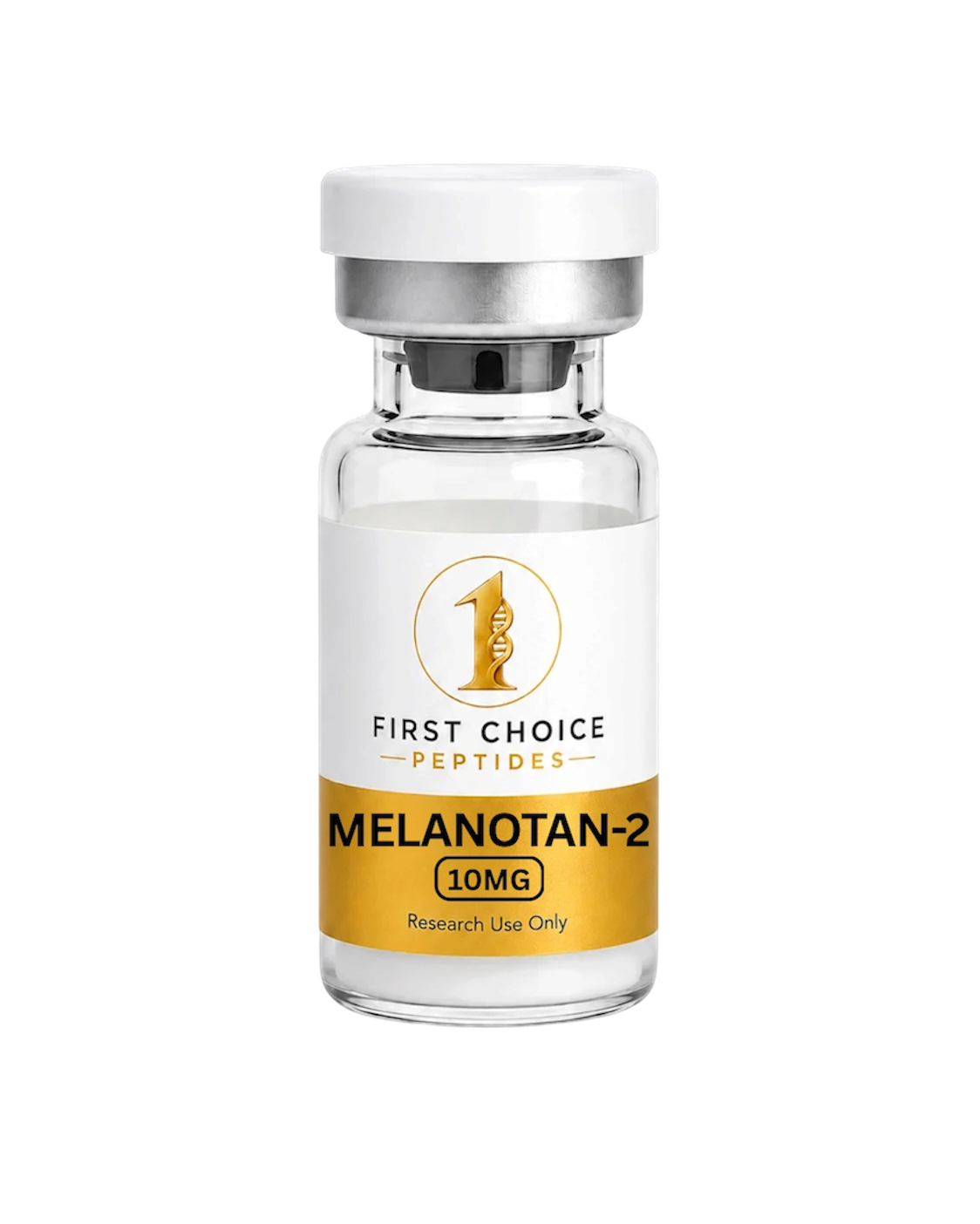

Melanotan-2 is a synthetic cyclic heptapeptide analogue of alpha-MSH (CAS 121062-08-6, C50H69N15O9, 1024.20 g/mol). Identity and handling. Research use only.
Melanotan-2 at a glance
- CAS number
- 121062-08-6
- Molecular formula
- C50H69N15O9
- Molecular weight
- 1024.20 g/mol
What Melanotan-2 is
Melanotan-2 is a synthetic seven-residue peptide whose structure corresponds to a cyclic analogue of alpha-melanocyte-stimulating hormone, the melanocortin peptide usually abbreviated alpha-MSH. It appears in the literature and in catalogue usage as Melanotan II and as MT-II. The parent peptide belongs to the melanocortin family, the group of short peptides derived from the precursor protein proopiomelanocortin, and the melanocortin receptors that this family addresses are a set of G protein-coupled receptors designated MC1R through MC5R. Melanotan-2 was developed as a research tool for laboratory investigation of signalling at that receptor family, and the catalogue describes it as having been used experimentally as a melanocortin receptor agonist in cellular and animal research models.
Two structural facts separate this analogue from its linear parent. It is shorter, at seven residues against the thirteen of the parent peptide, and it is cyclic rather than linear. Cyclisation is the more consequential of the two. A ring-closed backbone has far fewer accessible conformations than an open chain of the same length, so a cyclic analogue presents a more defined and more rigid surface to a receptor, and the same constraint generally makes the molecule less accessible to the exopeptidases that act on free chain termini. That combination, a shortened chain locked into a constrained geometry, is a standard approach in peptide medicinal chemistry for turning a flexible endogenous ligand into a stable laboratory probe, and it is the reason cyclic analogues of this kind became durable reference materials in receptor pharmacology.
The catalogue files Melanotan-2 under dermatology research and stocks it in a 10 mg presentation. It is supplied strictly for laboratory research use. It is not for human or veterinary use, and it is not for consumption, administration, diagnostic use or therapeutic use.
Structure and identifiers
The full residue-by-residue sequence of this analogue is not reproduced on this page. What the catalogue records about its structure is that it is a cyclic heptapeptide and a synthetic analogue of alpha-MSH, and the ring-closure chemistry by which the cycle is formed is not among the recorded details, so it is not stated here either.
The identifiers, however, are recorded in full. Melanotan-2 is catalogued under CAS 121062-08-6 with the molecular formula C50H69N15O9 and a molecular weight of 1024.20 g/mol. Two things are worth reading out of that formula. The absence of sulphur means the molecule contains no cysteine and no methionine, so whatever closes the ring is not a disulfide bond. The high nitrogen count relative to a chain of this length, fifteen nitrogen atoms across seven residues, indicates that several residues carry nitrogen-rich side chains, which is characteristic of the melanocortin family.
The mass of 1024.20 g/mol applies to the free peptide. Material supplied as a salt carries counter-ions that the formula does not represent, and the certificate of analysis for a given lot is the record of what was actually measured. The catalogue lists no further synonyms beyond the Melanotan II and MT-II spellings noted above.
What the published literature has examined
Published work has examined Melanotan-2 within melanocortin receptor pharmacology, using receptor binding and second-messenger signalling assays and structure-activity work on constrained cyclic analogues. The papers relevant to this compound are bibliographic references only; they are not evidence of safety or efficacy and describe laboratory findings, not any use in people or animals.
No bibliographic reference set is listed on this page, and none is invented. The reason is that a substantial part of the published record for this compound is clinical and regulatory in nature rather than laboratory work on the material as a chemical entity, and material of that kind falls outside what a research-material reference page describes. The catalogue lists this item as a research material only.
The laboratory portion of the field it belongs to is defined by its methods rather than by its findings. Melanocortin receptor pharmacology is studied in cell lines expressing individual receptor subtypes, using competitive radioligand and fluorescent binding assays to characterise affinity, and second-messenger readouts, principally cyclic AMP accumulation, to characterise signalling at each subtype. Structure-activity work in this area compares series of analogues that differ in ring size, in the residues held inside the constrained region and in the stereochemistry of individual positions, in order to map which structural features a given receptor subtype distinguishes. Analytical characterisation of the peptides themselves, by chromatographic separation and by mass spectrometry, runs alongside that pharmacology. No result from any of that work is described here.
Storage and handling as a laboratory reagent
The material is supplied lyophilized and is stored in that form at -20 C, protected from light. Vials are brought to ambient temperature before opening so that atmospheric moisture does not condense onto the lyophilized cake, which is the most common avoidable cause of degradation in a dry peptide preparation.
Reconstituted solutions are held refrigerated at 2 to 8 C for short-term laboratory use, and repeated freeze-thaw cycling is avoided. Where a single reconstitution is to be drawn on across several sessions, dividing it into single-use aliquots at the time of preparation holds each portion to one cycle. A constrained cyclic peptide is generally more robust in solution than an equivalent linear chain, but that stability concerns enzymatic cleavage rather than the physical handling losses of adsorption, aggregation and freeze-thaw, which apply here as they do to any other peptide reagent. The reconstitution calculator converts a vial size and a diluent volume into a working concentration, and bacteriostatic water is the diluent normally stocked for reconstituting lyophilized peptide research materials.
Analytical verification
Purity is determined by third-party high-performance liquid chromatography and identity is confirmed by mass spectrometry against the expected molecular weight of 1024.20 g/mol. A certificate of analysis is issued for each lot and filed in the certificate library, where it can be matched to the lot number printed on the vial.
Two background articles cover what those two measurements establish. Peptide identity testing by mass spectrometry explains how an observed mass is compared with a calculated one, a comparison that carries particular weight for a cyclic peptide, since ring closure changes the mass relative to the corresponding open chain and an incompletely cyclised species is therefore distinguishable by mass. What 99 percent peptide purity means sets out what a chromatographic purity figure describes and what it leaves out, and why identity and purity remain two separate questions answered by two separate instruments.
Published literature
Papers in which Melanotan-2 has been the subject of laboratory or preclinical study. Listed for bibliographic reference only.
Research and educational purposes only. These references are provided for bibliographic context. They are not evidence of safety or efficacy, and nothing here is medical advice or a claim about any use in humans or animals.
Journal of medicinal chemistry
CLIPSing Melanotan-II to Discover Multiple Functionally Selective hMCR Agonists
Journal of biological inorganic chemistry : JBIC : a publication of the Society of Biological Inorganic Chemistry
Melanoma targeting with alpha-melanocyte stimulating hormone analogs labeled with fac-[99mTc(CO)3]+: effect of cyclization on tumor-seeking properties
Peptides
Structure-function studies on the cyclic peptide MT-II, lactam derivative of alpha-melanotropin
Research use only