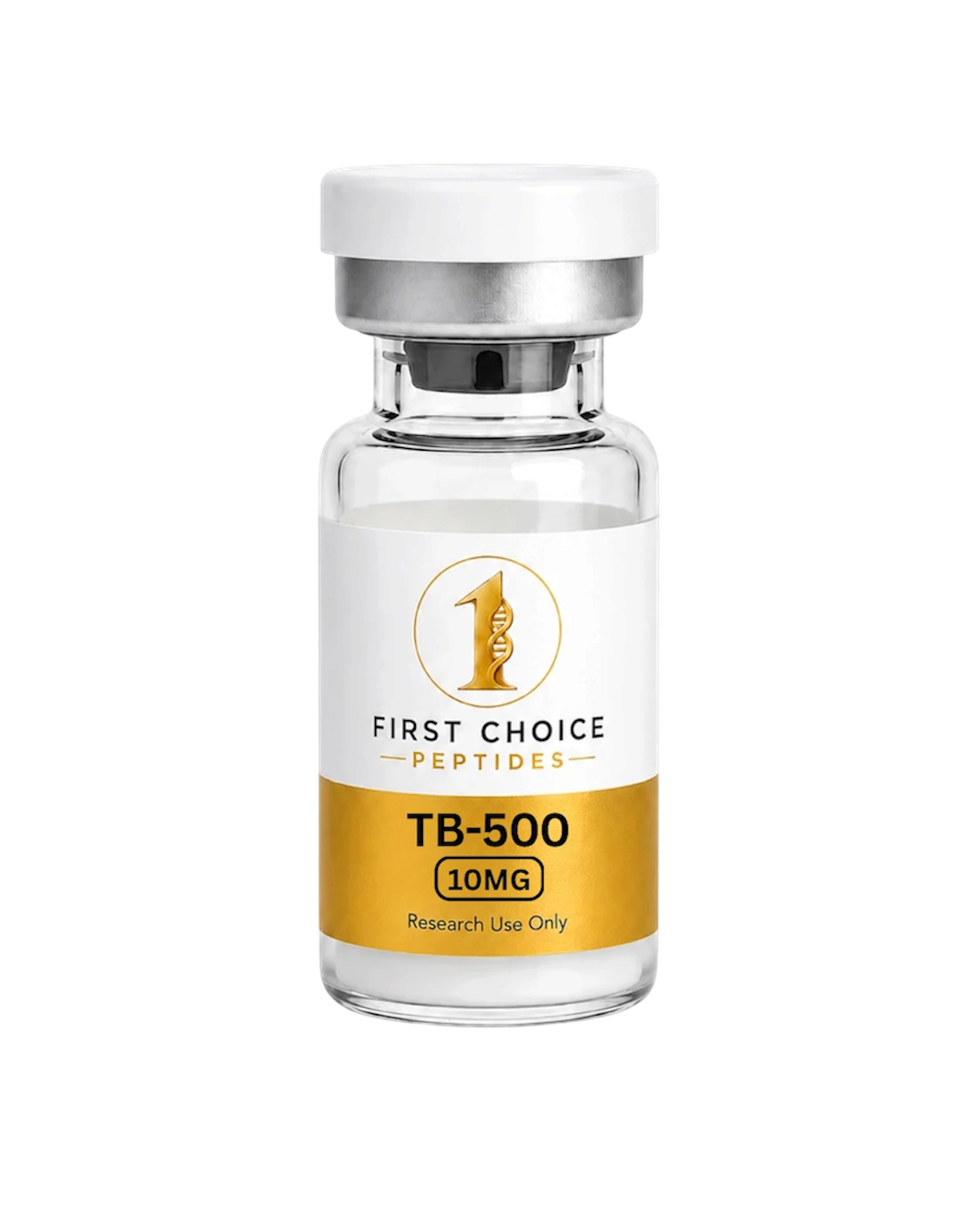
TB-500 is a synthetic N-acetylated 7-residue peptide (Ac-LKKTETQ, C38H68N10O14). Sequence, identity, storage and literature. Research use only.
TB-500 at a glance
- Molecular formula
- C38H68N10O14
What TB-500 is
TB-500 is a synthetic 7-residue peptide whose sequence corresponds to the LKKTETQ region of thymosin beta-4, associated with residues 17 to 23 of that parent protein, carried here in N-acetylated form. Thymosin beta-4 is a small, widely distributed actin-binding protein; the material catalogued on this page is not the full-length protein but the short acetylated fragment drawn from it. The catalogue lists Thymosin Beta-4 and TB4 as synonyms for the entry. Those names reflect common trade usage rather than chemical equivalence, and the distinction matters when analytical data for this fragment is compared against papers written about the intact protein.
The fragment is filed under regenerative biology in the catalogue and supplied as a lyophilized powder in a 10 mg vial. It has been the subject of published laboratory and preclinical research, and of analytical chemistry work concerned specifically with identifying and quantifying the acetylated fragment. This material is supplied strictly for laboratory research and is not for human or veterinary use.
Structure and identifiers
The sequence is written Ac-LKKTETQ: leucine, two lysines, threonine, glutamate, threonine and glutamine, with an acetyl group on the N terminus. Acetylation removes the free alpha-amino group at that terminus, which shifts both the net charge and the mass relative to the unmodified heptapeptide. It is also the feature that analytical papers use to tell this fragment apart from other short thymosin beta-4 sequences, since an unacetylated LKKTETQ preparation is a different molecule with a different expected mass.
The two lysine side chains are basic and the single glutamate is acidic, which leaves the fragment short, polar and only weakly retained on reversed-phase columns without an ion-pairing additive; chromatographic methods for it are built with that in mind. The catalogue entry lists the molecular formula C38H68N10O14. A CAS registry number and a molecular weight are not recorded in this entry, so neither value is stated here, and identity work proceeds from the sequence, the formula and the expected mass reported on the certificate for the lot in hand.
What the published literature has examined
Published work has examined TB-500 and its parent protein in in-vitro cell-culture systems, in biomaterials preparations and in rodent models, within regenerative biology, cytoskeletal cell biology and analytical peptide chemistry. The papers listed on this page are bibliographic references only; they are not evidence of safety or efficacy and describe laboratory findings, not any use in people or animals.
One strand of the literature is structural and cell-biological. Work published in the FASEB Journal in 2010 approached thymosin beta-4 by dissecting short peptide sequences drawn from it, which is the context in which the residue 17 to 23 region is discussed at all, and a 2007 paper in the Annals of the New York Academy of Sciences examined the subcellular distribution of the protein using localisation methods. A 2018 study in Expert Opinion on Biological Therapy worked in cultured human hepatic stellate cells stimulated with PDGF-BB, using proliferation and migration assays keyed to the actin-binding domain. The through-line across these papers is the actin-binding sequence itself as an object of study.
A second strand is analytical. A 2012 paper in Drug Testing and Analysis reports the synthesis and characterisation of the N-terminally acetylated 17 to 23 fragment as it is found in commercial TB-500 preparations, and a 2024 paper in the Journal of Chromatography B develops simultaneous quantification of the peptide and its metabolites in in-vitro incubations and in rats by UHPLC coupled to Q-Exactive Orbitrap tandem mass spectrometry. Work of this kind sits in the sports-drug-testing and bioanalytical literature, and it is the part of the record that defines what a laboratory should expect to see when confirming the identity of a lot.
A third strand is preclinical and materials based: a 2025 report in ACS Applied Materials and Interfaces describes an alkaline-phosphatase-triggered peptide hydrogel formulated with the sequence and evaluated in a corneal model, and a 2003 paper in the dermatology-model literature worked in mouse dermal models. Those studies are named here as model systems and formulation approaches only. No result from any of them is restated on this page.
Storage and handling as a laboratory reagent
The catalogue storage table lists two states for this entry. Lyophilized peptide is held at -20 C and protected from light. Reconstituted solution is held at 2 to 8 C and treated as a short-term laboratory reagent. A sealed vial is best equilibrated to room temperature before opening, so that condensation does not settle on the powder, and a brief spin down collects any material that has moved to the stopper during transit.
After reconstitution, single-use aliquots are preferable to repeated withdrawals from one vial, and repeated freeze-thaw cycling is avoided because each cycle risks aggregation and loss of intact peptide. Short, polar sequences of this kind are also worth protecting from prolonged exposure to warm ambient conditions on the bench. Aliquots labelled with lot number and date keep every analytical result traceable to a single certificate of analysis. Concentration arithmetic for a given vial mass and diluent volume can be worked through with the reconstitution calculator, and the usual laboratory diluent for a lyophilized peptide of this type is bacteriostatic water.
Analytical verification
Purity and identity are verified by third-party HPLC and mass spectrometry, with one certificate of analysis issued per lot. Reversed-phase HPLC reports purity as a percentage of integrated peak area. Mass spectrometry confirms identity by matching the measured mass against the expected mass for the acetylated sequence and the catalogued formula C38H68N10O14; because no molecular weight figure is recorded in this catalogue entry, the expected value used for comparison is the one stated on the certificate for the lot. Documents are filed in the certificate library.
For an acetylated fragment the identity test carries particular weight, since an unacetylated preparation can chromatograph respectably while differing from the intended molecule. How mass measurement is used to establish peptide identity is covered in mass spectrometry peptide testing, and the way a purity percentage is generated and bounded is covered in what 99 percent peptide purity means. Nothing beyond the HPLC purity result, the mass spectrometry identity result and the per-lot certificate is claimed for this material.
Published literature
Papers in which TB-500 has been the subject of laboratory or preclinical study. Listed for bibliographic reference only.
Research and educational purposes only. These references are provided for bibliographic context. They are not evidence of safety or efficacy, and nothing here is medical advice or a claim about any use in humans or animals.
ACS applied materials & interfaces
Alkaline Phosphatase-Triggered Spatiotemporal Repair of Corneal Injury with TB500 Peptide Hydrogel
Journal of chromatography. B, Analytical technologies in the biomedical and life sciences
Simultaneous quantification of TB-500 and its metabolites in in-vitro experiments and rats by UHPLC-Q-Exactive orbitrap MS/MS and their screening by wound healing activities in-vitro
Expert opinion on biological therapy
Thymosin β4 inhibits PDGF-BB induced activation, proliferation, and migration of human hepatic stellate cells via its actin-binding domain
Annals of the New York Academy of Sciences
Thymosin beta-4: actin-sequestering protein moonlights to repair
Drug testing and analysis
Synthesis and characterization of the N-terminal acetylated 17-23 fragment of thymosin beta 4 identified in TB-500, a product suspected to possess doping potential
FASEB journal : official publication of the Federation of American Societies for Experimental Biology
Biological activities of thymosin beta4 defined by active sites in short peptide sequences
Annals of the New York Academy of Sciences
Subcellular distribution of thymosin beta4
Wound repair and regeneration : official publication of the Wound Healing Society [and] the European Tissue Repair Society
Thymosin beta 4 and a synthetic peptide containing its actin-binding domain promote dermal wound repair in db/db diabetic mice and in aged mice
Research use only