
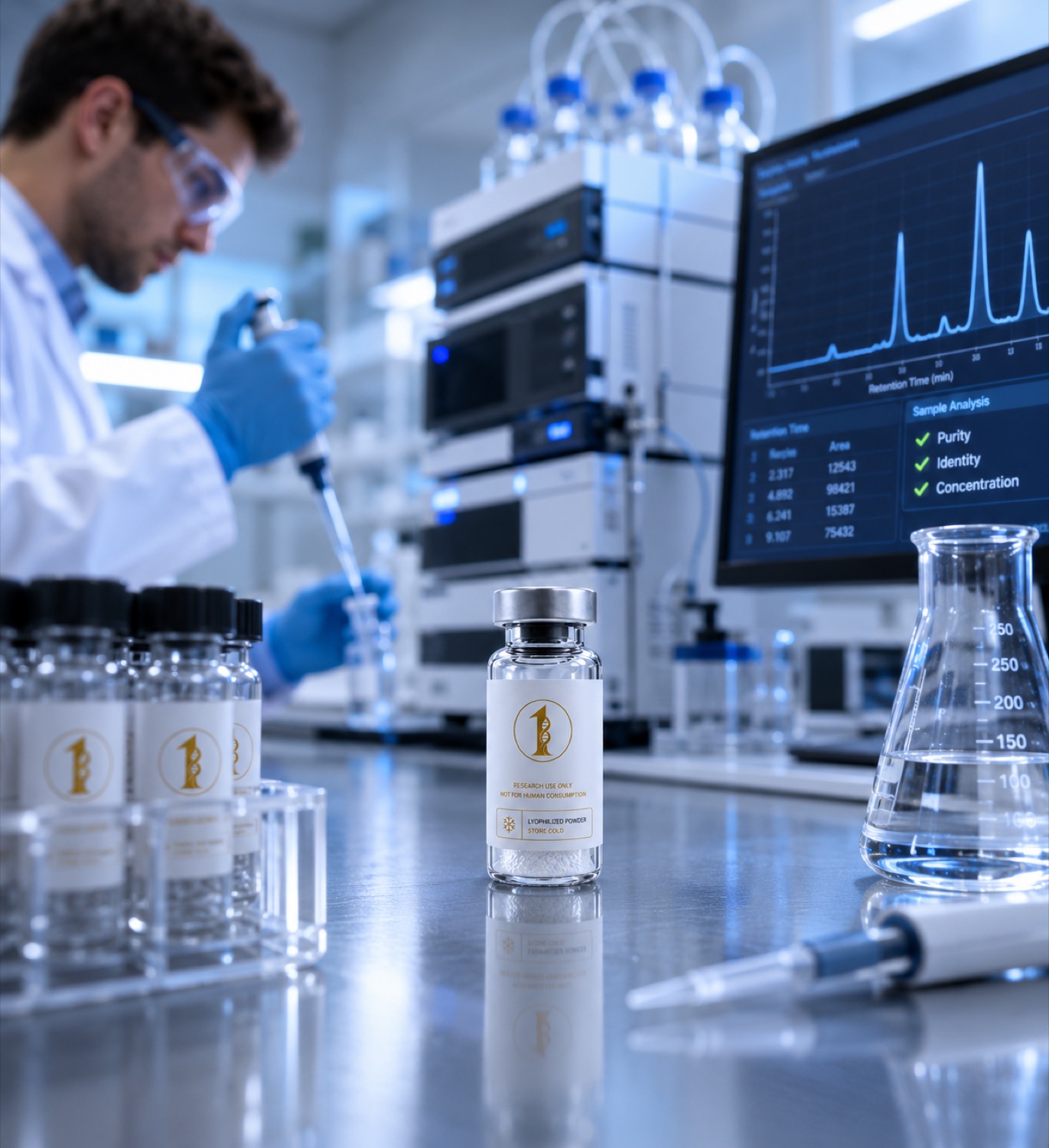
Temperature, moisture, light and freeze-thaw cycling decide how long a peptide stays what the label says it is. A laboratory storage reference. Research use only.
Short answer
Peptide storage reduces to one question: how much molecular mobility and how much water is the molecule exposed to, and for how long. Dry, cold, dark and sealed is the stable configuration; dissolved, warm, illuminated and repeatedly opened is the unstable one. Lyophilized powder in its original vial is normally held frozen for long-term stock and refrigerated for material in active use, while reconstituted solution is refrigerated, aliquoted for single use, and treated as a short-lived preparation. Freeze-thaw cycling is a separate and independently damaging variable that aliquoting removes entirely. All compounds discussed are supplied strictly as laboratory research materials. They are not for human or veterinary use, and nothing here is medical advice.
Two states, two sets of rules
A peptide exists in the laboratory in one of two states, and the storage logic differs for each. In the lyophilized state the molecule sits in an amorphous solid matrix with very little free water. Degradation still happens, but it is slow, and its rate is governed by residual moisture and by the mobility of the glassy matrix rather than by solution kinetics. A review of solid-state chemical stability in proteins and peptides describes this regime and the reactions that persist within it (PMID 10229638).
In the reconstituted state water is present in vast excess as both reactant and plasticiser, the molecule is conformationally free, and every degradation route is open at once. The practical consequence is that the two states are not on the same time scale and should not be discussed with a single storage rule. A powder specification that is measured in months does not transfer to the solution made from it.
The chemistry that storage is trying to slow
Four routes account for most of what happens to a stored peptide, and each responds to a different storage control.
- Hydrolysis cleaves the backbone and needs water, so it is a solution problem first and a wet-powder problem second. Aspartyl-containing sequences and acidic conditions accelerate it.
- Deamidation and isomerisation convert asparagine and glutamine side chains by way of a succinimide intermediate. Warmth, neutral to alkaline pH and residual moisture all raise the rate (PMID 10229638).
- Oxidation attacks methionine, cysteine, tryptophan and, more slowly, histidine and tyrosine. Oxygen in the headspace, trace metals and light are its inputs, so an inert headspace, amber or boxed storage and minimal opening are its controls.
- Aggregation changes physical state rather than covalent structure. It is driven by interfaces, agitation, concentration, pH near the isoelectric point and freeze-thaw cycling.
Temperature
Temperature is the largest single lever, because every route above is thermally activated. Conventional practice is minus 20 degrees Celsius or colder for long-term lyophilized stock, refrigeration at approximately 2 to 8 degrees Celsius for lyophilized material in active use and for reconstituted working solution, and ambient temperature only for the brief interval of weighing, reconstituting or aliquoting.
Two temperature-related handling errors are worth naming separately. The first is opening a cold vial in humid air, which condenses water onto the cold cake and defeats the drying that protects it; the fix is to let the sealed vial equilibrate to room temperature before piercing the stopper. The second is storing working stock in a frost-free freezer, whose automatic defrost cycles deliberately warm the compartment on a schedule and so impose repeated small thermal excursions on everything inside.
Transit temperature deserves its own note. A lyophilized cake tolerates a short ambient shipment because its degradation routes are largely closed while it is dry, which is precisely why research peptides are supplied as powder rather than as solution. That tolerance is a property of the dry state and does not transfer to a reconstituted stock, so a solution should not be treated as shippable or as tolerant of a warm bench simply because the powder it came from was. Once material arrives, the useful habit is to move it to its intended long-term condition promptly and to record the date of receipt alongside the date of first opening, since storage time only becomes interpretable when its starting point is written down.
Light, moisture and air
Light drives photo-oxidation of aromatic and sulfur-containing residues, so amber vials, the original carton, or simply a closed freezer address it at no cost. Moisture is both a reactant and a mobility source in the solid state; desiccated storage boxes and intact stoppers matter for the same reason the drying step mattered in manufacturing. Oxygen in the vial headspace is the default oxidant, which makes the number of times a vial is opened a real stability variable rather than a bookkeeping detail.
Freeze-thaw cycling
Repeated freezing and thawing is treated as its own hazard because the damage is not simply proportional to time spent cold. During freezing, ice growth concentrates the peptide and all solutes into the shrinking unfrozen fraction, buffer components can crystallise at different rates and shift local pH, and a large new ice interface is created. Thawing reverses the physical state but not necessarily the aggregation that occurred at those interfaces.
The effect has been measured directly in biological matrices. A study of repeated freeze-thaw cycles examined endocrine parameters in plasma and serum and reported how measured analyte concentrations behaved across successive cycles rather than across storage time alone (PMID 27303059). Earlier work on plasma atrial natriuretic peptide found the peptide to be unstable under most storage conditions examined, which is a useful reminder that a peptide in a complex matrix faces proteolysis and surface adsorption in addition to the chemical routes listed above (PMID 1386291).
Both findings point the same way for a research laboratory: the number of freeze-thaw cycles a sample has seen is metadata that belongs next to the concentration, and single-use aliquots reduce that number to one by design.
Containers, surfaces and matrix
Peptides adsorb to glass and to some plastics, and at low concentrations that adsorption can remove a meaningful fraction of the dissolved material without any visible change. Low-binding tubes, minimal transfer steps and avoiding very dilute long-term storage all reduce the loss. In biological matrix the picture broadens further, since endogenous proteases continue to work at temperatures well above freezing; the instability of plasma atrial natriuretic peptide across storage conditions is an illustration of how quickly a peptide can disappear from a matrix that is not itself stabilised (PMID 1386291).
Sequence-specific considerations
Storage rules are general, but the reason a given vial fails is specific to its sequence. Ipamorelin, Aib-His-D-2-Nal-D-Phe-Lys-NH2, CAS 170851-70-4, molecular formula C38H49N9O5 and molecular weight 711.90 g/mol, is a small C-terminally amidated pentapeptide built partly from non-standard residues. MOTS-c, sequence MRWQEMGYIFYPRKLR, CAS 1627580-64-6, molecular weight 2174.60 g/mol, carries two methionine residues and a tryptophan, so oxidation is a live route for it. BPC-157, sequence GEPPPGKPADDAGLV, molecular weight 1419.50 g/mol, contains an aspartate-glycine pair, the canonical deamidation motif. KPV is the tripeptide Lys-Pro-Val corresponding to alpha-MSH 11-13, short enough that adsorption and handling losses matter more than backbone chemistry. Knowing which residue is the weak point tells an analyst which impurity peak to look for after storage.
Practical laboratory handling
These are handling practices for research material and imply nothing about use in a person.
- Aliquot on first reconstitution. Split into single-use volumes immediately, then freeze. This is the single highest-value habit in peptide storage.
- Label every tube completely. Compound, lot, concentration, diluent and preservative status, date prepared, freeze-thaw count and preparer initials.
- Equilibrate sealed, open warm. Room temperature before the stopper is pierced, every time.
- Reconstitute gently. Diluent down the vial wall, quiet standing, gentle inversion, no vortexing. Target volumes come from the reconstitution calculator.
- Choose the diluent deliberately. Preserved diluent supports multiple draws from one vial but introduces its own chemistry; unpreserved sterile water pairs with single-use aliquots. Specifications are on the bacteriostatic water guide and the item is listed under bacteriostatic water.
- Prefer a manual freezer for stock. Avoid frost-free compartments and avoid the door shelf, which sees the largest temperature swings.
- Log appearance at every use. Cake collapse, browning, haze or particulate are stability data and belong in the notebook.
Verifying rather than assuming
Storage guidance predicts stability; analysis measures it. A reversed-phase purity trace run on receipt and repeated after a storage interval converts the prediction into a number, as described in HPLC peptide purity. Mass measurement identifies what any new peak is, since oxidation, deamidation and hydrolysis each shift mass in a characteristic direction, an approach set out in mass spectrometry peptide testing. The meaning of the headline number on the incoming document is unpacked in what 99 percent peptide purity means, and reading the document itself critically is covered in how to verify a peptide certificate of analysis. Lot documents for catalogue items are published on the certificates page.
All compounds discussed are supplied strictly as laboratory research materials. They are not for human or veterinary use, and nothing here is medical advice.
References
- Solid-state chemical stability of proteins and peptides. Journal of pharmaceutical sciences, 1999. PMID 10229638
- Plasma atrial natriuretic peptide is unstable under most storage conditions. Circulation, 1992. PMID 1386291
- Effects of repeated freeze-thaw cycles on endocrine parameters in plasma and serum. Annals of clinical biochemistry, 2017. PMID 27303059
Research use only