
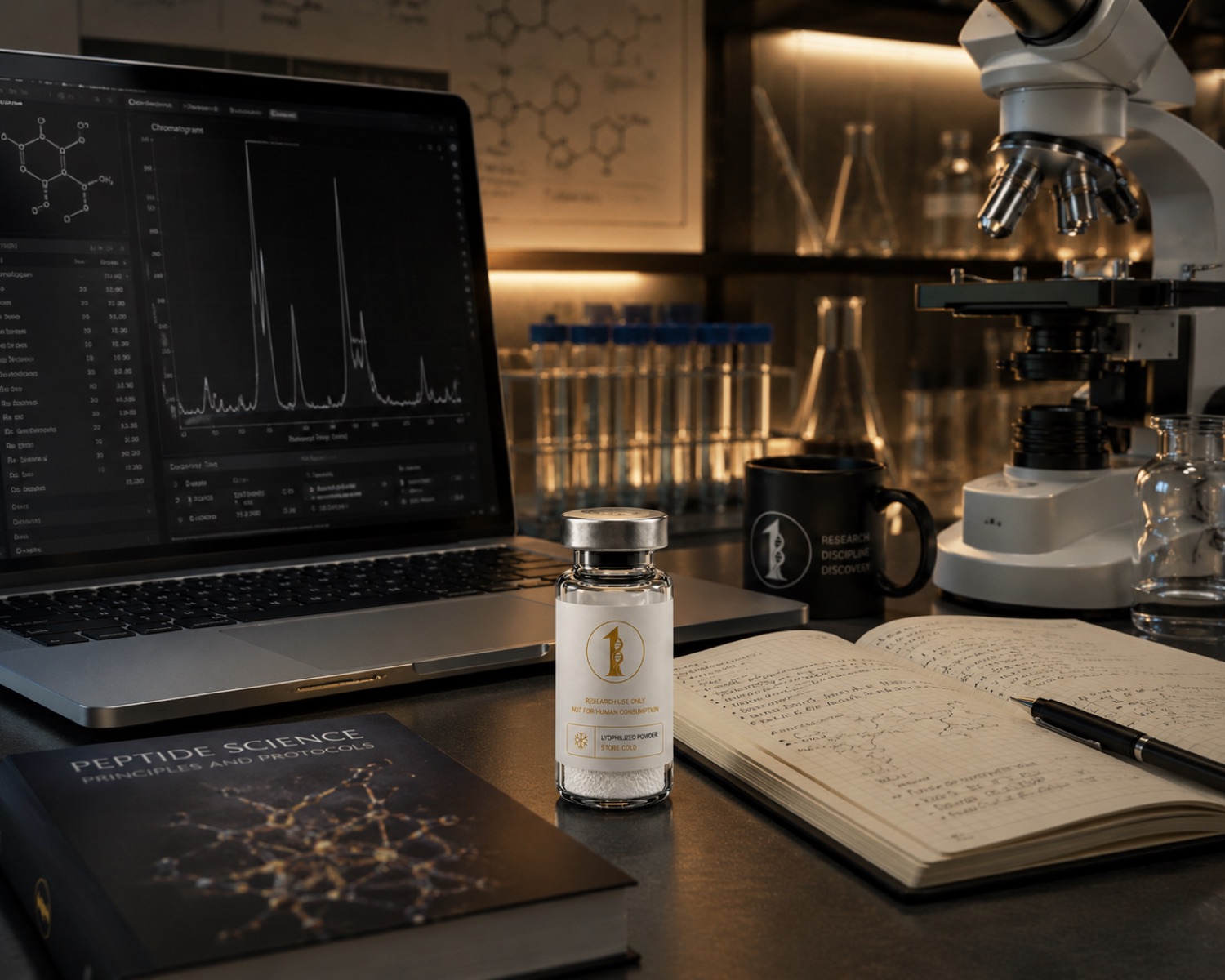
BPC-157 and TB-500 differ in origin, sequence and the preclinical models each was characterised in. A laboratory-side comparison. Research use only.
At a glance
BPC-157 and TB-500 appear side by side in preclinical tissue-repair literature, which makes them easy to treat as interchangeable. They are not. The two differ in origin, in sequence length, in the signalling class their published work is organised around, and in the assay systems where each has actually been measured. All compounds discussed are supplied strictly as laboratory research materials. They are not for human or veterinary use, and nothing here is medical advice.
- Origin. BPC-157 is a synthetic pentadecapeptide whose sequence corresponds to a fragment of a protein described in gastric juice. TB-500 is a synthetic acetylated fragment corresponding to residues 17 to 23 of thymosin beta-4, an endogenous actin-sequestering protein.
- Identity. BPC-157 is 15 residues, GEPPPGKPADDAGLV, CAS 137525-51-0, molecular formula C62H98N16O22, 1419.50 g/mol. TB-500 is the short sequence Ac-LKKTETQ, molecular formula C38H68N10O14.
- Mechanism class in the literature. Published BPC-157 work is organised around growth-factor receptor expression and angiogenic signalling readouts. Published TB-500 and thymosin beta-4 work is organised around actin binding and cell migration.
- Typical research models. BPC-157: rat tendon transection models, rodent gastrointestinal lesion models, cultured tendon fibroblasts. TB-500 and its parent protein: epithelial cell migration assays, matrix metalloproteinase activity assays, tumour cell migration assays.
- How each is supplied. Both ship as lyophilised powder in a sealed vial with a lot-specific certificate of analysis. Neither is supplied in solution, and reconstitution volume is a per-experiment calculation rather than a product property.
What BPC-157 is
BPC-157 is a 15-residue peptide, sequence GEPPPGKPADDAGLV, catalogued under CAS 137525-51-0 with the molecular formula C62H98N16O22 and a monoisotopic mass reported as 1419.50 g/mol. It contains no cysteine, so there is no disulfide bridge to preserve during handling, and no glycosylation or acylation is present in the synthetic material. The proline-rich central block is the structural feature most often noted in characterisation work, since polyproline segments influence chromatographic behaviour and can produce shoulder peaks on reversed-phase analysis that are conformational rather than compositional. That distinction matters when reading a purity trace, and it is covered in the notes on HPLC peptide purity.
The published characterisation is preclinical. In a rat Achilles tendon transection model, and in paired tendon explant outgrowth and cultured tendon fibroblast assays, investigators measured tendon outgrowth, cell survival and cell migration as the primary variables (PMID 21030672). A separate report in cultured tendon fibroblasts measured growth hormone receptor expression in the treated cultures relative to untreated controls, using expression-level readouts rather than functional endpoints (PMID 25415472). A wider review assembled rodent healing models across gastrointestinal tract, tendon, ligament, muscle and bone and compared the reported findings against those described for standard angiogenic growth factors in the same model families (PMID 29998800).
Each of those statements is a description of an animal or cell-culture experiment. None of them extends to people, and the catalogue entry at the BPC-157 research guide and the material itself at BPC-157 are offered on that basis only.
What TB-500 is
TB-500 is the acetylated heptapeptide Ac-LKKTETQ, molecular formula C38H68N10O14. The sequence corresponds to residues 17 to 23 of thymosin beta-4, the region identified in structural work as the actin-binding motif of the parent 43-residue protein. This is the single most important point of separation from BPC-157: TB-500 is a fragment of a known human protein, and most of the literature commonly cited for it was generated with full-length thymosin beta-4 rather than with the seven-residue fragment. Reading that literature accurately means keeping track of which molecule was in the assay.
In cultured epithelial cells, matrix metalloproteinase activity was measured as a required condition for thymosin beta-4 promotion of cell migration, with migration quantified in monolayer assays and MMP activity assessed alongside it (PMID 17348036). In tumour cell lines in vitro, work on the actin-sequestering protein examined its cooperation with hypoxia inducible factor-1 alpha and measured migration as the endpoint (PMID 20878135). A review of the parent protein collects its basic biochemical properties, including actin sequestration, across in vitro and animal model families (PMID 22074294). That same review also surveys clinical work; clinical literature exists for thymosin beta-4 in wound and corneal indications, and it is outside the scope of a research-materials catalogue.
The catalogue entries are the TB-500 research guide and TB-500, both grouped under tissue repair research materials.
Where the research models differ
The two compounds are not tested the same way, and that is the practical difference for anyone designing an experiment.
Model species and tissue
BPC-157 work is heavily rodent and heavily tissue-level. The tendon transection model in rats (PMID 21030672) produces a defined lesion and then measures recovery variables in the tissue itself, with the cell-culture arm serving as a mechanistic companion. The gastrointestinal, ligament, muscle and bone models collected in the 2018 review follow the same pattern of a defined injury in an animal followed by tissue-level scoring (PMID 29998800).
Assay level
Thymosin beta-4 and TB-500 work is weighted toward the cell. Migration assays in epithelial cells and in tumour cell lines are the recurring format (PMID 17348036, PMID 20878135), with the measured variable being distance or rate of movement in a monolayer, plus an enzymatic or transcriptional co-measurement. Actin sequestration is a biochemical property measurable in a cuvette, which is why the parent protein has a much larger in vitro literature than the seven-residue fragment.
Which molecule was actually in the tube
For BPC-157 the tested article and the catalogue article are the same 15-residue peptide. For TB-500 they frequently are not: a large share of the citations describe full-length thymosin beta-4 (PMID 22074294, PMID 20878135). A protocol that treats fragment data and full-protein data as one body of evidence is making an assumption that the papers themselves do not make.
Analytical burden
The two present different analytical problems. The proline-rich BPC-157 backbone raises conformational questions on reversed-phase columns. The short, lysine-rich TB-500 sequence raises different ones, including counter-ion content and the acetyl cap, which should be visible in the mass data. Both belong on a certificate, and both are discussed in mass spectrometry peptide testing.
Choosing between them for a laboratory question
The question is not which compound performs better. The question is which one the existing literature lets an investigator compare against.
- A tissue-level lesion model in a rodent has the deeper published comparison set with BPC-157, because the tendon, gastrointestinal and bone models already exist with defined scoring systems (PMID 21030672, PMID 29998800).
- A cell migration or cytoskeletal question has the deeper set with thymosin beta-4 and its fragment, because migration assays and actin sequestration are where that literature was built (PMID 17348036, PMID 20878135).
- A growth-factor receptor expression question has a direct precedent with BPC-157 in cultured tendon fibroblasts (PMID 25415472), which gives a comparable readout and cell type to work from.
- A protease-dependence question has a direct precedent in the matrix metalloproteinase work with thymosin beta-4 (PMID 17348036).
Investigators running both in the same protocol should note that the two have no shared mechanistic pathway in the published record. They are grouped together commercially, not biochemically, and any expectation of additive or interacting effects is a hypothesis to be tested rather than a result to be assumed.
Storage and handling
Both arrive lyophilised, and both are stable in that state under cold, dark, dry conditions far longer than either is in solution. Sealed vials belong at minus 20 degrees Celsius or colder, kept in the dark, and allowed to reach room temperature before the stopper is broken so that atmospheric moisture does not condense onto the cake.
Once reconstituted, both peptides are aqueous solutions subject to hydrolysis, and both should be aliquoted so that a single vial is not repeatedly thawed. TB-500 carries lysine and threonine residues; BPC-157 carries aspartate and glutamate residues adjacent to glycine, a motif associated with deamidation and isomerisation chemistry in stability studies of peptides generally. Neither observation is a shelf-life number, and neither replaces a lot-specific stability check.
Diluent choice is an experimental decision. The comparison between preserved and unpreserved diluent is set out in the note on bacteriostatic water versus sterile water, and the volume needed for a target concentration is arithmetic best done in the reconstitution calculator rather than by hand at the bench. Every lot ships with documentation; the method for reading it is in how to verify a peptide certificate of analysis and what 99 percent peptide purity means, and current documents are filed under certificates.
All compounds discussed are supplied strictly as laboratory research materials. They are not for human or veterinary use, and nothing here is medical advice.
References
- The promoting effect of pentadecapeptide BPC 157 on tendon healing involves tendon outgrowth, cell survival, and cell migration. Journal of applied physiology (Bethesda, Md. : 1985), 2011. 21030672
- Pentadecapeptide BPC 157 enhances the growth hormone receptor expression in tendon fibroblasts. Molecules (Basel, Switzerland), 2014. 25415472
- BPC 157 and Standard Angiogenic Growth Factors. Gastrointestinal Tract Healing, Lessons from Tendon, Ligament, Muscle and Bone Healing. Current pharmaceutical design, 2018. 29998800
- Cooperation of actin-sequestering protein, thymosin β-4 and hypoxia inducible factor-1α in tumor cell migration. Oncology reports, 2010. 20878135
- Matrix metalloproteinase activity is necessary for thymosin beta 4 promotion of epithelial cell migration. Journal of cellular physiology, 2007. 17348036
- Thymosin β4: a multi-functional regenerative peptide. Basic properties and clinical applications. Expert opinion on biological therapy, 2012. 22074294
Research use only